













































Drawing on data from 150+ active clients across 8 social platforms. Exploring what separates B2B brands building durable audiences from those still broadcasting into the void.
B2B social media is splitting in two: brands that own audiences and brands that rent attention.
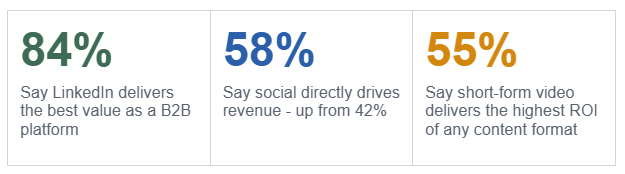
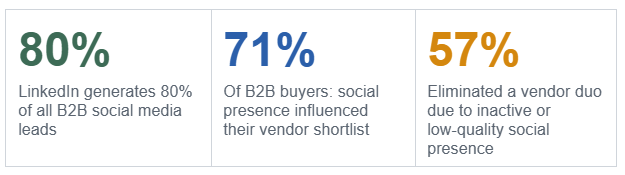
In 2026, LinkedIn consolidated its dominance. 84% of B2B marketers say it delivers the best organic results, and it now accounts for 84% of all B2B social media leads. Short-form video emerged as the highest-ROI content format, yet the majority of B2B tech teams are not taking advantage of this type of content.
AI-generated social content has increased drastically, yet, is not always the best solution for content creation. Buyers have noticed: 57% say they can detect it, and 71% of those report reduced trust in that brand. The platforms posting with genuine human perspectives and not with generic content are creating the warmest B2B pipeline.
Meanwhile, employee advocacy remains the most underleveraged channel in B2B social. Employee posts generate 8x more engagement and leads from advocacy convert 7x more frequently than brand-direct leads. Yet fewer than one in three companies recognize its importance for company visibility.
The divergence is accelerating.
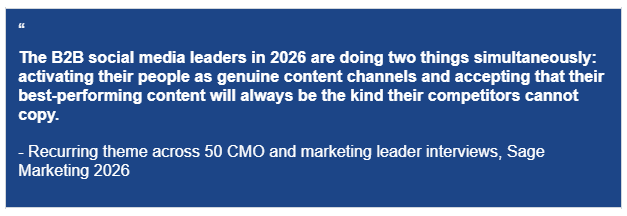
The B2B social media leaders in 2026 are doing two things simultaneously: activating their people as genuine content channels and accepting that their best-performing content will always be the kind their competitors cannot copy.
LinkedIn’s organic reach is tightening, but quality content is outperforming more than ever.
LinkedIn engagement jumped 44% year-on-year. Yet 68% of B2B buyers review a vendor’s LinkedIn before agreeing to a first sales meeting, and 54% have eliminated a vendor entirely because of a weak social presence. Multi-image carousels generate the highest likes and comments on the platform; videos are the most shared content type. Top-quartile content now earns 4.2x more impressions than the average post.
Employee advocacy is the most underleveraged channel in B2B social.
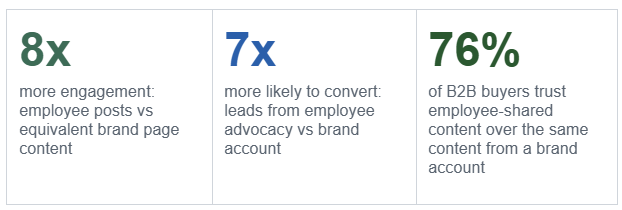
Posts from individual employees generate 8x more engagement than equivalent brand page posts, and leads sourced through advocacy programmes convert 7x more frequently. 76% of B2B buyers say they are more likely to trust content shared by an employee than the same content shared by a brand account.
Short-form video is the highest-ROI format and the biggest execution gap.
55% of B2B marketers say short-form video delivers the highest ROI of any content format. TikTok B2B usage doubled year-on-year, from around 8% to 19% of marketers. 46% plan to increase social video distribution over the next 12 months. Yet the majority of B2B tech companies still produce short-form video at low volume, creating a significant first-mover window.
Dark social generates the warmest pipeline and the lowest attribution confidence.
84% of B2B marketers say integrating data across platforms is their single biggest measurement challenge. 56% identify social ROI attribution as their top strategic challenge. Private channel sharing (LinkedIn DMs, Slack, WhatsApp) generates warm, qualified inbound but registers as direct traffic in analytics. 84% of B2B buyers actively seek peer input when researching, most of it in channels invisible to standard measurement.
AI content is detectable and it is eroding brand trust at scale.
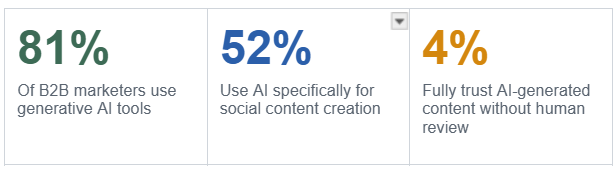
81% of B2B marketers now use generative AI tools: up from 34% in 2023. 52% use AI specifically for content creation. Yet only 4% fully trust AI output without human review, and only 38% have formal AI usage guidelines. The brands winning on social use AI for scheduling, reformatting, and research, not for generating the voice or opinion that buyers actually engage with.
Platform performance
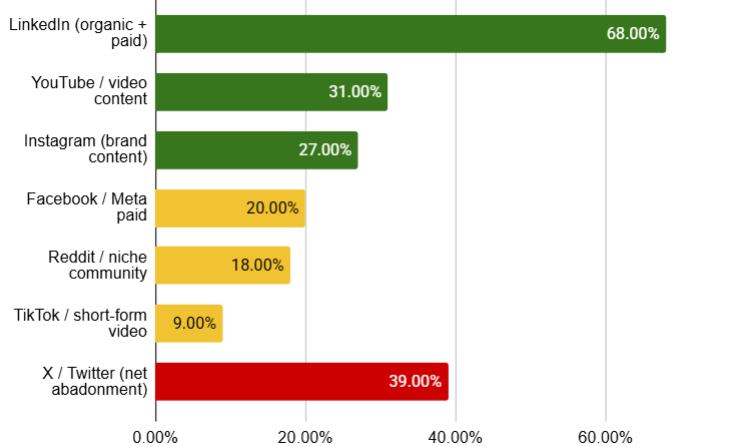
The B2B social landscape has consolidated sharply: LinkedIn is now the only platform where 84% of marketers say it delivers the best organic value, while X/Twitter has seen active abandonment. 39% of B2B marketers no longer use it at all, up from 27% the prior year. YouTube has emerged as the clear second platform for video-led strategies, with usage up 31% in a single year. TikTok’s B2B footprint doubled but remains nascent.
Platform investment shift – percent of marketers increasing use:
Content Strategy
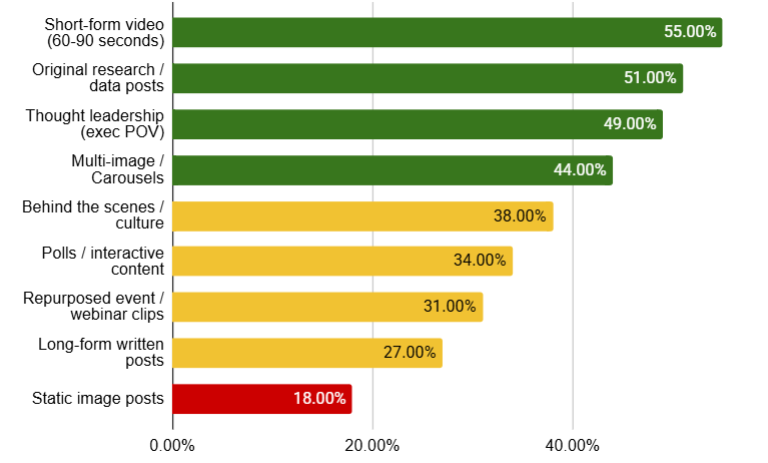
LinkedIn’s own engagement data shows which formats are earning attention: multi-image posts (6.6% engagement rate), native document posts (6.1%), and video (5.6%) consistently outperform other content types. Educational carousels generate up to 3.1x higher engagement than static posts. Lo-fi vertical video produces 2–3x more engagements than standard produced content for B2B brands.
Most effective B2B social media content formats – percent of marketers reporting high ROI:
Content volume on social has surged since AI tools became mainstream. 81% of B2B marketers use AI tools, but only 4% fully trust the output without human review.
Audience, Engagement & Dark Social
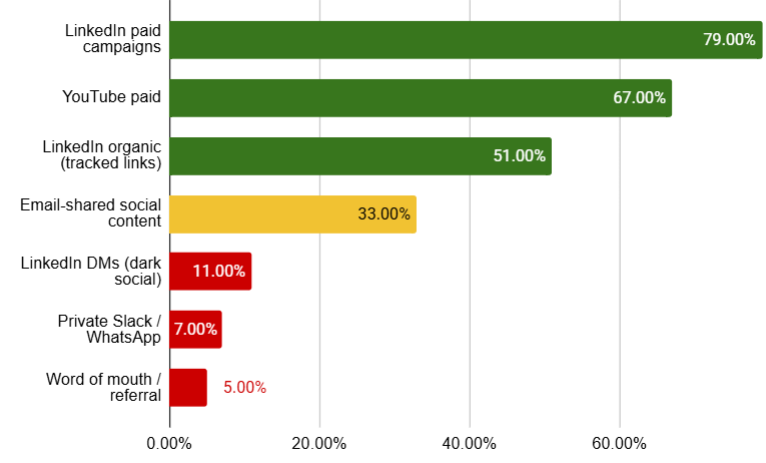
The warmest leads live where you can’t measure them. 84% of B2B marketers say integrating data across platforms is their top measurement challenge. The channels generating the most qualified pipeline: private DMs, Slack groups, WhatsApp shares, word-of-mouth referrals, all register as direct traffic in standard analytics. Investment follows measurement, so the best-performing channels remain chronically underfunded. 56% of teams identify ROI attribution as their top social media challenge.
Social attribution confidence by channel
Employee Advocacy & Thought Leadership
Your people are your most powerful social channel. Employee content generates 8x more engagement than equivalent brand posts, and leads from advocacy programmes convert 7x more frequently. 76% of B2B buyers are more likely to trust content shared by an employee than by a brand account. 74% of marketers say employee advocacy is effective for brand awareness, but 74% of advocacy programme managers cite consistent participation as their biggest challenge.
Companies where the CEO maintains an active LinkedIn presence – posting regularly on industry topics, company milestones, and their own point of view – report measurably higher brand credibility, stronger inbound volume, and faster trust-building at the top of the funnel. A start-up CEO’s LinkedIn profile is often the first search result a prospect encounters. Marketing teams consistently report that CEO social activation multiplies the impact of every other channel.
Budgets are shifting from paid amplification to content and people.
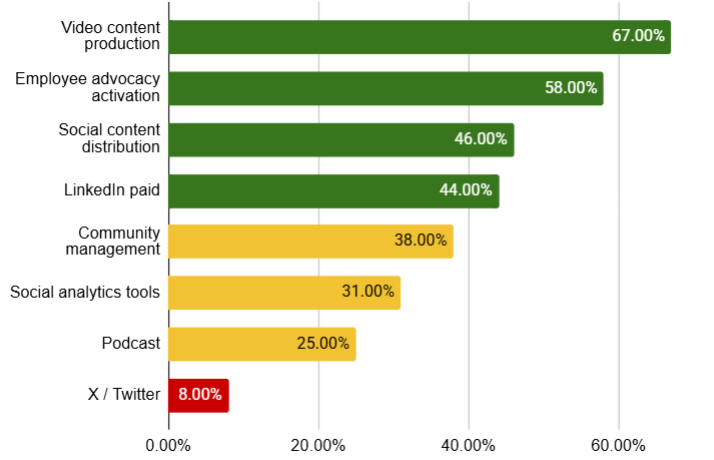
46% of B2B marketers plan to increase investment in social content distribution, and 41% plan to increase video distribution spend in the next 12 months. 84% currently use paid social channels and 73% run social ads. Budget allocation is shifting away from declining platforms toward content production, employee activation, and community management. The table below reflects SAGE client portfolio data across 150+ B2B tech companies.
Planned budget increases, next 12 months – percent of respondents
Track your social where your pipeline lives
The biggest barrier to sustained social investment is not performance, it’s proof. When social data lives in a separate analytics tool, disconnected from your CRM, email campaigns, and revenue data, it is almost impossible to demonstrate pipeline contribution to leadership. The measurement challenges documented throughout this report, 84% struggling to integrate data, 56% unable to attribute social ROI, are often a technology problem as much as a strategy problem.
Why SAGE Recommends HubSpot for B2B Social Tracking
HubSpot holds 38% of the global marketing automation market, the largest share of any platform, and serves 248,000+
customers across 135 countries. It is the only platform where B2B teams can manage social publishing,
monitor brand mentions, score leads from social engagement, and connect every interaction to a named CRM contact and a
revenue outcome, without any integration or data transfer between tools. LinkedIn organic social delivers 229% ROI and
LinkedIn paid delivers 192% ROI over three years when measured inside a unified platform like HubSpot.
| HubSpot capability | What it solves for B2B social teams |
| Social publishing + scheduling | Consistent cadence managed within the same platform as CRM |
| Social monitoring / listening | Brand keyword and competitor tracking alongside pipeline data |
| Contact-level social attribution | Every social interaction tied to a named CRM contact record |
| Campaign-level reporting | Social alongside email, ads and content in one dashboard |
| Lead scoring from social | High-intent prospects identified automatically from engagement |
| Revenue attribution reporting | Social touchpoints connected to closed revenue |
| 1,500 integrations | Connects to every tool in your marketing stack |
SAGE implements HubSpot for B2B tech companies at every stage, from initial CRM setup through full RevOps configuration and social attribution. As a HubSpot Diamond Partner, we have implemented unified social and pipeline tracking for over 150 B2B companies. The most common outcome: marketing teams can show leadership exactly which social activity is generating pipeline.
What the highest-performing B2B social media teams are doing differently
Five behaviours consistently separate the top B2B social media teams from the rest. These are not tactics, they are structural commitments that compound over time.
- Make your people the channel, not just the brand account: Leading companies activate founders, executives, and subject-matter experts as primary LinkedIn channels. Individual thought leadership consistently outperforms brand page posts across every content format. This is infrastructure. It requires programme design, content coaching, and consistent activation.
- Invest in short-form video: Lo-fi vertical video consistently outperforms produced content. The execution gap is wide and the window to establish category presence is still open.
- Build community infrastructure, not just follower counts: Top performers build private communities(LinkedIn groups, invite-only roundtables) alongside their public social presence.
- Accept dark social and measure leading indicators instead: Track DM volume, branded search uplift, profile visits, and content saves as leading indicators rather than demanding last-touch proof for every post.
- Use AI for production logistics, never for voice: Use AI for scheduling, reformatting, research, and distribution. Do not use AI to generate opinion or narrative. Buyers engage with genuine expertise – AI cannot replicate it at the level that builds trust.
About this research
| Data point | Detail |
| Client base | 150+ active B2B tech companies |
| Research period | 2024 – 2026 |
| Company states | Seed to Series B |
| Primary markets | US, US, EMEA |
| Platforms tracked | 8 B2B social media platforms |