

















































Everyone Uses AI, Few Win With It
Roughly 90% of companies now use AI in some form. Fewer than 10% say it has transformed how they work.
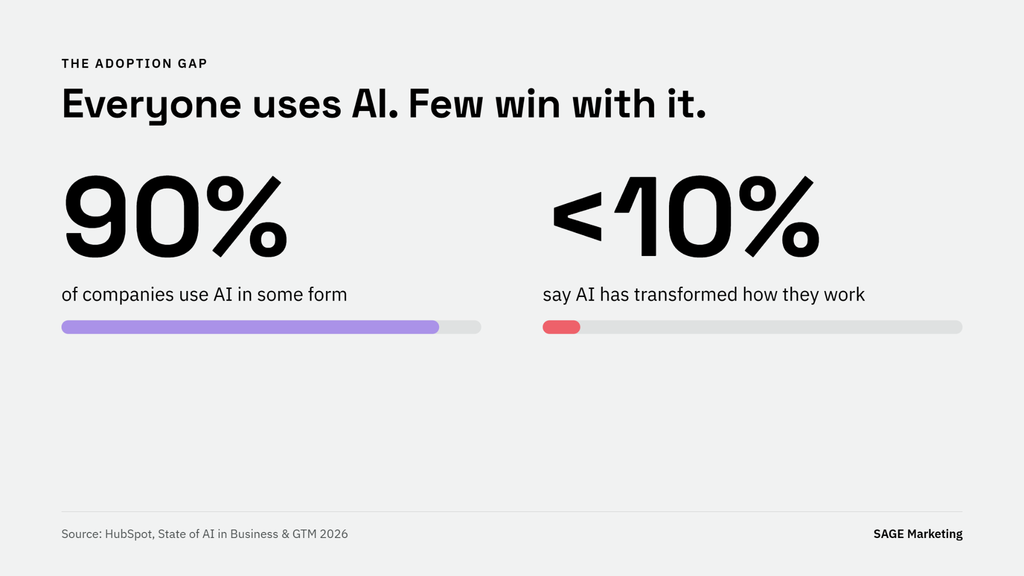
That’s the real story of AI adoption in 2026, and it’s the one we highlighted while reading HubSpot’s two new reports: the State of AI in Business & GTM 2026 (around 6,000 go-to-market professionals) and the State of AI in Marketing 2026 (1,754 marketers, surveyed in June).
We’re writing this together because we sit on opposite ends of the same funnel. Aliza runs social and content at SAGE. Niv leads sales for our HubSpot practice. As a HubSpot Diamond Partner, we spend our days inside client CRMs, and the data in these reports matches what we see there almost line for line.
Our thesis is simple. The gap between using AI and being successful with it isn’t about tools or budget. It’s about context. And the place context breaks most often is the handoff between marketing and sales.
Why Sales AI Adoption Lags Marketing
Aliza: If you map teams against HubSpot’s AI maturity model, marketing is clearly out in front.
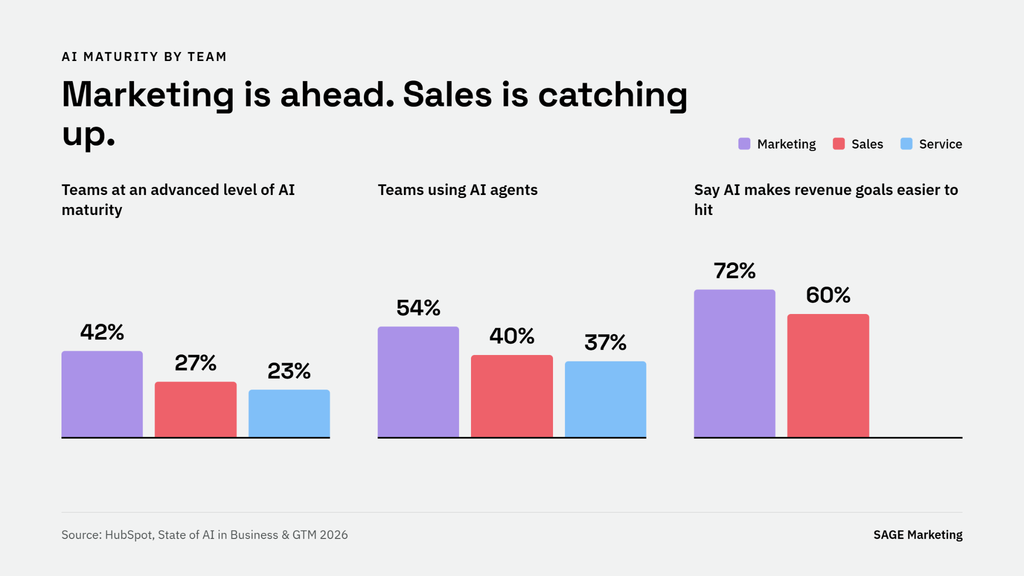
42% of marketing teams sit at an advanced level of maturity, compared with 27% of sales teams and 23% of service teams.
The pattern holds for agents too. 54% of marketing teams use AI agents, versus 40% in sales and 37% in service. And 72% of marketers say AI makes their revenue goals easier to hit, compared with 60% of sales professionals.
It’s tempting to read that as a win for marketing, but I don’t think it is. Marketing being ahead is only good news if what marketing learns actually reaches sales. Otherwise you’ve built a faster content and campaign engine that feeds a pipeline unable to use what it knows.
What Mature Marketing Teams Do Differently
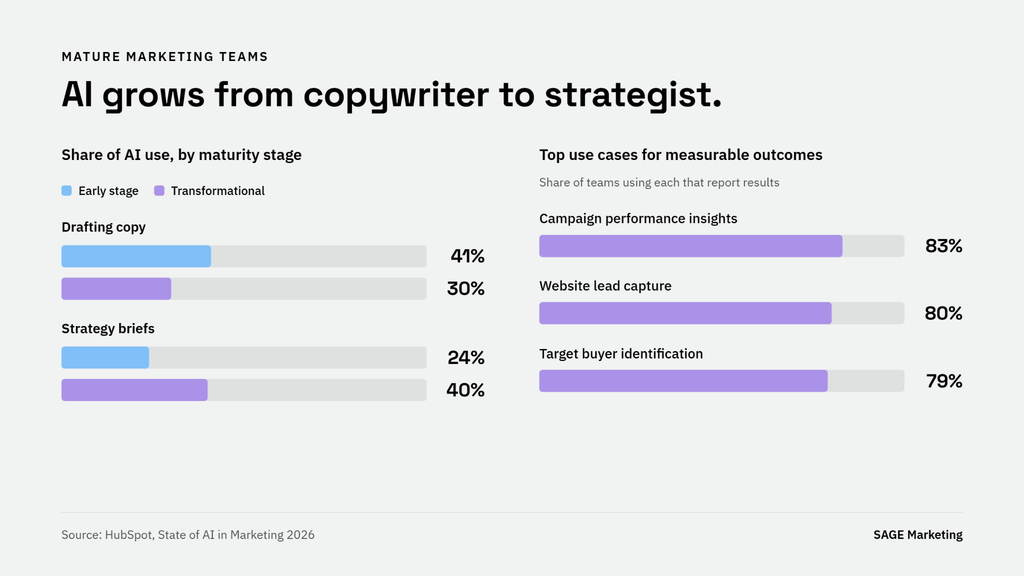
Aliza: The most interesting shift in the marketing report is what AI is actually used for as teams mature. It starts as a copywriter and grows into a strategist. Drafting copy drops from 41% of use at the early stage to 30% at the transformational stage, while strategy briefs climb from 24% to 40%.
The use cases most likely to produce measurable outcomes are data-driven, not creative: campaign performance insights (83%), website lead capture (80%) and target buyer identification (79%).
And the most mature teams aren’t running dozens of tools. Transformational marketing teams focus on about four use cases and go deep on them.
There’s no shortage of content today about how AI made execution cheap and how anyone can produce a decent post, email or landing page in minutes. What we need to focus on now is human perspective, positioning and clean data.
That’s where AI in B2B marketing earns its keep, and it’s why we don’t think AI will replace marketers who bring those three things.
Where Sales Is Leaving Money on the Table
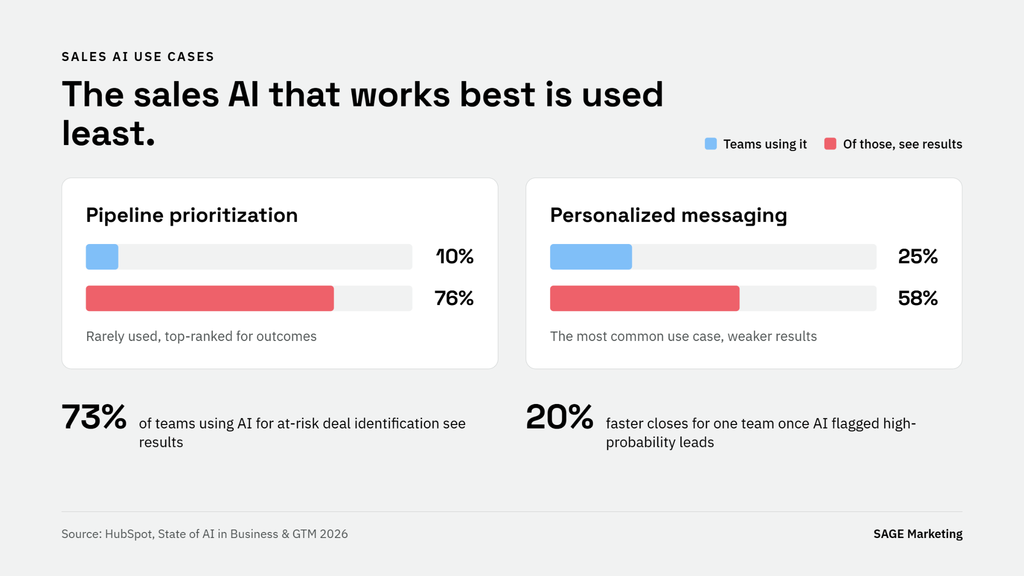
Niv: The sales numbers tell a story of misallocated effort. Only 10% of respondents use AI for pipeline prioritization, yet three out of four of those teams see measurable results. Meanwhile, the most common sales use case is personalized messaging (25%), and only 58% of those teams see results from it.
When you rank sales use cases by outcome, the top two are pipeline prioritization (76%) and at-risk deal identification (73%). In other words, the highest-value work is deal intelligence, and most teams aren’t doing it. One respondent in the report said their deals closed 20% faster once AI started flagging high-probability leads.
I see this every week. Reps default to AI for emails because it’s immediate and visible: you write a prompt, you get a draft, it feels productive. Deal intelligence asks more of a team. You have to trust the data in the CRM, and you have to change how pipeline reviews actually run. That’s harder, which is exactly why the teams that do it pull ahead.
The Handoff: Where Revenue Leaks
This is the section we care about most, because it’s where marketing’s lead and sales’ lag collide.
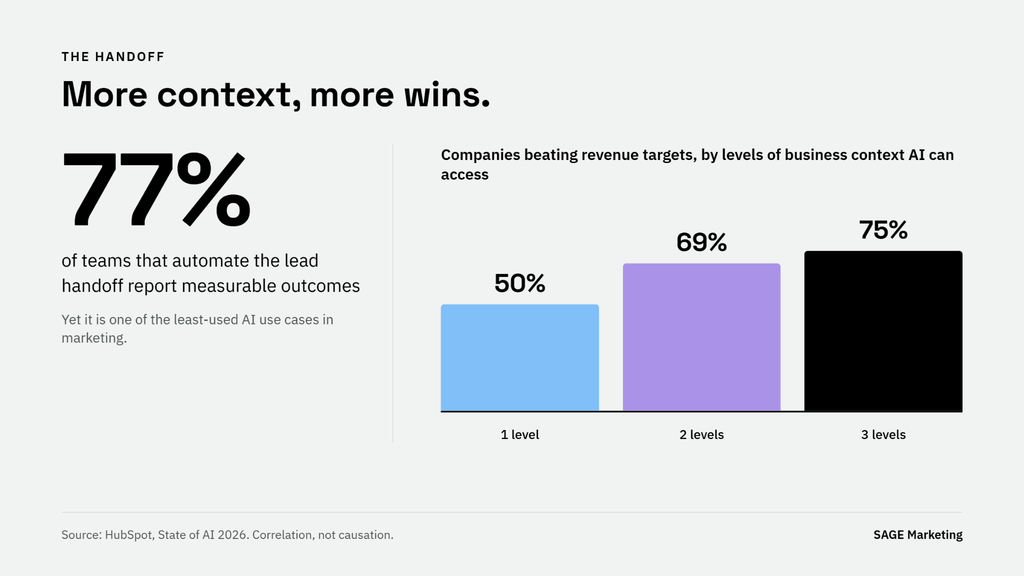
Lead handoff is one of the least-used AI use cases in marketing. Yet 77% of teams that automate it report measurable outcomes. Few teams are doing it, and most of those who do see it work.
The reason comes down to context. Companies that give AI access to one level of business context beat their revenue targets 50% of the time. With two levels, that rises to 69%. With three, 75%.
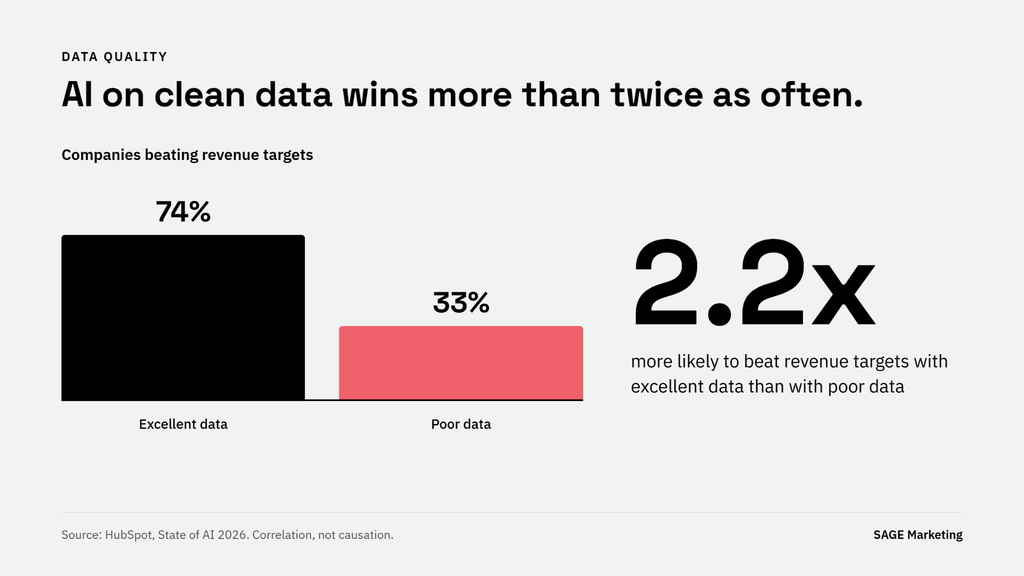
Data quality follows the same curve. 74% of companies with excellent data beat their revenue targets, compared with 33% of those with poor data. That’s a 2.2x difference.
A fair caveat: these are correlations, not proof of cause. HubSpot itself notes that more mature companies may simply have more resources. But the direction is consistent across every cut of the data, and it matches what we see in practice.
Here’s what that looks like in a real CRM. Marketing captures intent signals: the pricing page visit, the webinar attendance, the third download in a week. Sales never sees them, or sees them as a lead score with no explanation. Both teams use AI, but the two systems aren’t connected, so neither one has the full picture.
Strong sales and marketing alignment used to be a nice-to-have. With AI on both sides, it’s the thing that decides whether your AI works at all.
Agents: The Shortcut for Teams That Aren’t “Mature” Yet
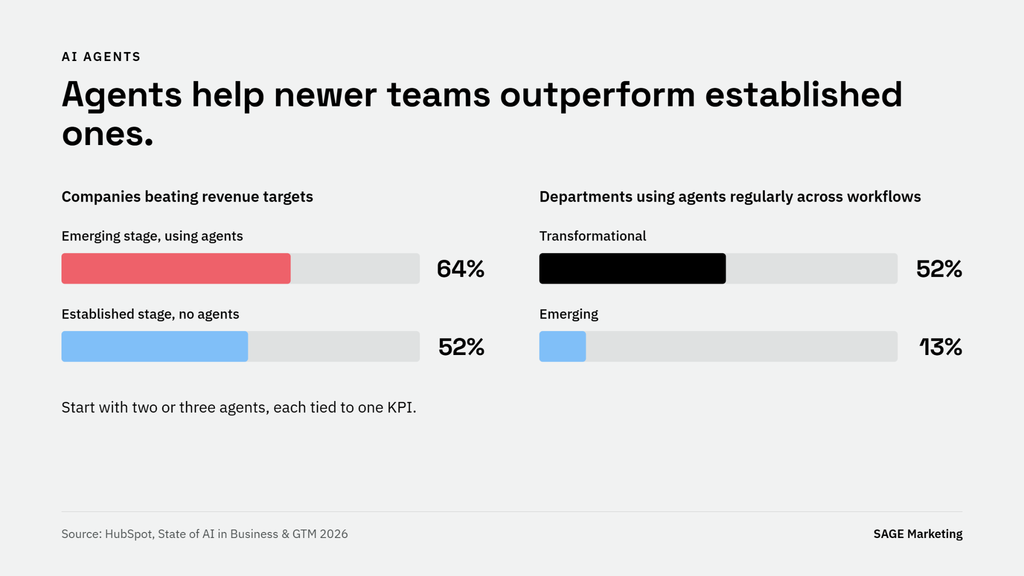
Niv: If you’re reading this and thinking your team is nowhere near “transformational,” here’s the most encouraging stat in the report. An emerging-stage company using agents beats its revenue targets 64% of the time. An established-stage company without agents does so 52% of the time.
Agents don’t replace maturity, but they can close part of the gap. Today, 52% of transformational departments use agents regularly across workflows, compared with 13% of emerging ones. That’s a big difference, and it’s also a big opportunity for teams willing to start.
My practical advice on AI agents in sales: start with two or three, each tied to one KPI. A prospecting agent measured on meetings booked. A deal-risk agent measured on slipped deals. Our Breeze AI guide is a good place to map where agents fit.
What AI Maturity Means for the People Doing the Work
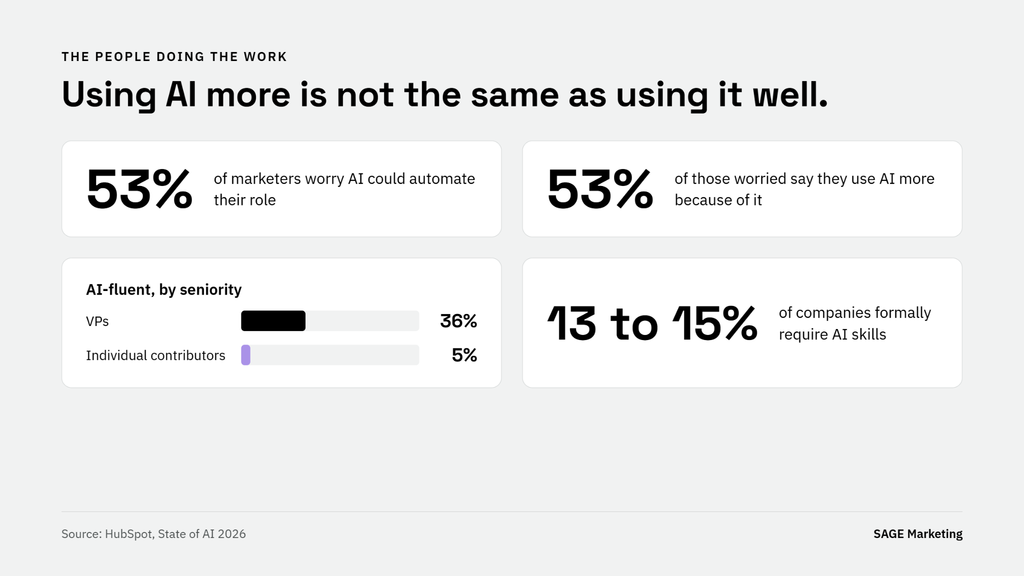
Aliza: 53% of marketers worry AI could automate their role. Interestingly, among those with job-security concerns, 53% say they use AI more because of it. Anxiety is driving adoption.
But using AI more isn’t the same as using it well. 36% of VPs are AI-fluent, compared with 5% of individual contributors. The difference isn’t access. Senior people get more value because they push back on AI outputs instead of accepting them.
Only 13% to 15% of companies formally require AI skills. Teams need enablement, not just licenses.
A Joint Playbook: 5 Moves for Marketing and Sales Leaders
- Agree on shared definitions before adding more AI. MQL, SQL and lifecycle stages need to mean the same thing to both teams, or AI will automate the disagreement.
- Fix CRM data quality first. AI on dirty data doesn’t fix mistakes. It scales them.
- Connect marketing intent signals to sales prioritization. Lead scoring and pipeline prioritization should run on the same signals marketing is already collecting.
- Pick one or two high-ROI use cases per team, each tied to a KPI. Then add agents.
- Invest in fluency. Teach people to challenge AI outputs, not just generate them.
The Bottom Line
AI maturity isn’t about how much AI you use. It’s whether marketing and sales are working from the same context.
Is your CRM AI-ready? Book a HubSpot AI readiness session with SAGE and we’ll show you where context is breaking between your marketing and sales teams, and what to fix first.
FAQ
What is AI maturity in marketing and sales?
AI maturity describes how deeply a team has built AI into its work, from early experimentation to transformational use across workflows. In HubSpot’s AI maturity model, mature teams use AI for strategy and decision-making rather than just content production, focus on a small number of use cases, and give AI access to rich business context and clean CRM data.
What percentage of sales teams use AI today?
Most sales teams use AI in some form, but few use it at an advanced level. According to HubSpot’s State of AI in Business & GTM 2026, 27% of sales teams are at advanced AI maturity and 40% use AI agents, both behind marketing. The most common sales use case is personalized messaging.
Does AI improve sales and marketing alignment?
It can, but only when both teams share data and definitions. AI applied separately in marketing and sales often widens the gap. Teams that automate the lead handoff see strong results, with 77% reporting measurable outcomes, and companies giving AI more business context are more likely to beat revenue targets.
Which AI use cases produce measurable results?
The highest-performing use cases are data-driven. In marketing, campaign performance insights (83%), website lead capture (80%) and target buyer identification (79%) lead. In sales, pipeline prioritization (76%) and at-risk deal identification (73%) top the list, while personalized messaging, the most common use case, delivers results less often.
Do smaller teams need AI agents to compete?
Agents can help smaller or less mature teams close the gap. HubSpot’s data shows emerging-stage companies using agents beat revenue targets 64% of the time, compared with 52% for established companies without them. The best approach is to start with two or three agents, each tied to a single KPI.