


















































Planning a B2B marketing budget for 2027 is not going to be a matter of taking your 2026 spreadsheet, adding 5%, and calling it a plan.
The economics of B2B marketing are changing.
AI is transforming how buyers search, how marketers research and create, how campaigns are optimized, how prospects are identified, and increasingly how marketing work itself gets done.
But there is another side to the story.
As AI makes it dramatically easier to create content, launch campaigns and automate outreach, buyers are being exposed to more marketing than ever before.
More emails. More posts. More articles. More automated LinkedIn messages. More AI-generated thought leadership. More “personalized” outreach that doesn’t feel personal at all.
So 2027 creates a strange marketing paradox:
Companies need to invest more in AI while simultaneously investing more in the things AI cannot easily reproduce: distinctive brands, original ideas, creativity, expertise, relationships, experiences and human connection.
That should change the way we build budgets.
The question is no longer simply: How much should we spend on marketing?
It is:
What combination of investments will make our company visible, credible, memorable and commercially effective in a market increasingly shaped by AI?
Key Takeaways
If you remember only a few things from this guide, make them these:
- Start with business goals, not last year’s budget. Work backward from revenue, pipeline and strategic objectives.
- Don’t blindly apply a benchmark. Established companies may operate comfortably at 5–10% of revenue, while startups, category creators and companies entering new markets may need considerably more.
- AI deserves a real budget category covering tools, tokens and usage, AI development, automation, GEO, data, training and experimentation.
- AI should not replace brand investment. As execution becomes commoditized, differentiation becomes more valuable.
- B2B buyers don’t live entirely online. Protect budget for events, communities, partnerships, executive relationships and face-to-face interaction.
- Don’t automate every prospect interaction. In a world of automated communication, genuine personalization becomes a competitive advantage.
- Keep approximately 5–10% of the annual budget flexible for experiments, new technologies and opportunities you cannot predict today.
- Review allocation quarterly. A budget is a hypothesis, not a contract with your January self.
How Much of Revenue B2B Companies Put Into Marketing
Let’s start with the question every CEO asks: “What percentage of revenue should we spend on marketing?”
There is no universal answer, but there are useful benchmarks.
Gartner’s 2026 CMO Spend Survey found that marketing budgets averaged 7.8% of company revenue, compared with 7.7% in 2025. Gartner surveyed 401 CMOs and marketing leaders, primarily from large companies in North America, the UK and Europe.
Callout: Marketing budgets barely grew as a percentage of revenue – but expectations of marketing certainly did.
That is one of the biggest budgeting challenges going into 2027.
Gartner found that 56% of CMOs said they lacked sufficient budget to execute their strategy, while 54% said they lacked sufficient resources.
In other words, 2027 isn’t necessarily about having more money. It is about making much more deliberate choices with it.
That context matters.
A mature billion-dollar business with significant market awareness, an installed customer base and an established sales engine is very different from a Series A cybersecurity company trying to establish itself in the United States.
How much should B2B companies invest in marketing?
For planning purposes, SAGE recommends thinking about ranges rather than one magic number:
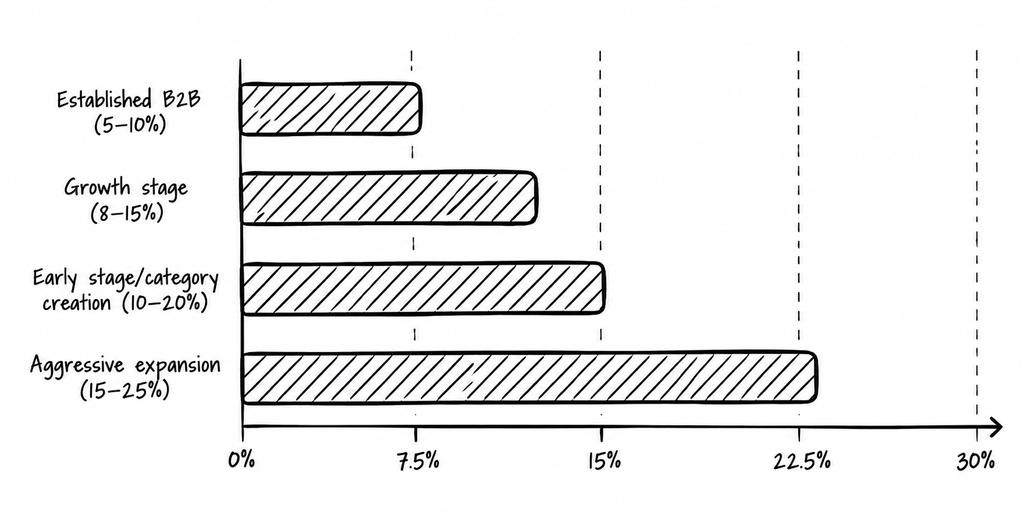
Actual investment should reflect growth goals, market maturity and GTM strategy.
These are planning ranges, not external industry benchmarks.
The percentage should ultimately be driven by what marketing is expected to accomplish.
A company that needs to maintain its existing market position needs one level of investment.
A company that needs to create a category, launch in three countries, build a brand from zero and generate pipeline for a rapidly expanding sales organization needs another.
That’s why we recommend starting with strategy rather than percentages, as we explain in our guide to allocating your B2B startup marketing budget.
What to Gather Before You Open the Budget Spreadsheet
One of the most common budgeting mistakes we see is starting with Excel.
Before discussing channels, campaigns or software licenses, collect four sets of inputs.
1. Last year’s actual spend
Not the approved budget.
Actual spend.
Include everything:
- Internal marketing salaries
- Agencies and consultants
- Freelancers
- Paid media
- Content
- Design and creative
- Video
- Website
- SEO/GEO
- PR
- Social media
- Events and conferences
- Sponsorships
- CRM
- Marketing technology
- Prospecting and data platforms
- AI platforms
- AI API/token consumption
- Customer marketing
- Research
- Travel
- Promotional materials
- Unplanned projects
Then ask the harder question:
What did each investment actually contribute?
Not every activity will have a neat revenue attribution number. That’s normal.
But you should understand which investments generated demand, strengthened your brand, influenced opportunities, supported sales, improved conversion or created infrastructure the company continues to use.
2. Revenue and pipeline targets
Your marketing budget should be connected to what the company wants to achieve.
Start with the revenue target. Then work backward:
Revenue target → required pipeline → opportunities → qualified accounts/leads → marketing activity
For example:
If the company wants $10 million in new ARR and historically closes 25% of qualified pipeline, it needs approximately $40 million in qualified pipeline.
If marketing is expected to influence or source 50% of that, you now have a very different budgeting discussion.
You’re no longer asking: “Can marketing have $1 million?”
You’re asking: “What resources are required for marketing to contribute to $20 million of pipeline?”
That’s a much better conversation.
3. Funnel economics
Look at:
- CAC
- Cost per opportunity
- Cost per qualified lead/account
- Lead-to-opportunity conversion
- Opportunity-to-close conversion
- Average contract value
- Sales cycle
- Marketing-sourced pipeline
- Marketing-influenced pipeline
- Expansion revenue
- Retention
But be careful with attribution.
B2B buying journeys are rarely linear.
McKinsey’s B2B Pulse research found that buyers use an average of ten interaction channels during their buying journey.
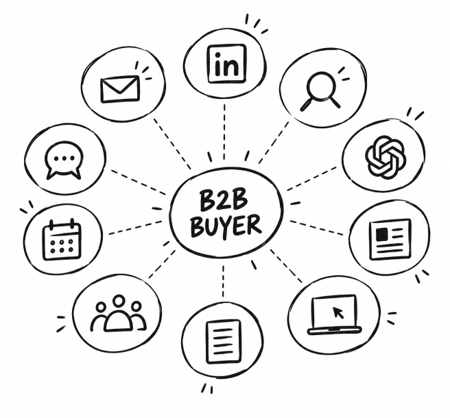
A prospect might:
see your CEO on LinkedIn → meet you at a conference → read an article → ask a colleague about you → visit your website → see your brand mentioned in an AI answer → attend your webinar → receive sales outreach → finally request a meeting.
Which channel gets the lead? The answer is: the ecosystem did. Or as Hubspot call it: The loop marketing
4. Headcount and capability plans
Don’t think only about how many marketers you need.
Think about which capabilities you need access to.
You may need:
- Strategic leadership
- Product marketing
- Content
- Social media
- Design
- Performance marketing
- PR
- Marketing operations
- HubSpot/CRM expertise
- AI implementation
- Data
- Events
- Video
- Analyst relations
Very few companies need all of those skills full-time.
That’s why the real budgeting decision is often not:
In-house or outsourced?
It is: What should we own internally, and where should we access specialist expertise externally?
How to Split a 2027 B2B Marketing Budget Across Channels
There is no perfect marketing budget allocation, but every budget needs a starting hypothesis.
Here is a SAGE planning model for 2027:
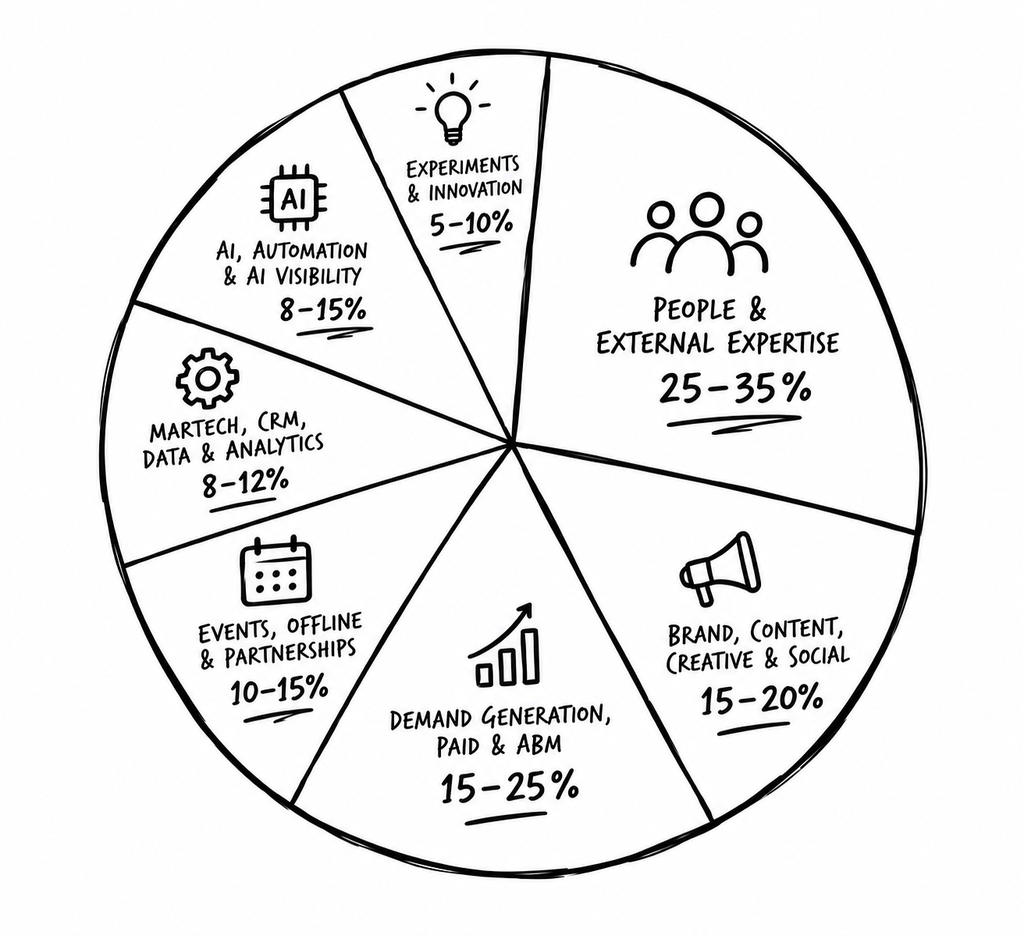
These are intentionally overlapping ranges rather than a fixed 100% formula. Your company should determine the mix based on stage, GTM model and existing infrastructure.
The important point isn’t whether your paid media budget is exactly 17%.
It is the balance.
A modern B2B marketing organization needs to fund demand today while building preference for tomorrow.
Your Budget Should Change With Your Company’s Stage
The same allocation doesn’t make sense for every business.
Early-stage
Your priorities may be:
- Positioning
- Brand
- Website
- Foundational content
- Founder presence
- Early demand generation
- Market learning
You may spend proportionally more on foundations and experimentation because you’re still discovering what works.
Growth stage
Now the emphasis shifts toward:
- Scalable demand generation
- ABM
- Content engine
- Events
- Sales enablement
- CRM
- Marketing operations
- Attribution
- Customer marketing
Established company
The challenge becomes different again:
- Defending market position
- Brand renewal
- Category leadership
- Customer expansion
- Thought leadership
- Efficiency
- Automation
- New markets
- Innovation
This is why copying another company’s budget percentages rarely works.
Budget according to the problem you need marketing to solve.
Lead Generation Still Matters – but Don’t Automate the Humanity Out of It
Of course 2027 budgets still need lead generation.
Budget for:
- Search
- Paid social
- Retargeting
- ABM
- Content syndication where relevant
- Webinars
- Outbound
- Partnerships
- Conversion optimization
But we need to recognize what is happening to outbound.
AI makes it possible to research thousands of prospects, generate personalized messages and execute enormous volumes of outreach.
Which means everybody can do it.
And when everybody does it, buyers learn to ignore it.
That creates an interesting opportunity:
Real personalization becomes more valuable precisely because artificial personalization becomes cheaper.
A thoughtful message from your CEO to 20 carefully selected executives may create more business than 20,000 AI-generated messages.
Budget for scale.
But also budget for attention.
Social Media: Budget for People, Not Only Company Pages
B2B social media should increasingly be treated as a network of people rather than a corporate broadcast channel.
That means investing in:
- CEO/founder presence
- C-level thought leadership
- Employee advocacy
- Subject-matter experts
- Customer stories
- Video
- Community
- Conversation
This isn’t simply about producing LinkedIn posts.
It is about making the expertise inside the company visible and recognizable.
That matters because B2B purchases are increasingly made by complex buying groups.
The 2025 Edelman – LinkedIn B2B Thought Leadership Impact Report found that “hidden buyers” – stakeholders such as finance, legal, compliance, procurement and operations – can significantly influence purchase decisions despite often having little contact with sales.
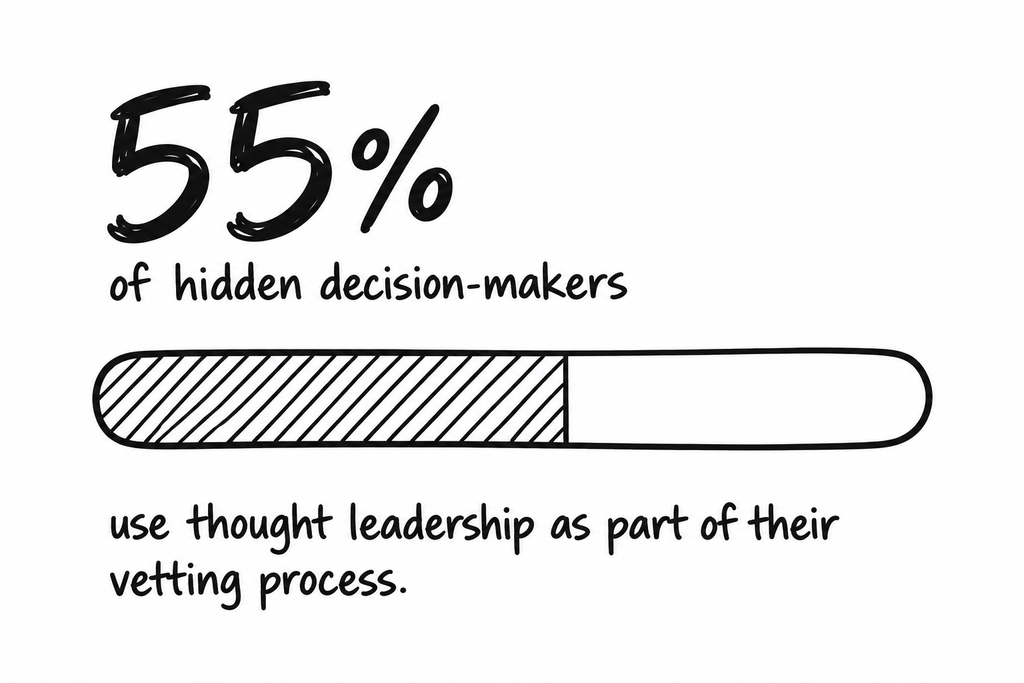
95% of hidden buyers surveyed said strong thought leadership makes them more receptive to sales and marketing outreach.
That’s a very strong argument for protecting thought leadership and executive visibility budgets.
Don’t Forget Offline Marketing
One of the easiest mistakes to make when building a modern marketing plan is assuming modern means digital.
It doesn’t.
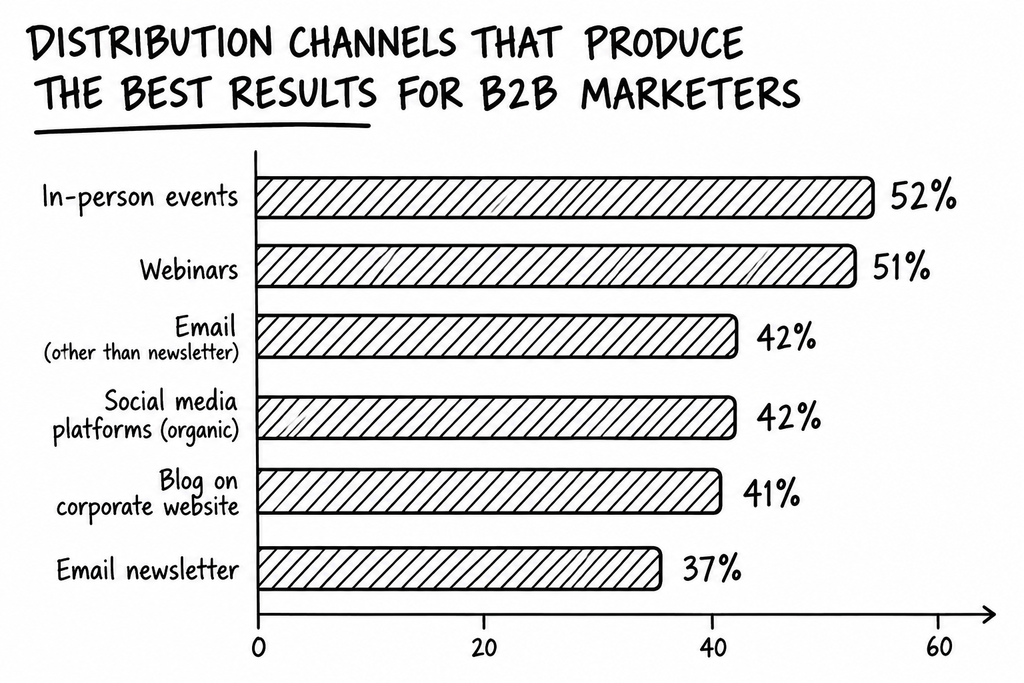
Content Marketing Institute’s B2B research found that marketers rated in-person events (52%) and webinars (51%) as their most effective distribution channels.
That’s important.
The more business communication becomes automated and digital, the more memorable genuine human interaction can become.
Consider budget for:
- Industry conferences
- Executive dinners
- Customer roundtables
- Breakfast events
- Small invitation-only gatherings
- Partner events
- Communities
- Speaking opportunities
- Customer advisory boards
Don’t evaluate every event by badge scans.
For an enterprise B2B company, ten meaningful conversations with the right executives may be worth considerably more than 500 random leads.
Quality of interaction matters.
Where to Put Budget for AI Search Visibility
Here’s a budget category that barely existed two planning cycles ago.
SEO isn’t disappearing. But search is changing.
Prospects increasingly ask ChatGPT, Gemini, Perplexity and other AI systems questions they once typed into Google:
“What are the best cybersecurity platforms for…”
“Which companies provide…”
“Compare X with Y.”
“What should I consider when choosing…”
Your company needs to be discoverable in those conversations.
That requires investment in GEO/AEO – Generative or Answer Engine Optimization.
Budget for:
- Content answering real buyer questions
- Category pages
- Comparison content
- Expert-led articles
- Original research
- Proprietary data
- Customer case studies
- Third-party coverage
- PR
- Review and recommendation ecosystems
- Strong technical website foundations
- Structured content
- Monitoring AI visibility
- Testing how your company appears across AI engines
Interestingly, HubSpot itself now sells an AEO capability specifically for monitoring visibility across ChatGPT, Gemini and Perplexity.
That tells us something important.
AI visibility is moving from experimental practice to measurable marketing infrastructure.
AI Needs a Real Budget – Not a ChatGPT Subscription
This deserves much more attention in 2027.
Gartner found that CMOs allocated an average of 15.3% of their marketing budgets to AI initiatives in 2026. AI-ready organizations went even further, allocating 21.3%.
But there is an important warning in the same research.
Only 30% of CMOs said their organizations had mature or fully developed AI readiness capabilities.
So the lesson isn’t:
Buy more AI.
It is: Budget for the ecosystem required to make AI useful.
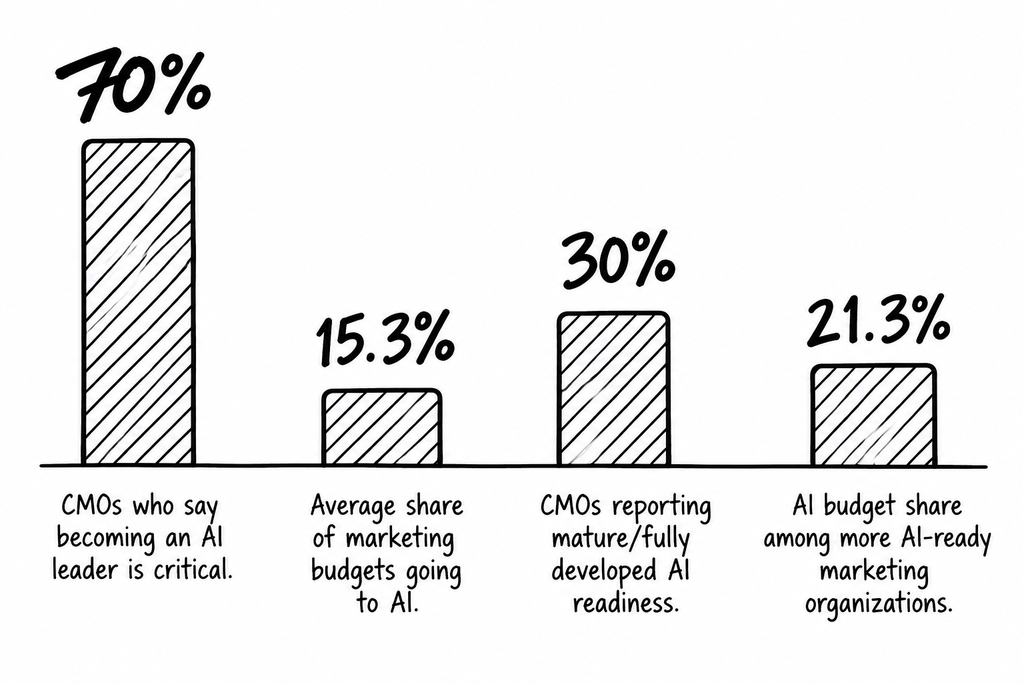
Source: Gartner 2026 CMO Spend Survey.
That gap between ambition and readiness is one of the most important budgeting lessons for 2027.
What Exactly Goes Into the AI B2B Marketing Budget?
We recommend separating AI spending into at least five categories.
1. AI platforms
This includes:
- Research
- Content
- Design
- Video
- Analytics
- Personalization
- Prospecting
- Automation
- Customer intelligence
The important discipline here is avoiding AI tool sprawl.
If five platforms perform largely the same task, that’s not innovation. That’s waste.
2. Tokens, credits and usage
This is going to become increasingly important.
AI costs are shifting from fixed software licenses toward consumption.
Think:
- API calls
- Tokens
- Agent actions
- Data processing
- Automated research
- Prospect enrichment
- Content generation
- Video generation
- Personalization at scale
These variable costs need their own forecast.
Even HubSpot is moving in this direction with HubSpot Credits, which are consumed when AI-powered features and agents perform actions.
So your 2027 budget needs to ask not only:
“What does the software cost?”
but:
“What will it cost when we actually use it at scale?”
3. AI development and integration
Some of the biggest productivity gains won’t come from another SaaS subscription.
They will come from connecting AI to your actual processes.
That could mean:
- Internal marketing agents
- Competitive intelligence agents
- Automated reporting
- Content repurposing workflows
- Sales research agents
- CRM enrichment
- Lead qualification
- Customer intelligence
- Campaign analysis
- Knowledge systems
That requires development and integration budget.
4. Training, governance and adoption
Technology that nobody knows how to use is not transformation.
Budget for:
- Training
- Prompt/workflow development
- Governance
- Data security
- Process redesign
- AI policies
- Team experimentation
5. GEO and AI visibility
Finally, some AI investment needs to face outward.
How does AI understand your company?
Does it recommend you?
Does it cite you?
Does it understand your positioning?
Does it confuse you with competitors?
This will increasingly become a measurable marketing KPI.
How to think about your AI marketing investment
Rather than claiming there is one universal allocation, show the AI budget as five boxes:
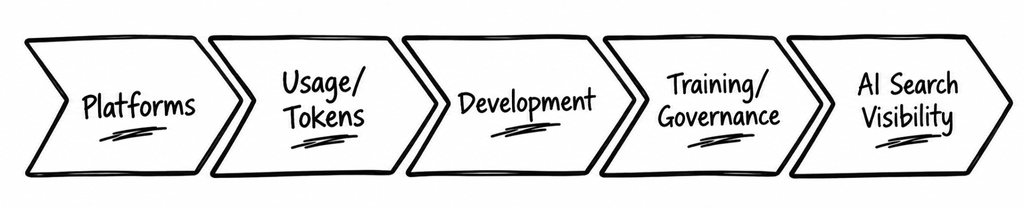
Your AI budget is an ecosystem – not a software subscription.
Budget for Your Marketing Technology Stack
AI doesn’t eliminate MarTech.
It changes it.
2027 is an excellent time to challenge every renewal.
Ask:
- Are people actually using this?
- Does another platform already provide this functionality?
- Can AI now replace part of it?
- Does it integrate with our CRM?
- Does it improve customer experience?
- Does it provide data we actually use?
- Can we connect activity to pipeline?
Your CRM deserves particular attention because it is increasingly the infrastructure connecting marketing, sales and AI.
For example, HubSpot currently lists Marketing Hub Professional starting at $890/month, with Enterprise starting at $3,600/month. HubSpot also includes monthly AI credits in its paid packages and offers additional usage models.
But don’t budget only for the license.
Budget for:
- Implementation
- Onboarding
- Integrations
- Data migration
- Database hygiene
- Reporting
- Workflow development
- Optimization
- Training
- Ongoing RevOps support
A powerful CRM badly implemented is an expensive address book.
A well-implemented CRM is part of your revenue infrastructure.
Brand May Be Your Most Important AI-Era Investment
This may sound contradictory.
It isn’t.
AI makes competent execution cheap.
It can create a reasonable article.
A reasonable graphic.
A reasonable email.
A reasonable landing page.
A reasonable campaign concept.
And that means the internet is about to become absolutely flooded with reasonable marketing.
Reasonable won’t be enough.
When everyone can create competent content, competence stops being differentiation.
The premium shifts toward:
- Original ideas
- Distinctive creative
- Strong opinions
- Recognizable visual identity
- Expertise
- Trust
- Personality
- Reputation
- Community
In other words:
Brand.
The Edelman – LinkedIn research reinforces this. Hidden B2B buyers don’t simply want product information. They respond to thinking that helps them understand their business differently.
In its 2025 research, 81% said high-quality thought leadership helped them understand previously unrecognized challenges or opportunities.
So don’t take the efficiency gains AI creates and simply use them to produce ten times more content.
Use some of those gains to create something ten times more memorable.
As we discussed in The State of B2B Tech Marketing for 2026, AI is changing execution rapidly – but differentiation remains fundamentally human.
Creativity Needs a Line in the Budget
Creativity often disappears from spreadsheets because it doesn’t have a software SKU.
That’s a mistake.
Set aside money specifically for:
- Campaign concepts
- Experimental formats
- Original research
- Creative video
- Brand activations
- Unexpected partnerships
- Guerrilla ideas
- Interactive content
- New communities
Don’t require every idea to come with a predictable CPL before you’re willing to try it.
If it is entirely predictable, it probably isn’t innovative.
How to Leave Room for What You Cannot Plan
Whatever you do, don’t allocate 100% of your 2027 budget in January.
Nobody knows exactly what marketing will look like by September 2027.
New AI platforms will emerge.
Existing channels will change.
A competitor will do something unexpected.
A new market opportunity may appear.
A customer may offer you a partnership.
A brilliant campaign idea may emerge.
If every dollar is already committed, your answer to all of those opportunities becomes:
“Maybe next year.”
We recommend protecting approximately 5–10% for experimentation and opportunity.
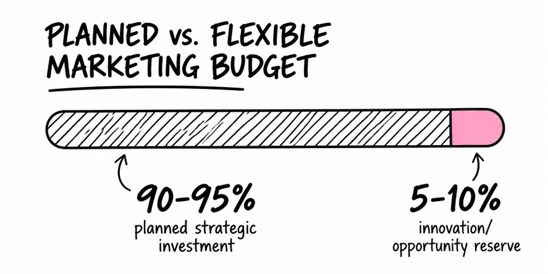
The important part is protecting that reserve.
Don’t let it become the first money Finance removes.
Build Three Budgets, Not One
A useful exercise is to prepare three scenarios.
Scenario A: Minimum viable budget
What must marketing spend simply to maintain the business?
Scenario B: Growth budget
What investment is required to realistically achieve the company’s agreed targets?
Scenario C: Acceleration budget
If the company decided to move faster enter another market, build the category or accelerate pipeline – what additional investment would you make and why?
This is particularly useful when presenting to a CEO or board.
Instead of arguing over one number, management can make an informed decision about ambition versus investment.
How to Defend the Number to a CEO or Board
Don’t present your budget as a list of marketing expenses.
Present it as an investment thesis.
Start here:
Business objective → marketing objective → strategy → capabilities → investment → expected business impact
Then divide the budget into three strategic categories.
Run the business
What must exist to keep your current marketing engine operating?
CRM, people, website, basic content, core campaigns, reporting.
Grow the business
What directly supports growth?
Demand generation, ABM, events, market expansion, content, sales enablement, partnerships.
Build the future
What creates future competitive advantage?
AI, brand, research, innovation, new channels, experimentation.
This changes the boardroom conversation.
Instead of:
“Marketing wants another $300,000.”
you can say:
“The business plan calls for 35% growth, entry into two markets and $20 million of qualified pipeline. Here’s the marketing investment required to support those objectives, here’s what we expect it to produce, and here’s what we would remove if the investment is reduced.”
That’s not defending a marketing expense.
That’s discussing a business plan.
For more on doing more with existing resources, see our guide to maximizing your marketing budget.
Your 2027 Budget Should Be a Living Document
Budget approval isn’t the end of budgeting.
It’s the beginning.
Review performance monthly and make meaningful allocation decisions quarterly.
Ask:
What’s working?
What’s not?
What’s changed?
What have we learned?
Where would the next dollar produce the most value?
Do not keep funding a channel in October simply because you put it into a spreadsheet in November of the previous year.
Your annual marketing budget template creates discipline.
Your quarterly reviews create intelligence.
Final Thought: Don’t Let AI Make Your Marketing Average
There will be enormous pressure in 2027 to use AI to do more.
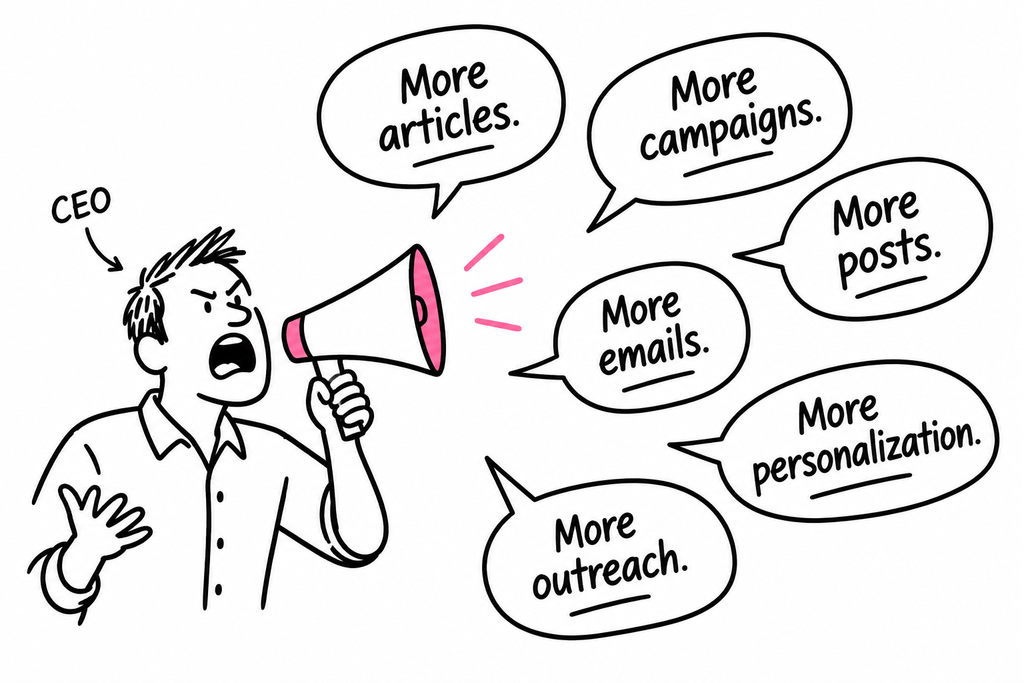
More articles.
More campaigns.
More posts.
More emails.
More personalization.
More outreach.
But every one of your competitors has access to many of the same technologies.
Efficiency alone therefore cannot become your competitive advantage.
The companies that rise above the noise will combine AI-powered efficiency with distinctly human marketing.
They will have stronger points of view.
Better ideas.
More memorable brands.
Recognizable leaders.
Real expertise.
Real relationships.
And the courage to do things that don’t look exactly like everyone else’s marketing.
So when you build your 2027 budget:
Use AI for efficiency.
Use data for decisions.
Use technology for scale.
Use people for judgment, creativity, trust and connection.
And leave enough room for the ideas you haven’t had yet.
Because those may turn out to be the best investments you make all year.
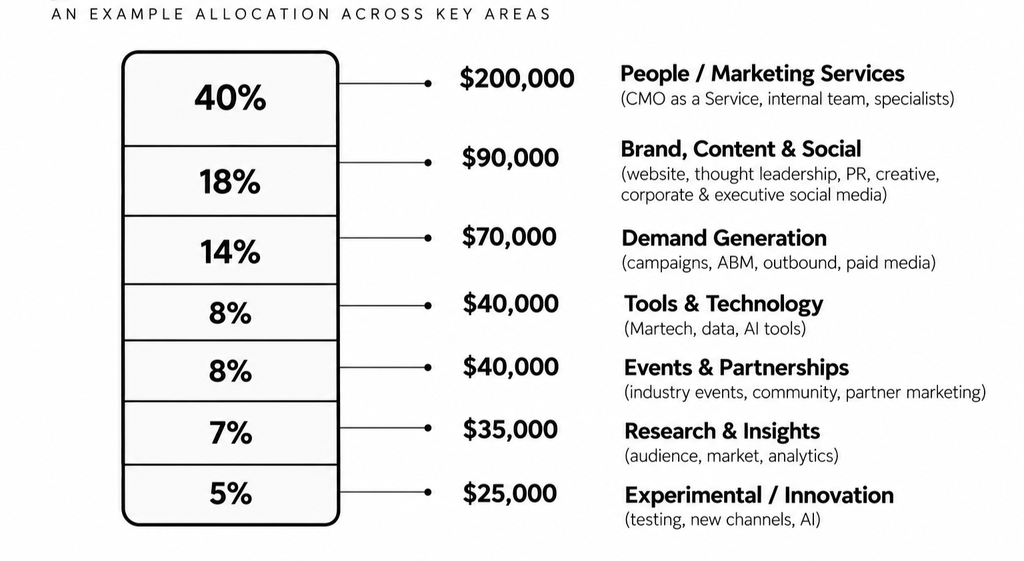
What a $500,000 yearly marketing budget can look like:
FAQs
When should a B2B company start planning next year’s marketing budget?
Ideally, start three to four months before the beginning of the fiscal year. Marketing needs time to understand management’s revenue targets, sales plans, product launches, geographic expansion and hiring assumptions before building the budget. Starting early also gives finance, sales and marketing time to challenge assumptions together rather than negotiating individual line items under deadline pressure.
How often should a marketing budget be revisited during the year?
At minimum, conduct a meaningful review quarterly, with monthly performance monitoring. High-growth companies may need to reallocate more frequently. The annual budget should establish strategic priorities, but it should not prevent you from shifting investment when channels underperform, new opportunities emerge or company revenue targets change.
What share of a marketing budget usually goes to headcount?
There is no universal figure, but 25–35% for people and external expertise is a useful SAGE planning range for many B2B organizations. The number varies substantially by operating model. When comparing options, include salaries, benefits, recruitment, agencies, freelancers and specialists—the relevant figure is the total cost of accessing the capabilities your strategy requires.
How do you adjust a marketing budget when the revenue target changes mid-year?
Work backward from the new revenue target. Calculate the additional pipeline required, then assess your conversion rates, sales capacity and which marketing programs can realistically scale. Don’t simply increase every line item proportionally. Additional budget should go to the channels and capabilities most likely to produce the incremental pipeline, awareness or market access required.
What is the most common mistake in a first B2B startup marketing budget?
Trying to do everything at once. Startups frequently divide limited resources among PR, paid media, SEO, events, content and social until no activity receives enough investment to create meaningful impact. Prioritize the channels most closely aligned with your ICP, buying journey and GTM strategy, test them properly, measure results and expand based on evidence.
How much should a B2B company budget for AI in 2027?
There isn’t one correct percentage. Gartner reported an average of 15.3% of marketing budgets going to AI initiatives in 2026, but that doesn’t mean every company should copy the number. Start with use cases and expected value, then budget across platforms, tokens/credits, development, integration, training, governance and AI search visibility.
Should brand or lead generation get more budget in 2027?
For most companies, this shouldn’t be an either/or decision. Demand generation helps capture existing demand; brand helps create preference before buyers enter an active purchasing cycle. The right balance depends on company maturity, awareness and sales cycle. Companies with weak market recognition generally cannot performance-market their way out of a brand problem.
Should events still be part of a B2B marketing budget?
Yes. When your buyers actually attend them and you have a clear strategy. Content Marketing Institute’s research found in-person events among the most effective B2B content distribution channels. But evaluate events based on the quality of target-account engagement, relationships, influenced opportunities and follow-up not simply the number of badges scanned.
More articles and references to read about the topic: