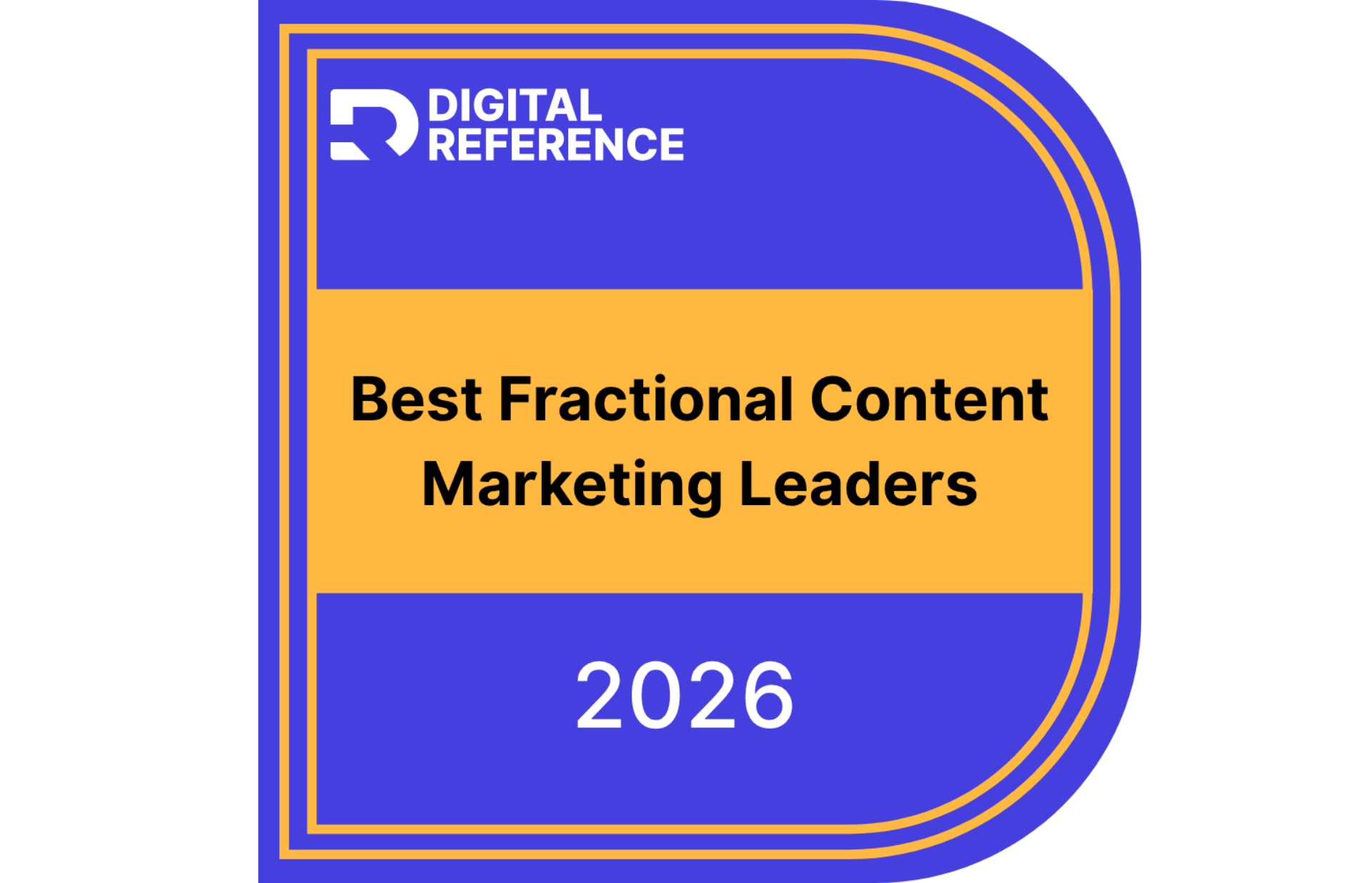
We’re proud to share that SAGE Marketing has been recognized by Digital Reference as one of the top fractional content marketing leaders in its latest industry rankings.
The recognition highlights agencies and marketing leaders helping modern B2B companies scale through strategic, flexible, and results-driven marketing leadership. As more businesses move away from traditional full-time marketing structures, the demand for fractional marketing expertise continues to grow. Companies are increasingly looking for experienced partners who can provide senior-level strategy, content leadership, and execution without the overhead of a full in-house team.
According to Digital Reference, the featured companies and marketing leaders were selected through a research-led evaluation process designed to reflect real-world performance, leadership visibility, and measurable business impact.
The methodology focused on several key criteria, including:
Strategic clarity and positioning
Demonstrated business outcomes and client impact
Leadership involvement from founders or senior executives
Ability to support global and distributed teams
Flexible engagement models aligned with modern business needs
Revenue and growth-oriented marketing execution
Digital Reference also reviewed public case studies, leadership profiles, client outcomes, and broader market presence to identify agencies and fractional marketing leaders consistently delivering measurable value to clients. The platform places strong emphasis on transparency, authentic leadership, and outcome-driven marketing rather than traditional agency scale alone.
For SAGE Marketing, the recognition reinforces the company’s approach to helping B2B technology and SaaS brands build authority through content in all its aspects from strategic branding and messaging, executive thought leadership, tradeshows, social media, demand generation and SEO/GEO.
“We’ve always believed that effective B2B marketing starts with clarity, authenticity, and consistency,” said Sarit Lamerovitch, CEO and Founder of SAGE Marketing. “Being recognized by Digital Reference is a meaningful milestone because it reflects the work we do every day to help our clients stand out in highly competitive markets.”
Over the past few years, SAGE Marketing has worked with startups, scaleups, and global technology companies across sectors including SaaS, AI, cybersecurity, hyperspectral imaging, construction technology, FinTech, robotics, security, and travel technology – helping brands translate complex technologies into compelling stories that drive measurable business growth.
Today, as CMO-as-a-Service at SAGE Marketing, Shlomit partners with technology companies to build powerful brands, accelerate demand generation, and connect innovation with results. Her approach is creative, data-driven, and always focused on what truly matters — turning strategy into measurable success.
We’re proud to share that it has achieved Cyber Essentials certification, a UK Government-backed cybersecurity scheme overseen by the National Cyber Security Centre and delivered through IASME.
This certification was issued to SAGE Marketing by The IASME Consortium Ltd, following the successful completion and assessment of our Cyber Essentials submission.
But for us, this certification is not just about the certificate.
It is about the responsibility that comes with the work we do every day.
As a marketing, HubSpot, and growth partner, SAGE works across websites, CRM systems, marketing automation platforms, customer data, campaign infrastructure, integrations, and digital operations. Our clients trust us not only to help them grow, but also to work in a way that is structured, responsible, and secure.
Achieving Cyber Essentials is another important step in reinforcing that trust.
At SAGE, we see cybersecurity as part of operational maturity.
For companies using platforms like HubSpot, security and growth are not separate conversations. A well-managed marketing ecosystem needs both: the ability to move fast, launch campaigns, connect systems, and act on data – while also maintaining proper access control, clean configuration, updated systems, and responsible ways of working.
“As a company that works deeply inside our clients’ digital, CRM, and marketing systems, trust is a core part of what we deliver. Cyber Essentials certification is important to us because it reflects our commitment to responsible digital operations, secure ways of working, and protecting the information our clients trust us with.
This is not a one-time achievement. It is part of our ongoing effort to strengthen the way we operate as a strategic marketing and HubSpot partner.”
Sarit Lamerovich, Founder and CEO, SAGE Marketing
What Cyber Essentials Certification Means
Cyber Essentials is a UK Government-backed, industry-supported cybersecurity scheme designed to help organizations protect themselves against common online threats. The scheme is overseen by the UK’s National Cyber Security Centre, while IASME acts as the official Cyber Essentials Delivery Partner responsible for managing and delivering the scheme.
The certification is built around five core technical controls:
Firewalls and routers
Secure configuration
User access control
Malware protection
Security update management
Together, these controls are designed to help organizations reduce exposure to common cyber risks by making sure essential security measures are in place across their systems.
For SAGE Marketing, achieving Cyber Essentials certification means that our cybersecurity practices have been assessed against this recognized framework and that we have demonstrated alignment with its core requirements.
Our Ongoing Commitment to Secure Digital Services
Achieving Cyber Essentials certification is an important milestone for SAGE Marketing.
More importantly, it reflects our ongoing commitment to maintaining responsible practices as we continue supporting clients across marketing, HubSpot, websites, automations, integrations, and RevOps.
For our clients, this certification adds another layer of confidence: the confidence that their strategic marketing partner is not only focused on performance, growth, and execution, but also on the operational standards that make long-term partnerships stronger.
As marketing ecosystems become more connected, the way companies manage security, access, systems, and data becomes increasingly important.
SAGE will continue to review, strengthen, and improve the way we work, so our clients can move forward with a partner they can trust.
Today, as CMO-as-a-Service at SAGE Marketing, Shlomit partners with technology companies to build powerful brands, accelerate demand generation, and connect innovation with results. Her approach is creative, data-driven, and always focused on what truly matters — turning strategy into measurable success.
Today, as CMO-as-a-Service at SAGE Marketing, Shlomit partners with technology companies to build powerful brands, accelerate demand generation, and connect innovation with results. Her approach is creative, data-driven, and always focused on what truly matters — turning strategy into measurable success.
Sarit founded SAGE to allow technology companies to take innovation to the next business level and fulfill the entrepreneur’s dream to change the world by building market recognition, increasinge customer awareness and improvinge the foundation for strong and sustainable revenue growth.
From the moment a startup is born, it looks to the future of taking those first baby steps into a successful and scalable business that will evolve and grow. At the outset, you need to ensure that those baby steps have a strong foundation. If you’re building a real company with real customers and revenue, you need not only to invest in product development but also build a strong marketing foundation that will be ready to capture the potential leads which will later convert into customers.
First things first. What is the best way to start generating new leads and how do we convert those leads into customers?
One significant way to employ lead generation is through the use of content marketing. Content marketing focuses on building relevant and engaging content that will essentially convert your audience to sales leads for your startup. It’s not only a powerful strategy to sell your brand, but it also builds brand awareness and improves your search engine ranking, which translates into increased traffic to your website and other digital assets. Through content marketing, you build trust with prospects over time by establishing yourself as an authority in your field.
Beyond having a talented and proficient marketing team obsessed with creating compelling content, you should always ensure that your marketing team uses helpful tools and quick wins to enhance lead conversion across all fronts. You need to ensure that your marketing team knows how to improve conversion rates.
6 Quick Wins for Improving Conversion Rate for Startups
1. Use Smarter, Intent-Driven Forms (Not Just Pop-Ups)
Pop-up forms are a cost-effective way to bring anonymous visitors into your conversion funnel, but not all pop-ups are created equal. Basic timed pop-ups are increasingly blocked by browsers or dismissed by savvy users. The shift is toward intent-driven triggers: exit-intent pop-ups (which fire when a visitor is about to leave), scroll-triggered forms (activated after reading 60–70% of a page), and time-on-page overlays that appear only after a visitor has demonstrated genuine interest.
There’s also a strategic shift at play. With third-party cookies largely phased out, first-party data, the kind you collect directly through forms, has become a critical business asset. Every email address or phone number you collect is now more valuable than ever for retargeting, nurturing, and personalization.
Recommended placement: homepage, blog posts, pricing page, and product page. Keep forms short (name + email is often enough at the top of the funnel) and always offer something of value in exchange such as a guide, a checklist, a free audit.
2. Link your CTA (Call To Action button) to a Dedicated Landing Page
If you’ve ever clicked on a digital advertisement to find an online business, chances are that you have ended up on a landing page. A landing page is usually a standalone web page with a specific purpose; such as selling a product or collecting information from a prospect.
One of the key elements to a landing page is the CTA (Call To Action button). It’s what will turn a visitor into a lead. Keep it simple and clear to get more conversions, the more options you give visitors, the more likely they will get distracted and leave your ad without further engaging with your marketing asset.
In digital advertisements, don’t use CTAs to drive people to your homepage. You should always link a CTA to a dedicated landing page, as this is the first interaction your visitor will have with your brand.
The most effective B2B landing pages go beyond static copy and a form. Interactive product demos using tools like: Navattic or Storylane, allow prospects to self-explore your product before ever speaking to sales. This dramatically improves lead quality, because visitors who complete a demo have already self-qualified.
For startups, this means your landing page CTA doesn’t always have to be “Book a Demo”. “Try It Yourself” or “See It in Action” can convert better with B2B buyers who prefer to do their own research before engaging with a salesperson.
3. Let AI Run Your PPC (And Focus on Feeding It Better Signals)
PPC advertising has undergone a fundamental shift. In 2026, AI-driven campaign formats—Google’s Performance Max and Meta Advantage+ have largely replaced manual, persona-based ad management. Algorithms now decide where, when, and to whom ads are shown, optimizing in real time across search, display, YouTube, Gmail, and Maps simultaneously.
For startups, this is both an opportunity and a mindset change. You no longer need to micromanage targeting parameters or build separate ad sets for each persona. Instead, your job is to feed the algorithm high-quality signals: strong landing pages, clear conversion events, and rich first-party data from your CRM.
The startups that win at PPC in 2026 are those that obsess over what happens after the click, not before it. A highly optimized landing page with a fast load time and clear CTA will outperform a manually curated campaign every time.
Focus on: Conversion tracking setup, landing page quality score, and feeding your CRM data back into ad platforms for lookalike audiences.
Watch out for: Over-relying on broad match without proper negative keywords, and letting Performance Max cannibalize branded search without exclusions.
Tools: Google Performance Max, Meta Advantage+, Microsoft Ads, Triple Whale (attribution).
4. Build Multi-Channel Nurture Sequences, Not Just Email Flows
Email nurture remains one of the highest-ROI tactics for lead generation for startups. “email nurture” means something broader than it used to. Buyers interact with your brand across multiple touchpoints before converting, and your nurture strategy needs to reflect that.
Modern nurture sequences connect email with LinkedIn retargeting, in-app messages, SMS follow-ups, and even direct mail for high-value ABM targets. The goal is to stay present across the channels your buyer actually uses – not just their inbox.
AI has also transformed what “automated” means in this context. Tools like Clay, Customer.io, and HubSpot AI can now personalize email content dynamically referencing a lead’s company, role, recent activity, or even news about their business. This level of personalization was previously only possible with a large sales team; today, a startup of five can run sequences that feel genuinely 1:1.
Quick win: Connect your email nurture to a LinkedIn Matched Audiences retargeting campaign. Leads who see your brand in both channels convert at significantly higher rates.
Key metric to track: Email-to-meeting rate, not just open rate. Opens are vanity; meetings are pipeline.
5. Upgrade from Manual Lead Scoring to Predictive AI Scoring
Lead scoring is one of the most powerful tools in startup growth hacking, but the manual model of assigning fixed points to page visits and email opens is showing its age. In 2026, the shift is toward predictive lead scoring, where AI models analyze hundreds of behavioral, firmographic, and intent signals simultaneously to predict which leads are most likely to convert.
The difference is significant. A traditional scoring model might give 10 points for visiting your pricing page. A predictive model from a platform like 6sense, MadKudu, or HubSpot AI factors in the lead’s company size, industry, tech stack, recent funding, hiring signals, and how their behavior compares to your historical closed-won customers – all in real time.
For B2B startups especially, this shifts the conversation from “how engaged is this lead?” to “how ready is this lead?” – a much more actionable question for a lean sales team.
Getting started: Most modern CRMs including HubSpot offer AI-assisted lead scoring out of the box. Start there before investing in a dedicated platform.
Intent data add-on: Tools like Bombora or G2 Buyer Intent can tell you which companies are actively researching solutions like yours—even before they visit your website.
Tools: HubSpot AI Scoring, 6sense, MadKudu, Bombora, G2 Buyer Intent.
6. Use AI to Personalize Your Conversion Funnel
The next frontier of website conversion optimization is personalization at scale, and AI tools now make this accessible even for lean startup teams. Rather than showing every visitor the same landing page or CTA, AI-powered platforms analyze visitor intent, industry, and behavior in real time to deliver tailored experiences that dramatically increase website conversions.
Here are three practical ways AI is reshaping b2b conversion optimization:
Personalized CTAs: Tools like Mutiny let you dynamically swap headlines, CTAs, and page copy based on a visitor’s company size, industry, or traffic source without touching your code. A SaaS startup targeting both SMBs and enterprise clients can show each segment an entirely different value proposition on the same URL.
AI Chatbot Flows: Drift’s AI chatbots qualify leads 24/7 by asking the right questions, routing high-intent buyers straight to a sales rep and nurturing early-stage visitors with relevant content. This is startup growth hacking in action, doing the work of a full SDR team without the headcount.
Smart Landing Page Variants: HubSpot AI and similar platforms enable automated A/B testing of landing page variants adjusting images, body copy, and form lengths based on what converts best for each audience segment. Instead of guessing what works, the algorithm learns and optimizes continuously.
For startups operating with limited resources, these AI-driven tools offer an outsized advantage: you no longer need a large team to run sophisticated personalization. Set up your rules once, and let the system do the heavy lifting while you focus on building the product.
FAQ
What is the fastest way for a startup to improve conversions?
The fastest wins in website conversion optimization typically come from fixing what’s already in place. Start by adding pop-up forms to your highest-traffic pages, sharpening your CTAs, and linking every ad to a dedicated landing page instead of your homepage. These changes require no additional ad spend—they simply make better use of the traffic you’re already getting. Pair these with a quick A/B test on your main CTA copy and you can see measurable results within days.
How do B2B startups use landing pages to generate more leads?
For b2b conversion optimization, dedicated landing pages outperform generic website pages because they eliminate distractions and focus the visitor on a single action—downloading a guide, booking a demo, or starting a free trial. High-converting B2B landing pages typically feature a clear value proposition, social proof (such as customer logos or a quick testimonial), and a short form that asks only for essential information. The less friction in the form, the higher the submission rate which is the foundation of effective lead generation for startups.
What AI tools help startups increase website conversions?
Several AI platforms are particularly well-suited to help startups increase website conversions without large teams. Mutiny is ideal for personalizing landing pages by visitor segment. Drift automates lead qualification through conversational AI chatbots. HubSpot AI offers built-in tools for smart CTAs, email personalization, and automated A/B testing. Together, these tools represent a practical startup growth hacking stack, enabling smaller teams to compete with the personalization capabilities of much larger organizations.
Final Thoughts
The big question for most startups is – who should be monitoring and leading all this? The answer is- a data-driven, capable marketing executive who will keep up with the ever-changing trends to stay relevant. When it comes to developing the marketing team, one size definitely does not fit all. Hiring a professional marketing staff may be a bit of overkill as there are many great resources out there, such as dedicated B2B marketing agencies, that can help you harness the full potential of marketing solutions.
Today, as CMO-as-a-Service at SAGE Marketing, Shlomit partners with technology companies to build powerful brands, accelerate demand generation, and connect innovation with results. Her approach is creative, data-driven, and always focused on what truly matters — turning strategy into measurable success.
Today, as CMO-as-a-Service at SAGE Marketing, Shlomit partners with technology companies to build powerful brands, accelerate demand generation, and connect innovation with results. Her approach is creative, data-driven, and always focused on what truly matters — turning strategy into measurable success.
Sarit founded SAGE to allow technology companies to take innovation to the next business level and fulfill the entrepreneur’s dream to change the world by building market recognition, increasinge customer awareness and improvinge the foundation for strong and sustainable revenue growth.
In the fast-paced world of B2B startups, marketing plays a crucial role in driving growth and success. However, allocating the necessary funds to develop and execute an effective marketing strategy is often a challenging endeavor. With tightening budgets and increased pressure from management to demonstrate performance, finding the right balance becomes even more critical.
When it comes to B2B startups, budget allocation is crucial. While product development and operations are vital, effective marketing is equally essential. Without a strong marketing strategy, even the most innovative product won’t sustain a company. In this blog post, I will outline how to plan your marketing budget based on your company’s strategy and goals.
Think Big!
When I started working as a marketer for a B2B SaaS company, a wise mentor shared an invaluable piece of advice with me: think big! Don’t let budget constraints limit your vision. Instead, develop a marketing plan that incorporates all the elements you believe will help your company reach its goals. Remember, the management team will review your plan and make the necessary adjustments. So, embrace this advice and stay true to the guiding principles as you plan your B2B SaaS marketing budget.
Planning your B2B startup marketing budget: Key Aspects to Consider
To create a successful marketing budget for your B2B startup, there are several key aspects you need to consider. Let’s explore them:
1. Company Goals: Begin by defining your marketing objectives. These goals should align with your overall business objectives and go-to-market plan. Whether it’s increasing brand awareness, generating leads, driving website traffic, boosting sales, or launching a new product, your objectives will serve as a compass throughout the budget planning process.
2. Company Maturity: Consider your company’s stage of maturity, whether it’s at the seed stage, has received round A or B financing, or is ready to launch its product. The level of maturity will influence your marketing budget allocation and the strategies you employ.
3. Marketing Strategy: Determine your marketing strategy based on your company’s needs. Are you aiming to increase brand awareness, educate the market, or generate leads? Clearly defining your strategy will help you make informed budgeting decisions.
General outline for budget planning
Now that we’ve covered the essential aspects let’s outline a general framework to help you get started:
Start from the Top
Define your marketing objectives:
Identify specific marketing goals aligned with your business goals and go-to-market plan. These objectives will serve as the foundation for your budget planning.
Understand your target audience:
Gain a deep understanding of your target audience’s demographics, preferences, behavior, pain points, motivations, and decision-making criteria. This knowledge will enable you to identify the most effective marketing channels and allocate your budget accordingly. Remember, the user of your product or technology may not necessarily be the decision-maker or budget owner, so tailor your marketing efforts to reach all relevant stakeholders.
Conduct competitive analysis:
Analyze your competitors’ marketing efforts to gain insights into their strategies and tactics. Their positioning, channel strategy, content approach, thought leadership, and paid acquisition efforts. This analysis helps benchmark your marketing budget for startups against market expectations.
Focus on targeted marketing channels:
B2B startups often benefit from focused and targeted marketing channels. Evaluate options such as content marketing, thought leadership, email marketing, social media, search engine optimization (SEO) and GEO, paid advertising, exhibitions and conferences, webinars, and public relations. Allocate an initial budget for testing each new channel to assess its effectiveness in reaching key decision-makers and influencers in your target industry.
Many startups are also shifting budgets away from “spray-and-pray” paid campaigns toward long-term content ecosystems and owned channels.
As discussed in several recent Reddit conversations among B2B marketers, many teams are doubling down on:
SEO and thought leadership
LinkedIn content
Partnerships
AI search visibility
Revenue attribution tools
while reducing spend on trade shows and broad paid campaigns with unclear ROI.
Infographic: choosing the best marketing channels. ׂ( Pulse agency)
Build industry partnerships:
Collaborate with industry partners, influencers, or complementary businesses to expand your reach and generate leads. Allocate a portion of your budget to building and nurturing these partnerships through co-marketing activities, joint events, partner portals, and referral programs.
Lead generation and account-based marketing (ABM):
Generating leads and driving growth are key objectives for any B2B startup. If you’ve already built awareness and demand for your product or service, it’s time to focus on converting prospects into customers. This is where lead nurturing activities and guerilla outreach campaigns come into play. By implementing a CRM tool like HubSpot, a startup company can automate workflows, manage attribution track pipeline, improve lead quality visibility, and closely monitor progress, ensuring optimal results.
Aligning your budget with sales goals:
To allocate your marketing budget effectively, it’s crucial to align it with your company’s sales goals. If you have data from the previous year, you have an advantage. For instance, if your sales revenue was $1,000,000 last year, with 10 new deals out of 150 marketing qualified leads (MQLs), and this year’s sales revenue target is $2,000,000 with a goal of bringing in at least 300 MQLs, you can calculate your marketing budget accordingly.
Consider investing more in the tools and strategies that have proven effective, and don’t be afraid to request an increased marketing budget for these activities. If you’re early-stage and lack historical data, benchmark against industry standards instead.
According to recent B2B marketing benchmark studies, most companies allocate between 7–12% of revenue toward marketing, while early-stage startups and SaaS companies often invest significantly more aggressively.
2026 Benchmarks for B2B Startup Marketing Budgets:
Marketing budgets in 2026 look very different from just a few years ago.
Rising customer acquisition costs, longer B2B sales cycles, and the growing role of AI have forced startups to rethink how they allocate resources across channels and tools.
For most early-stage companies, a practical marketing budget for startups in 2026 typically falls into these ranges:
Seed-stage startups: 10–20% of annual revenue
Series A startups: 15–25% of annual revenue
Product-led growth startups: 20%+ during aggressive expansion phases
The most effective startup marketing budget today is no longer heavily weighted toward paid acquisition alone.
Modern B2B go to market strategy increasingly balances:
demand generation
SEO
thought leadership
brand awareness
AI-powered automation
revenue operations
A modern B2B marketing budget allocation often looks like this:
25–30% content and SEO
20–25% paid acquisition
15–20% outbound and sales enablement
10–15% brand and creative
10–15% AI tools and automation
5–10% analytics and experimentation
The key is flexibility.
The best-performing startups review allocation quarterly and shift spend toward channels tied directly to revenue contribution rather than vanity metrics.
Harnessing the power of referrals and testimonials:
In the B2B space, word-of-mouth and social proof are game changers. Allocate resources to encourage satisfied customers to provide referrals and testimonials. Utilize case studies, success stories, and customer testimonials as part of your content marketing strategy to build credibility and trust with potential customers. And don’t forget about your colleagues in the office, they are your most valuable ambassadors. Set a separate budget to ensure their well-being and encourage their engagement on social media.
Crafting the perfect marketing mix:
Your target audience, objectives, and competitive analysis will guide you in determining the optimal marketing mix for your business. It’s important to strike a balance between different channels and tactics to maximize your effectiveness. Allocate your budget accordingly, considering factors such as advertising costs, branding and design, content and video creation, technology and software platforms, personnel, AI tools, and any additional expenses specific to your strategies.
Setting a realistic and ambitious budget:
Once you have your marketing mix and associated costs, it’s time to set your budget. Consider your business’s financial capabilities, revenue projections, and expected return on investment (ROI). Be both realistic and ambitious in your budgeting to achieve your marketing goals.
Monitoring and measuring success:
Implement a system like HubSpot to track and measure the effectiveness of your key performance indicators (KPIs) and marketing efforts. Allocate a portion of your budget for experimentation and testing and ensure that you measure the ROI of each campaign. This data will provide valuable insights for future decision-making, allowing you to adjust your budget allocation accordingly. Collaborate closely with your sales team to understand the quality of incoming leads and the feedback received from prospects.
How to Budget for AI Marketing Tools in 2026
AI tools are no longer experimental line items.
In 2026, they are becoming a core part of startup marketing operations.
For most early-stage startups, allocating $300–$2,000 per month toward AI marketing tools is realistic and impactful.
Content Creation
Tools like ChatGPT and Claude help small marketing teams create:
blog drafts
landing pages
campaign messaging
social media content
email sequences
research summaries
Typical budget:
$20–$200/month
These tools work best when combined with strong human editing and subject matter expertise.
Outreach and Prospecting
AI-powered outbound tools such as Clay and Apollo.io help startups:
enrich prospect data
personalize outreach
automate prospecting workflows
scale account-based outreach
Typical budget:
$150–$1,000/month
For many startups, these platforms now replace part of traditional paid advertising spend.
Analytics and Attribution
Measurement has become one of the biggest competitive advantages in B2B marketing.
Platforms like HubSpot AI and Google Analytics 4 help startups understand which channels generate qualified pipeline – not just traffic.
Typical budget:
GA4: free
HubSpot AI features: included within CRM plans
As CAC continues rising across B2B industries, attribution and analytics are becoming critical investment areas.
Monitoring and Measuring Success
Implement systems to track:
campaign performance
attribution
pipeline contribution
conversion rates
CAC
ROI
Allocate part of your budget specifically for:
experimentation
A/B testing
optimization
new channel testing
Data-driven iteration is essential for startup growth.
Last But Not Least – Be Creative
In conclusion, creativity remains one of the most valuable assets in B2B marketing.
There is no universal template for a startup marketing budget.
Every company is different. Every audience is different. Every market evolves differently.
The most successful B2B startups stay agile, continuously evaluate performance, and adapt their budget allocation based on real business impact.
By combining creativity, analytics, strategic planning, and the smart use of AI tools, startups can maximize the impact of every marketing dollar and build sustainable long-term growth.
FAQ
What percentage of revenue should a B2B startup spend on marketing?
Most B2B startups spend between 10% and 25% of annual revenue on marketing, depending on company stage and growth goals. Seed-stage startups often invest more aggressively to build awareness and generate pipeline, while later-stage companies focus more heavily on efficiency and retention. In 2026, many startups are also allocating part of their marketing budget toward AI tools and automation.
Which marketing channels offer the best ROI for B2B startups in 2026?
According to HubSpot’s marketing statistics and channel research, the highest ROI channels for B2B startups include SEO, website content, email marketing, LinkedIn marketing, and paid social campaigns. Many startups are also seeing strong results from webinars, partnerships, and thought leadership content that builds long-term authority.
How should a startup split its budget between brand awareness and lead generation?
Most B2B startups should allocate roughly 60–70% of their budget toward lead generation and 30–40% toward brand-building activities. While performance marketing supports short-term pipeline goals, long-term brand investment improves conversion rates, lowers acquisition costs, and strengthens positioning over time. The most effective b2b go to market strategy balances both areas rather than prioritizing only immediate lead volume.
Today, as CMO-as-a-Service at SAGE Marketing, Shlomit partners with technology companies to build powerful brands, accelerate demand generation, and connect innovation with results. Her approach is creative, data-driven, and always focused on what truly matters — turning strategy into measurable success.