













































B2B Social Media Posting Cadence: Finding Your Posting Schedule That Actually Works

Aliza Hughes
written by Aliza Hughes Head of Social Media

Aliza is a seasoned content and social media strategist with over a decade of experience humanizing B2B tech brands through organic growth and executive thought leadership.

Sarit<br> Lamerovich
reviewed by Sarit
Lamerovich
Founder/CEO

Sarit founded SAGE to allow technology companies to take innovation to the next business level and fulfill the entrepreneur’s dream to change the world by building market recognition, increasinge customer awareness and improvinge the foundation for strong and sustainable revenue growth.

7 min read
Share
Why Partner with SAGE Marketing?
100+ B2B tech companies and startups — we literally grow unicorns.
No office, no walls — we work inside your world, embedded in your team.
Full-stack marketing approach: strategy, storytelling, content, HubSpot and execution under one roof.
Let’s Build Something Remarkable!
Whether you’re launching, scaling, or rebranding —
we’ll help you connect,
engage, and grow.
Contact us
client logo client logo client logo client logo client logo client logo
B2B Marketing Reddit LinkedIn Social Media

Key Takeaways

  • There is no universal posting frequency that works for every B2B brand. The right cadence depends on your team size, content pipeline, platform, and audience behavior.
  • LinkedIn remains the most important platform for B2B brands, but in 2026, quality and engagement matter far more than volume.
  • SAGE Marketing helps B2B teams build a social media posting cadence that fits their actual content capacity and audience expectations.

Why There Is No One-Size-Fits-All Posting Schedule for B2B

Every few months, a new report comes out telling B2B marketers exactly how many times per week they should post on LinkedIn. Three times. Five times. Even once a day. The numbers change, but the confidence never wavers.

Spoiler: there is no magic number.

The right social media posting cadence for your B2B brand depends on factors that no benchmark report can account for: how large your team is, how much original content you’re actually producing, which platforms your buyers use, and what your audience expects from you. A 12-person SaaS start-up and a 5,000-person enterprise software company are not operating at the same level, and they shouldn’t be following the same schedule.

What the question about frequency actually misses is this: your audience doesn’t care how often you post. They care whether the content is worth their time. Showing up every day with filler is worse than showing up twice a week with something genuinely useful. The goal of a B2B social media posting schedule isn’t just click done on your Monday board, it’s to build a cadence you can sustain without sacrificing quality.

The right cadence balances three things:
✔️What your team can produce consistently
✔️What your audience actually engages with
✔️What the algorithm rewards on each platform. 

Get those three things aligned, and you’ve found your schedule.

Platform-by-Platform: How Often B2B Brands Should Post

Different social media platforms have different rhythms, audiences, and content styles. Your posting frequency should reflect those differences, even if the content is mostly the same.

LinkedIn Posting Frequency for B2B Brands

LinkedIn is the centerpiece of almost every B2B content strategy, and for good reason. According to LinkedIn’s own marketing blog, 80% of B2B leads from social media come through LinkedIn, more than all of the other social media platforms combined. And 4 out of 5 LinkedIn members drive business decisions at their organizations, making it uniquely valuable for reaching the people who actually control decision making and purchasing

The right posting frequency for a company page depends heavily on where your organization is right now.

Start-ups should aim for 1–2 posts per week and lean into whatever resources they already have. If you have a blog, use it. If you have a case study, share it. No long-form content yet? That’s fine! Sharing a relevant industry article and adding your perspective, or explaining how your product relates to a trend in your space, is completely legitimate content. It shows your audience that you’re informed and have a point of view.

Startups can also factor in content from the CEO or other team members. Reposting a founder’s personal LinkedIn post to the company page is an easy win – it keeps the page active, gives the CEO more visibility, and makes leadership feel accessible to your audience. A company page that mixes original content, curated industry commentary, and team posts signals something important to early prospects: that there are real, engaged people behind the brand.

At this stage, the goal isn’t a perfectly curated feed. It’s an active, thoughtful one.

Mid-size companies generally have the content infrastructure to support around 3 posts per week: blogs, case studies, webinars, playbooks, and PR coverage can all be repurposed into strong social content. On top of that, there’s a steady stream of business activity to draw from: client wins, hiring milestones, team events, employee spotlights, and conferences. The content pipeline isn’t the challenge at this size – it’s about having a system to capture and use what’s already being created.

Three posts per week is a cadence most mid-size marketing teams can sustain without sacrificing quality.

If you want to extend that pipeline even further, an employee advocacy program does it with almost no extra effort. Give employees one ready-to-share post per week and you’ve essentially multiplied your content output by however many people participate. Research shows that content shared by employees generates 8x more engagement than the same content shared by the brand directly, and reaches networks the company page would never touch organically.

Enterprise companies can post every day, and for different reasons than you might expect: at this level, the goal isn’t only about reaching a new audience, it’s staying top of mind with the audience you already have. Daily posting keeps the brand present and consistently delivers value to buyers who are already in the consideration phase.

Enterprise organizations also have the raw material to sustain that cadence without stretching. Think about everything being produced at any given time: blogs, reports, thought leadership from executives and subject matter experts, conference appearances and event recaps, product announcements, customer stories, regional campaigns, hiring initiatives, and industry commentary. There’s no shortage of content. The challenge is often having a system to capture and publish it consistently.

Employee advocacy at the enterprise level works differently than it does at a mid-size company. The content library needs to be robust enough that employees across different regions, roles, and verticals can find something relevant to share, not just a single company-wide post pushed out to everyone. The best enterprise advocacy programs offer a mix: some content that’s relevant across the entire organization, and some that’s specific to a geography, a vertical, or a business unit. 

The biggest obstacle for enterprise marketing teams isn’t content volume, it’s the approvals process. Multiple stakeholders, legal reviews, regional sign-offs – all of it slows the pipeline and turns a timely post into a missed moment. Building a streamlined content approval workflow, with pre-approved formats, clear ownership, and defined turnaround times, is often what separates enterprise brands that show up consistently from those that don’t.

For founder and executive personal profiles, the calculus is different, and in 2026, it’s shifted significantly. The LinkedIn algorithm is now keeping posts alive for much longer than it used to. Strong posts are circulating for two to three weeks before losing momentum. That changes how personal profiles should approach posting frequency.

The pressure to post every day just to stay visible? It’s gone. What the algorithm is actually rewarding now is content that generates real engagement – comments, shares, saves, and time spent reading. A founder who posts once or twice a week with something genuinely worth reading will consistently outperform someone posting daily just to fill space.

This is the principle that should guide every B2B personal profile: we don’t post because it’s a scheduled day to post. We post because we have something to say. If you don’t have something valuable to contribute on a given day, don’t post.

X (Twitter) Posting Frequency for B2B Brands

X rewards a higher posting frequency than LinkedIn, and the content style is fundamentally different. Posts are shorter, more reactive, and more conversational. Where LinkedIn favors depth and narrative, X favors speed and wit. It’s also worth knowing that a post on X has a very short shelf life, which is actually what makes X a natural home for repurposed content. A LinkedIn post you spent time crafting can be broken down into a thread, a quick take, or a punchy one-liner on X without your audience ever feeling like they’ve seen it before.

Posting frequency on X should still reflect your company’s size and capacity:

Startups can treat X as a low-effort extension of their LinkedIn presence. Repurposing existing content into shorter posts or commentary a few times a week keeps the account active without adding meaningful workload to a small team. And here’s something worth knowing that will help leaner teams: the X algorithm weighs replies much more heavily than likes, which means jumping into relevant conversations can be just as effective, if not more so, than posting original content. For a startup with limited time, being genuinely active and engaged on the platform often matters more than how much you’re creating for it. 

Mid-size companies should post more actively, a mix of repurposed content, industry commentary, and real-time engagement with conversations already happening in their space. Replies and quote posts count here just as much as original content.

Enterprise companies with the resources to maintain an active X presence can post multiple times per day, but like smaller companies, they also can not forget about participating in conversations, not just broadcasting. Reacting to industry news, engaging with customer posts, and joining trending conversations in your vertical is what builds a dedicated audience on X.

That said, X is not the right channel for every B2B brand. It tends to perform best for companies in tech, media, cybersecurity, and finance – industries where real-time commentary on news and trends is a genuine competitive advantage. If your buyers aren’t actively on X, investing heavily in that platform is a distraction. Know where your audience actually lives before you build a posting cadence there.

Reddit Posting Frequency for B2B Brands

Reddit is underused by B2B marketers, and that’s precisely what makes it valuable. The platform hosts highly engaged, niche communities across almost every industry vertical, asking the questions that you want your brand to answer.

But for Reddit, frequency is the wrong frame. Rather than thinking in posts per week, think in terms of participation. Find two or three subreddits where your buyers are active (r/cybersecurity, r/marketing, r/startups, r/sysadmin – depending on your industry) and contribute meaningfully when you have something worth adding. Even a few thoughtful comments per week can establish your brand as a trusted voice in a community that will eventually want to know more about what you do.

Instagram and Facebook Posting Frequency for B2B Brands

For most B2B tech brands, Instagram and Facebook are  secondary channels. They can support employer branding, company culture content, and event coverage well, but rarely drive the kind of pipeline activity that LinkedIn does. Unless you have a visual-forward brand, a strong employer brand initiative, or a consumer-adjacent product, your time is almost always better spent deepening your LinkedIn strategy first.

Across every stage, content repurposing is one of the most effective tools for maintaining cadence without burning out your team. But repurposing done right is not copying and pasting the same post twice. It means going back to a strong asset – a blog, a webinar, a case study – and finding a different angle, a different excerpt, or a different visual to bring it to a new audience or revisit it with fresh framing.

This approach also has a strategic bonus: testing different posts from the same asset is one of the most reliable ways to learn what resonates most with your audience. When you see which angle drives the most engagement, you know what to create more of going forward.

The Real Risk of Posting Too Much or Too Little

Both extremes carry real costs, and most B2B teams are more aware of the risk of posting too little than the risk of posting too much.

Posting too little makes you invisible. Irregular, infrequent posting signals to your audience, and to the algorithm, that you’re not worth following consistently. You lose momentum, and rebuilding it takes longer than maintaining it would have.

But posting too much without substance creates a different problem: disinterest. When your audience starts seeing your posts as just noise (or in 2026 as AI slop), they tune you out. They stop clicking, stop commenting, and eventually stop following. Recovering from that kind of audience disengagement is harder than most marketers realize.

The sustainable middle ground looks different for every team, but the principle is consistent: post as often as you can while maintaining quality. That’s the frequency formula that actually works. If your team can produce two genuinely strong posts per week, that is your cadence.

How to Find and Test the Right Cadence for Your B2B Brand

The best B2B social media posting schedule for your brand is one you discover through your own data, not one you borrow from a benchmark report. Here’s how to find it:

Start with what you can sustain. Before you set any targets, audit your actual content pipeline. How much original content is your team producing per month? How much of it is adaptable for social media? Let those answers set your posting frequency. If you can realistically produce three strong posts per week, that’s your cadence. Build from what you have, not from what you aspire to have.

Pick a starting cadence and commit to it for 60–90 days. Consistency is what generates the data you need. If you’re posting at random intervals, you can’t draw meaningful conclusions about what’s working. Choose a frequency that feels manageable and hold it long enough to see patterns emerge.

Track engagement metrics, not just reach. Impressions tell you how many people saw your content. Comments, saves, profile clicks, and link clicks tell you whether they cared. Optimize for the metrics that indicate real interest, not the ones that just look good in a report.

Use a content calendar to stay consistent. A well-built content calendar doesn’t just schedule posts, it maps your content pipeline across formats, topics, and platforms so you can see gaps before they become missed weeks. It’s the operational backbone of a sustainable cadence.

Adjust based on what the data tells you. After your initial 60–90 day test period, look at which post types drove the most meaningful engagement and at what frequency. Let that guide your next iteration. 

FAQ

How many times per week should a B2B company post on LinkedIn?

It depends on your company size and content capacity. Startups can start with 1-2 posts per week. Mid-size companies should have the content infrastructure to support 3 posts per week. And enterprise companies can post every day. What matters even more than frequency though is consistency and quality. A reliable cadence of strong content will always outperform an aggressive schedule of filler posts.

Does posting more often on social media improve reach for B2B brands?

Not automatically. Posting more can increase visibility, but only if the content quality holds. Algorithms on LinkedIn and other platforms prioritize engagement over volume. Posting too frequently with low-value content can actually hurt your reach over time as engagement rates drop and the algorithm deprioritizes your posts.

How do you maintain a consistent posting schedule with a small marketing team?

Repurpose content strategically and plan ahead. A single blog post can generate multiple social posts when approached from different angles. A content calendar helps you plan weeks in advance so you’re never scrambling. Batching content creation, writing and scheduling multiple posts in one session, is also one of the most effective ways small teams stay consistent.

What is the best time of day to post on LinkedIn for B2B audiences?

There’s no universal best time. What matters is when your specific audience is likely to be on the platform and engaged. If you’re targeting a specific region, post during their business hours, not yours. And because LinkedIn’s algorithm now keeps posts alive for weeks, the most important thing is early engagement: make sure your employees are activated to like and comment as soon as a post goes live. That initial momentum, plus continued engagement, is what signals to the algorithm to keep distributing it.

Aliza Hughes Head of Social Media
About
the author
Aliza is a seasoned content and social media strategist with over a decade of experience humanizing B2B tech brands through organic growth and executive thought leadership.
Learn more

The State of B2B Tech Marketing for 2026

Sarit<br> Lamerovich
written by Sarit
Lamerovich
Founder/CEO

Sarit founded SAGE to allow technology companies to take innovation to the next business level and fulfill the entrepreneur’s dream to change the world by building market recognition, increasinge customer awareness and improvinge the foundation for strong and sustainable revenue growth.

Shlomit<br> Hertz
reviewed by Shlomit
Hertz
CMO-as-a-Service

Today, as CMO-as-a-Service at SAGE Marketing, Shlomit partners with technology companies to build powerful brands, accelerate demand generation, and connect innovation with results. Her approach is creative, data-driven, and always focused on what truly matters — turning strategy into measurable success.

15 min read
Share
Why Partner with SAGE Marketing?
100+ B2B tech companies and startups — we literally grow unicorns.
No office, no walls — we work inside your world, embedded in your team.
Full-stack marketing approach: strategy, storytelling, content, HubSpot and execution under one roof.
Let’s Build Something Remarkable!
Whether you’re launching, scaling, or rebranding —
we’ll help you connect,
engage, and grow.
Contact us
client logo client logo client logo client logo client logo client logo
start-ups Cmo as a service startups marketing B2B Marketing

Drawing on data from over 150 active clients across 14 technology verticals what separates the marketers pulling ahead from those still running 2022 playbooks.

150+
Active Clients

14
Tech Verticals

50
CMO Interviews

2026
Annual Edition

EXECUTIVE SUMMARY

B2B Tech marketing is under more pressure and more scrutiny than ever

In 2026, B2B tech marketing reached an inflection point. AI flooded every channel with content that sounds identical.

Cold outreach reply rates in cybersecurity and AI collapsed to under 1%. Attribution remained the industry’s number one unsolved challenge for the third consecutive year. Consumer excitement about AI dropped from 50% to 19% in under two years and the buyers who are most fatigued happen to be the same senior decision-makers every B2B tech company is trying to reach.

Drawing on data from over 150 active clients across 14 technology verticals, this report does not describe a market in gradual transition. It describes a market in active divergence between the companies building durable, human-first marketing engines and those still running campaigns their ICPs stopped responding to in 2022.

78%
Using AI in content production (engagement down 38%)

46%
Investing in community-led growth

74%
Attribution is #1 unsolved challenge – 3rd year running.

The gap is not closing. It is accelerating.

  1. ICP attention is collapsing
    A senior buyer in cybersecurity receives an estimated 112 unsolicited marketing touchpoints per week. Cold outreach reply rates in Cyber and AI have fallen to 0.8% — effectively invisible. 62% of tech companies say their ICP is harder to reach than two years ago.
  2. AI has tripled content volume and halved its value
    78% of our clients are using AI in content production — up from 41% two years ago. Content output is up 184% since 2022. Engagement per piece is down 38%. The marketers winning are using AI as a production engine while investing human effort in the insight, POV, and voice that AI cannot generate.
  3. HubSpot is the de facto operating system but teams are using only a third of it.
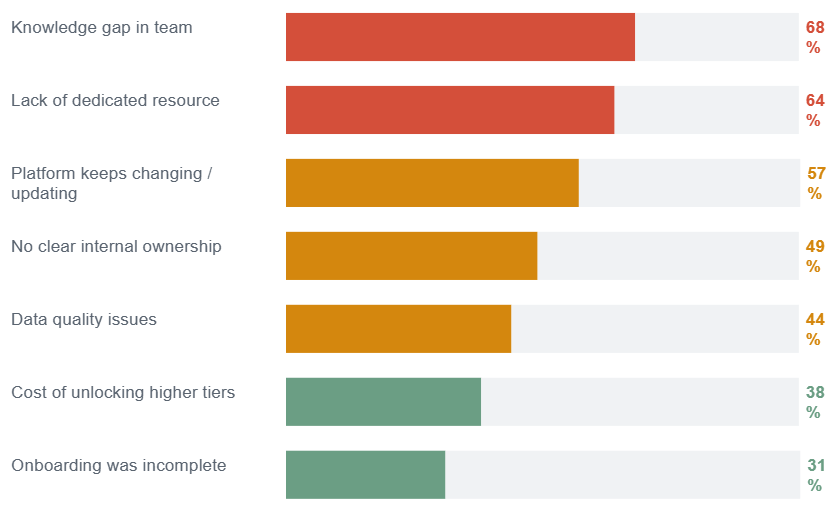
    71% of our clients use HubSpot as their primary CRM — the dominant single source of truth bridging product, sales, and marketing data. Yet the average team uses an estimated 34% of available features. Knowledge gaps and lack of dedicated resource are the top barriers.
  4. Community, B2B influencers, and channel experimentation are accelerating.
    46% of B2B organizations are investing in community-led growth. Companies leveraging customer communities and industry influencers report 2.3× higher customer advocacy. The average Sage client is now testing 3.4 new channels simultaneously – up from 1.8 in 2023.
  5. Attribution is still the number one unsolved problem.
    74% of marketing leaders cite attribution as their top challenge – unchanged from 2023. The channels with the lowest attribution confidence (community, word of mouth, B2B influencer, employee thought leadership) are consistently generating the warmest and highest-converting pipeline.

KEY NUMBERS AT A GLANCE

“ The B2B tech marketers winning in 2026 are doing three things simultaneously: building owned audiences their competitors cannot buy access to, using AI to do more of the operational work so humans can do more of the creative work. 

– Recurring theme across 50 CMO and marketing leader interviews, Sage Marketing 2026.

PIPELINE HEALTH

Volume is down. Quality is up. The tension is real.

The era of “more leads” as a marketing KPI is ending for B2B tech. We’re seeing a shift toward fewer, better-qualified opportunities but this creates tension with sales teams still expecting volume targets.

30%
Average SQL-to-opportunity conversion rate in 2026

4.2×
Revenue multiple: inbound vs outbound leads

187d
Average B2B tech sales cycle for deals over £50K

6.8
Average buying committee size for enterprise tech.

CHANNEL PERFORMANCE

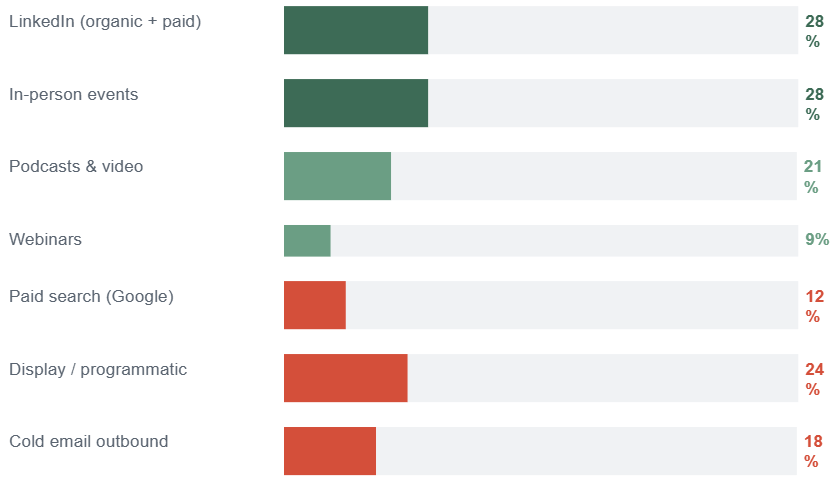
LinkedIn dominates. SEO is fracturing. Events are back.

The channel landscape for B2B tech has shifted materially. LinkedIn’s combination of targeting precision and organic reach has made it dominant. Meanwhile, AI-generated content is commoditizing SEO, and in-person events are generating disproportionate pipeline relative to their cost.

CHANNEL INVESTMENT SHIFT 2024–2025

Budget shift: Paid media lost 7 percentage points of budget share. Reallocation went toward people, events, and content channels with longer payback windows but stronger long-term compounding returns.

CONTENT & AI ADOPTION

AI has unlocked volume. It hasn’t solved differentiation.

Content production rates have surged following AI adoption. But so has competitive noise. The marketers winning are using AI as a production tool while investing human effort in the POV, experience, and narrative that AI cannot generate.

78%
Using AI in content creation (up from 41% in 2023)

284
Content output index vs 100 in 2022

62
Engagement quality index (down from 100 in 2022)

2.3×
Higher pipeline: expert-authored vs AI-only content.

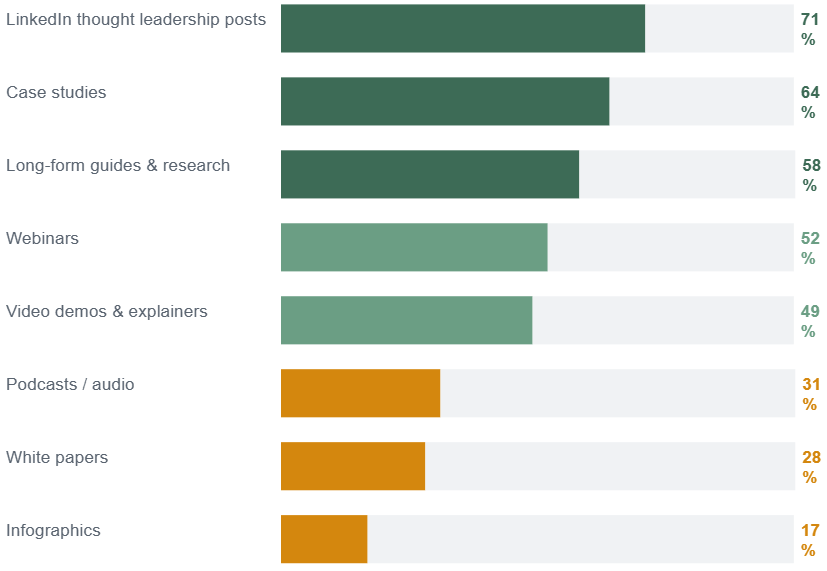
MOST EFFECTIVE CONTENT FORMATS IN B2B TECH, 2025

We tripled our content output using AI in 12 months. Our organic traffic grew. Our pipeline from content dropped. We had to completely rethink what ‘good content’ meant – it’s not volume, it’s the insight only we can provide.

– Head of Marketing, Series B SaaS company

ICP ATTENTION, ATTRIBUTION & COMMUNITY

Getting heard is harder. Proving it worked is harder still.

Two compounding pressures define 2026 B2B tech marketing: ICPs more saturated with outreach than ever – especially in cybersecurity and AI and an attribution problem that has persisted as the industry’s single biggest unsolved challenge.

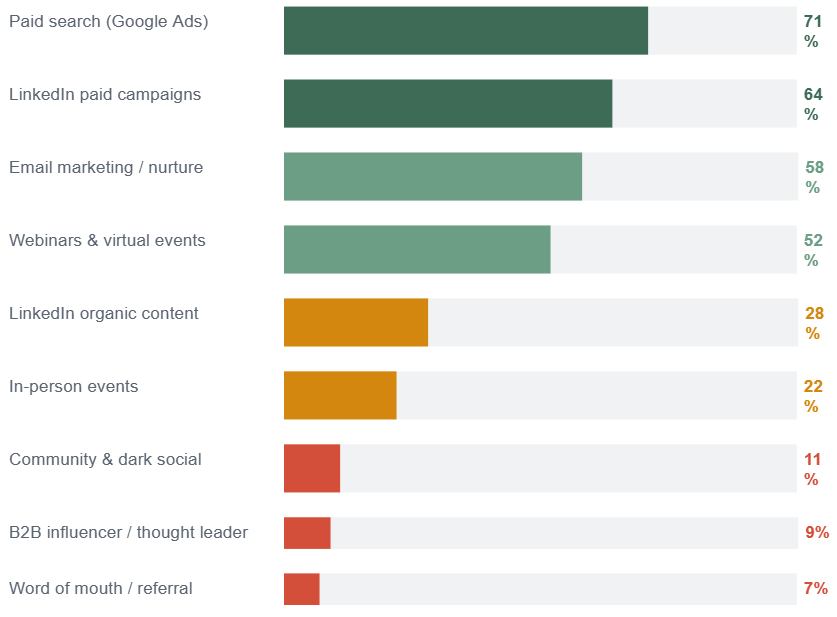
ATTRIBUTION CONFIDENCE BY CHANNEL

Attribution irony: The channels with the lowest attribution confidence community, influencer, word of mouth are often generating the warmest pipeline. The inability to measure them causes chronic underinvestment in the very things that work best.

In the age of AI-generated everything, creativity is the last real moat. Your ICP has seen every subject line, every quick question, every ‘I came across your profile’. The only thing that still works is being genuinely interesting, genuinely relevant, or genuinely different. Usually all three.

– CMO, Series B cybersecurity company

SIGNAL FROM THE MARKET

The anti-AI brand is becoming a real market position

52% of consumers reduce engagement the moment they suspect AI-generated content. Brands including Aerie, Equinox, and iHeartMedia are explicitly marketing ‘human-made’ as a premium differentiator. B2B tech is next.

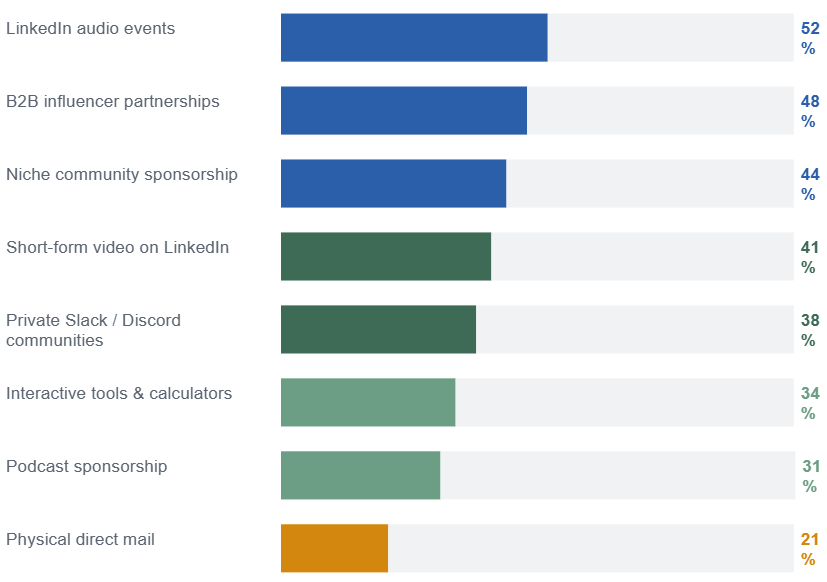
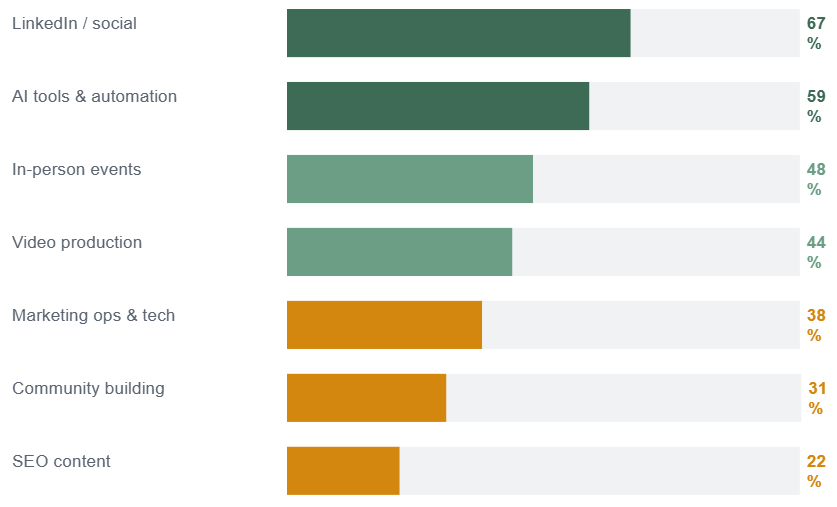
NEW AND EXPERIMENTAL CHANNELS BEING TESTED, 2025

MARKETING TECHNOLOGY

HubSpot has become the single source of truth – but most teams are only scratching the surface.

Across our client base, HubSpot CRM has emerged as the dominant operating system for B2B tech go-to-market teams – the single source of truth bridging product, sales, and marketing data. Yet most teams are using a fraction of its capability, leaving significant pipeline intelligence, automation, and alignment value on the table.

71%
Use HubSpot as a primary CRM and marketing platform

34%
Estimated average of HubSpot features actively in use

68%
Say team lacks the knowledge to fully utilize HubSpot

82%
Higher pipeline: expert-authored vs AI-only content.

HubSpot is our single source of truth – every deal, every contact, every campaign. But we’re probably using 30% of what it can do. We simply don’t have the time or the people to go deeper, and every time we try, the platform has already added new features we haven’t caught up with.

– VP Marketing, Series A B2B SaaS, 45 employees

HUBSPOT HUB ADOPTION – ACTIVE VS INACTIVE

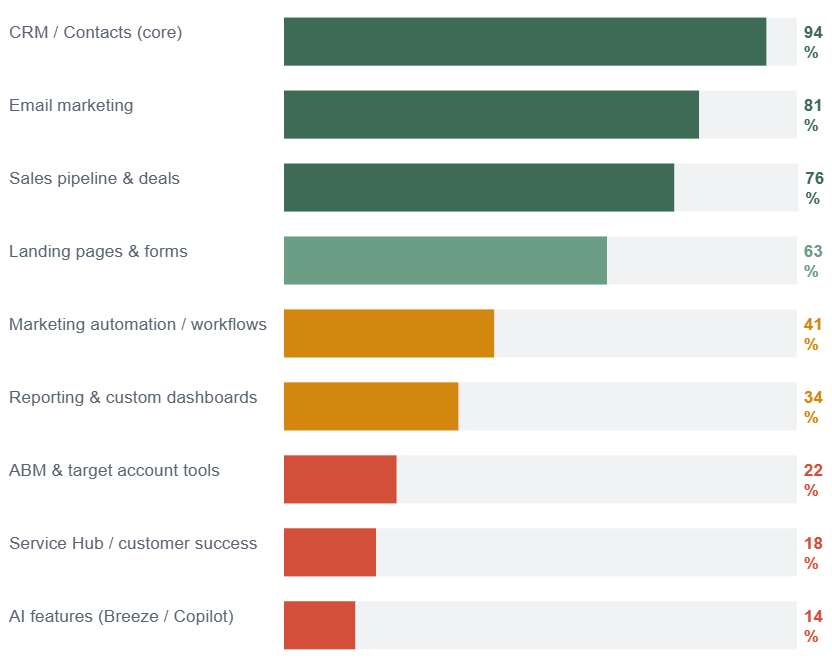
The drop-off is steep: Nearly every client uses HubSpot for contacts and email. Fewer than half run automation workflows. Under a quarter use ABM, service, or AI features despite having paid access to them.

WHY TEAMS UNDER-UTILISE HUBSPOT

WHICH TEAMS ACTIVELY USE HUBSPOT?

TeamActive users
Marketing98%
Sales91%
Leadership/exec61%
Customer success34%
Product28%

BUDGET & INVESTMENT

Budgets are tighter. Accountability expectations are higher.

Marketing budget as a % of revenue has compressed across B2B tech. At the same time, CFO and board expectations around marketing-attributed revenue have never been more explicit.

Budget category2025 avg2023 avgChange
People & agency38%34%↑ +4pp
Paid media24%31%↓ -7pp
Events14%10%↑ +4pp
Content production12%11%→ +1pp
Marketing tech8%10%↓ -2pp
Other4%4%→ flat

PLANNED BUDGET INCREASES, NEXT 12 MONTHS

TEAMS & TALENT

Marketing team structures are being redesigned around AI and specialisation.

Generalist roles are giving way to specialist functions particularly in marketing operations, demand generation, and content strategy. AI proficiency has become an expectation at every level.

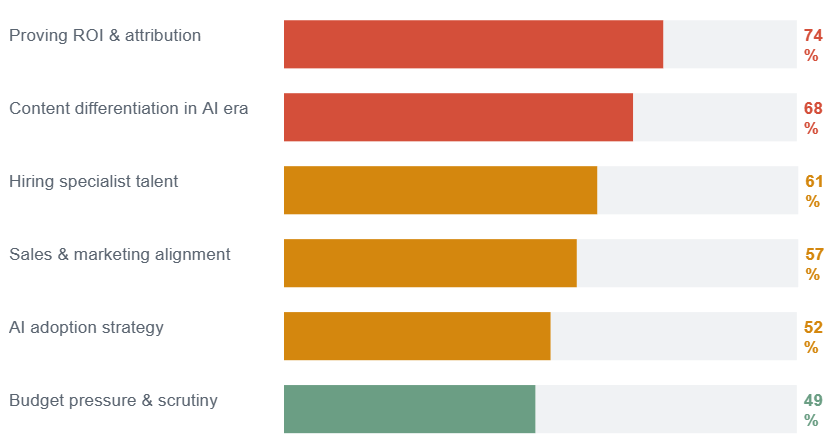
TOP MARKETING TEAM CHALLENGES, 2025

THE 2026 PLAYBOOK

What the highest-performing B2B tech marketers are doing differently

Across our top-quartile clients by pipeline efficiency, five behaviors consistently separate them from the rest. These are not tactics they are structural commitments that compound over time.

  1. Build owned audiences before you need them
    Top performers invest in newsletters, LinkedIn followings, and community building as infrastructure. Their cost per engaged prospect is 3.2× lower than peers relying solely on paid channels.
  2. Invest in genuine point of view, not just content volume
    The marketers outperforming on content have a clear editorial stance. AI handles drafting; human experts provide the insight. Their content earns shares and backlinks at 4.7× the rate of generic educational content.
  3. Make their people the brand’s most visible assets
    Founders, heads of product, and subject-matter experts who post regularly are generating an average of 34% of company pipeline through their personal LinkedIn audiences.
  4. Align brand and demand into one strategy
    Top performers run brand and demand as a single flywheel. They spend 54% of budget on brand and content, vs 31% for peers. Brand activity makes demand gen more efficient; demand gen data informs brand positioning.
  5. Use outbound as a conversation starter, not a lead factory
    The highest-converting outbound sequences combine warm social signals with highly personalised, low-volume outreach, 15–20 precision outreaches per week. Conversion rates are 4–8× industry average.

The B2B tech marketers winning in 2026 are not doing more. They are doing the right things consistently, with a genuine point of view, for an audience they have actually built. That combination is very hard to replicate at scale, and it gets harder every month that competitors delay starting.

– SAGE Marketing, 2026 Research Conclusion

METHODOLOGY

About this research

The State of B2B Tech Marketing report draws on proprietary data from Sage Marketing’s active client portfolio, supplemented by direct interviews with marketing leaders and analysis of published benchmarks from HubSpot, Demand base, LinkedIn Marketing Solutions, and The State of Brand (June 2026).

Data pointDetail
Client base150+ active B2B tech companies
Research periodJanuary 2024 – April 2026
Company stagesSeed to Series B
Primary marketsUK, US, EMEA
Industries covered14 B2B tech verticals
Qualitative interviews50 marketing leaders (CMO level and above)
External benchmarksHubSpot 2025, Demandbase 2025, LinkedIn, The State of Brand 2026

Disclosure
All client data is aggregated and anonymized. No individual company data is identifiable. Benchmarks referenced from third-party research are cited for directional comparison only.

About SAGE Marketing

SAGE Marketing is a global B2B tech marketing agency and HubSpot Diamond Partner, helping companies turn marketing into a structured, scalable growth engine. With experience working with over 150 B2B tech companies worldwide, we specialize in taking startups and growing companies from early traction to global expansion.

We operate as a true growth partner either as a CMO-as-a-Service or through focused, high-impact services combining strategic leadership with hands-on execution across the entire marketing funnel.

Our capabilities include go-to-market strategy, branding and messaging, demand generation, social media and thought leadership, HubSpot and RevOps implementation, AI and LLM visibility (GEO), content and SEO, as well as global events and tradeshows.

By aligning marketing with business goals and building the right infrastructure, we help companies generate pipeline, strengthen their market presence, and scale into international markets with confidence.

Sarit
Lamerovich
Founder/CEO
About
the author
Sarit founded SAGE to allow technology companies to take innovation to the next business level and fulfill the entrepreneur’s dream to change the world by building market recognition, increasinge customer awareness and improvinge the foundation for strong and sustainable revenue growth.
Learn more

The Future of Marketing in the Age of AI: 5 Trends Every B2B Marketer Should Watch in 2026

Sarit<br> Lamerovich
written by Sarit
Lamerovich
Founder/CEO

Sarit founded SAGE to allow technology companies to take innovation to the next business level and fulfill the entrepreneur’s dream to change the world by building market recognition, increasinge customer awareness and improvinge the foundation for strong and sustainable revenue growth.

Shlomit<br> Hertz
reviewed by Shlomit
Hertz
CMO-as-a-Service

Today, as CMO-as-a-Service at SAGE Marketing, Shlomit partners with technology companies to build powerful brands, accelerate demand generation, and connect innovation with results. Her approach is creative, data-driven, and always focused on what truly matters — turning strategy into measurable success.

15 min read
Share
Why Partner with SAGE Marketing?
100+ B2B tech companies and startups — we literally grow unicorns.
No office, no walls — we work inside your world, embedded in your team.
Full-stack marketing approach: strategy, storytelling, content, HubSpot and execution under one roof.
Let’s Build Something Remarkable!
Whether you’re launching, scaling, or rebranding —
we’ll help you connect,
engage, and grow.
Contact us
client logo client logo client logo client logo client logo client logo
AI Marketing B2B Marketing Marketing strategy start-ups

For most of the last decade, marketers have been obsessed with optimization.

We optimized funnels, attribution models, conversion rates, campaign performance, bidding strategies, automation workflows, customer journeys, and every measurable touchpoint in between. The promise was simple: if we could collect enough data and build sophisticated enough systems, marketing would become predictable. We would know exactly what worked, exactly what didn’t, and exactly where to invest the next dollar.

Then AI arrived and changed the rules almost overnight.

What once took months can now be done in minutes. Content can be generated instantly strongest drivers of attention. Research can be automated. Personalized campaigns can be created at scale. Sales teams can receive AI-generated insights before every customer conversation. Entire marketing departments are suddenly questioning which parts of their jobs will still exist five years from now.

The speed of change is difficult to comprehend. Former PayPal CEO Dan Schulman recently described AI as compressing one hundred years of progress into five years. Whether that estimate is precisely correct is almost irrelevant. What matters is that for the first time in decades, marketers are experiencing technological acceleration at a pace that feels genuinely uncomfortable.

Yet something fascinating is happening beneath all the headlines about AI.

As technology becomes more powerful, human psychology is becoming more important.

The more artificial content floods our feeds, the more valuable authenticity becomes. The more automated communication becomes, the more memorable genuine human experiences feel. The more predictable algorithms become, the more consumers crave surprise, emotion, connection, and meaning.

This creates an interesting paradox for marketers.

The future will undoubtedly be shaped by artificial intelligence, but the brands that thrive won’t necessarily be the ones with the most sophisticated AI stack. They will be the ones that understand how people think, feel, behave, and make decisions in a world that feels increasingly uncertain.

Because if there is one word that defines the current moment, it is uncertainty.

Economic uncertainty. Political uncertainty. Technological uncertainty. Professional uncertainty. Social uncertainty.

People are questioning what work will look like, how industries will evolve, which skills will remain relevant, and what role technology will ultimately play in their lives. This uncertainty influences far more than purchasing behavior. It influences attention, trust, emotion, memory, and the way people engage with brands.

When we analyze some of the most successful campaigns, fastest-growing brands, and strongest communities emerging today, we can see five distinct trends taking shape. While they may appear unrelated on the surface, they are all connected by one underlying force: the human response to uncertainty.

These trends are curiosity, experiences, humanity, creator-led influence, and nostalgia. Together they offer a glimpse into what marketing will look like in 2026 and why understanding people may become the most valuable competitive advantage in an AI-powered world.

TrendWhy It’s EmergingHuman Need It Addresses
CuriosityContent overloadDiscovery and anticipation
ExperiencesAdvertising fatigueMemorability
HumanityAI-generated abundanceAuthenticity
Creator-Led InfluenceDeclining trust in institutionsConnection
NostalgiaGrowing uncertaintyStability

Curiosity is Becoming Marketing’s Most Underrated Growth Engine

For years, marketers focused on providing answers. We built campaigns designed to explain, educate, and persuade. We created content that promised to solve problems and deliver clarity. While those approaches still matter, some of the most successful brands today have discovered that questions can be more powerful than answers.

Curiosity has become one of the strongest drivers of attention in modern marketing.

This may seem counterintuitive. After all, consumers are already overwhelmed with uncertainty. Why would they seek more of it?

The answer lies in the difference between threatening uncertainty and playful uncertainty.

People dislike uncertainty when it feels dangerous or uncontrollable. However, they are drawn to uncertainty when it feels exciting, entertaining, or rewarding. This explains why mystery has become such a powerful commercial tool.

Consider the extraordinary success of blind-box products. Consumers willingly purchase products without knowing exactly what they will receive. The phenomenon began decades ago with products such as Kinder Surprise, where the toy hidden inside the chocolate egg was often more exciting than the chocolate itself. Today, the same principle drives global brands across industries. Mystery-flavor campaigns from Fanta, limited-edition Oreo releases, surprise product drops, and collectible toys such as Labubu all tap into the same psychological trigger.

The product itself is no longer the entire value proposition. The anticipation becomes part of the experience.

What makes this particularly relevant for marketers is that curiosity works equally well in B2B environments. Many organizations assume curiosity belongs exclusively to consumer marketing, but human psychology does not suddenly change when someone enters the office.

One of the most effective examples comes from cybersecurity company Wiz, whose LinkedIn campaigns frequently outperform industry benchmarks by breaking traditional expectations. Instead of presenting another predictable security message, the company often creates curiosity gaps that compel professionals to engage. Rather than immediately satisfying the audience’s need for information, they create tension that audiences feel compelled to resolve.

This approach works because of several powerful psychological mechanisms. Curiosity creates an information gap that people naturally want to close. It activates a fear of missing out. It interrupts established behavioral patterns. Most importantly, it transforms passive audiences into active participants.

In a digital environment overflowing with content, curiosity may become one of the most effective ways to earn attention rather than simply buying it.

Experiences are Replacing Advertising

The second major trend shaping marketing is the shift from advertising to experience creation.

For decades, marketing largely revolved around communication. Brands created messages and distributed them through media channels. Success depended on how effectively those messages could be delivered to the right audience at the right time.

Today, that model is becoming less effective.

Consumers are exposed to thousands of marketing messages every day. Most are forgotten almost instantly. The problem is not necessarily the quality of the message. The problem is the sheer volume of competing messages.

As a result, brands are increasingly shifting from being advertisers to becoming experience providers.

The distinction is important.

Advertising creates awareness. Experiences create memories.

Awareness can disappear quickly. Memories remain.

This is why experiential marketing is evolving far beyond traditional events and physical activations. Experiences can be digital, emotional, entertaining, educational, or entirely virtual. What matters is not the format. What matters is whether people remember it.

One framework that is proving particularly effective is the idea of building the first-ever something for a specific audience.

The first-ever conference for a niche community. The first-ever tool solving a particular problem. The first-ever game, challenge, or interactive experience designed for a specific group of professionals.

People are naturally attracted to novelty because novelty creates conversation.

A remarkable B2B example comes once again from Wiz. Instead of publishing another cybersecurity report, the company launched CISOtopia, a fictional toy store designed exclusively for cybersecurity professionals. The website featured humorous fictional products tailored to the everyday frustrations of security leaders. The concept was clever, unexpected, and highly shareable.

Importantly, it wasn’t focused on selling software.

It was focused on creating delight.

That distinction explains why it generated significant attention across LinkedIn, Reddit, and other channels. The campaign succeeded because it delivered an experience rather than a promotion.

The lesson for marketers is becoming increasingly clear. In a world saturated with content, the brands that create memorable experiences will consistently outperform those that simply create more messages.

Humanity is Becoming a Competitive Advantage

Perhaps the most important trend of all is the growing value of humanity itself.

The rapid adoption of AI has created an unexpected market dynamic. As artificial content becomes abundant, authentic human connection becomes scarce.

And scarcity creates value.

For years, marketers pursued perfection. Every message was polished. Every visual was refined. Every customer interaction was carefully controlled. Today, consumers are becoming increasingly skeptical of anything that feels overly optimized.

People are looking for evidence that real humans still exist behind the brand.

They want personality. They want vulnerability. They want humor. They want emotion.

This explains why some of the most effective modern campaigns focus less on product benefits and more on human aspirations.

A powerful example comes from the email marketing startup Loops. Instead of competing on features, pricing, or technology, the company created a campaign around a dream shared by many startup founders.

For small startups, appearing on a Times Square billboard feels almost impossible. It represents visibility, validation, and success. Loops purchased billboard space and invited startup founders to place their logos on it for free.

The campaign had very little to do with email marketing.

Yet it generated meaningful conversations with exactly the audience the company wanted to reach.

Why?

Because it addressed a deeply human desire to be seen, recognized, and celebrated.

This represents a broader shift occurring across marketing. The most successful campaigns increasingly focus on helping audiences achieve emotional outcomes rather than simply functional ones.

In the age of AI, the brands that understand human aspirations may have a greater advantage than those with the most advanced technology.

The Creator Economy is Redefining What a Brand Actually is

One of the most profound changes happening in marketing today has very little to do with technology and everything to do with influence.

For decades, brands, publishers, and media companies controlled attention. If you wanted to reach an audience, you bought advertising from a newspaper, sponsored a television program, purchased billboard space, or ran campaigns through established media channels. Brands created messages, and media companies distributed them.

That model is rapidly disappearing.

Today, individuals can command audiences larger than traditional publishers. A single creator can influence millions of people across multiple platforms while building a deeper relationship with their audience than many global brands ever achieve.

This isn’t simply the rise of influencer marketing. It’s the rise of creator-led ecosystems.

The most successful creators are no longer individuals posting content. They have become media companies, production studios, communities, entertainment networks, and brands all at once.

This shift raises a fascinating question: What exactly is a brand in 2026?

Consider creators like Kai Cenat. He isn’t merely an influencer promoting products. He is the platform. He is the media channel. He is the distribution network. He is the entertainment company. Brands don’t simply advertise through him; they become part of the world he has created.

For marketers, this represents a fundamental shift in thinking.

Historically, media was something you rented.

Today, influence increasingly belongs to people rather than institutions.

This is one of the reasons major global brands are dramatically reallocating marketing budgets. Unilever has publicly announced significant increases in social-first investment. Estée Lauder continues expanding influencer partnerships. Nescafé and countless other global brands are prioritizing creator-led strategies.

These companies are not following a trend blindly. They are responding to a deeper reality.

People trust people.

In an age where AI-generated content is becoming increasingly common, audiences place greater value on voices that feel authentic, relatable, and human. Whether that trust is always justified is almost irrelevant. What matters is that audiences perceive creators as individuals rather than corporations.

For B2B organizations, this trend carries enormous implications.

For years, companies invested heavily in corporate pages while largely ignoring executive visibility. Today, many of the strongest-performing B2B brands understand that people want to buy from people, not logos.

A founder’s LinkedIn profile often generates more engagement than the company page.

A subject matter expert can become a powerful distribution channel.

Employees can become creators.

Communities can become media assets.

The companies that embrace this shift will build influence that cannot easily be replicated by competitors. Those that continue relying exclusively on traditional corporate communications may find themselves increasingly disconnected from how modern audiences consume information.

The future belongs to brands that understand how to empower human voices rather than replace them.

Nostalgia is Becoming a Strategic Marketing Tool

While AI pushes us toward the future, another force is quietly pulling consumers in the opposite direction.

That force is nostalgia.

At first glance, nostalgia might seem unrelated to technology, innovation, or modern marketing. Yet it has become one of the most influential emotional drivers shaping consumer behavior today.

Whenever societies experience periods of rapid change, people instinctively seek stability. They look for symbols, memories, and experiences that provide a sense of certainty.

And certainty is exactly what nostalgia offers.

When the future feels unpredictable, the past feels comforting.

This is why nostalgia is appearing everywhere.

We see it in entertainment, where classic franchises continue dominating box offices and streaming platforms.

We see it in fashion, where styles from previous decades return in endless cycles.

We see it in home entertainment, where board games, vinyl records, and analog experiences continue growing despite endless digital alternatives.

And we see it very clearly in branding.

One of the best examples comes from Burger King.

Several years ago, the company embraced a more modern visual identity designed for digital channels and contemporary audiences. The redesign was logical, clean, and aligned with prevailing design trends.

Yet it never fully resonated.

Eventually, Burger King made a surprising decision. Instead of moving further into the future, it moved backward.

The company reintroduced a refreshed version of its classic logo inspired by designs from previous decades.

The response was overwhelmingly positive.

Consumers described the new-old identity as warmer, friendlier, and more authentic. The logo didn’t simply represent a fast-food chain. It represented memories.

And memories are powerful.

This illustrates an important principle.

People rarely buy products because of colors, fonts, or logos.

They buy what those elements make them feel.

Nostalgia allows brands to access emotional territory that modern design often struggles to reach. It reconnects consumers with experiences they associate with safety, happiness, childhood, community, or belonging.

In many parts of the world, nostalgia has become even more powerful because of broader social dynamics.

Periods of political division, economic pressure, and technological disruption often create collective longing for an imagined version of the past. Whether that past truly existed is less important than the emotional comfort it represents.

This is why nostalgia repeatedly appears in political campaigns, cultural movements, and brand positioning.

It is not really about history.

It is about identity.

The brands that successfully leverage nostalgia understand this distinction. They do not simply recreate the past. They reinterpret it.

They use familiar symbols, aesthetics, and stories to create relevance in the present.

Done correctly, nostalgia becomes much more than a creative device. It becomes a way to help audiences feel grounded in a world that often feels unstable.

What These Trends Mean for B2B Marketing in 2026

Although many of the examples discussed originate from consumer brands, the underlying lessons apply equally to B2B organizations.

In fact, one could argue that B2B marketing is entering an especially interesting period because many of these trends remain underutilized.

Most B2B companies continue competing with remarkably similar messaging.

  • Every cybersecurity company promises protection.
  • Every SaaS platform promises efficiency.
  • Every AI company promises transformation.
  • Every technology vendor promises innovation.
  • As AI makes content creation easier, this problem will only intensify.

The internet will become flooded with increasingly similar content generated by increasingly similar tools.

The companies that stand out will not necessarily be those producing the most content.

They will be the companies producing the most memorable content.

  • The most human content.
  • The most emotionally resonant content.
  • The most surprising content.
  • This means marketers should begin asking different questions.

Instead of asking:

“How can AI help us create more content?”

Ask:

“How can AI help us create more meaningful experiences?”

Instead of asking:

“How do we automate more customer interactions?”

Ask:

“Which interactions should remain deeply human?”

Instead of asking:

“How do we optimize every touchpoint?”

Ask:

“How do we create moments people remember?”

The answers to those questions will determine which brands thrive over the next decade.

The Future of Marketing is Not AI Versus Humans

The conversation around AI often becomes unnecessarily polarized.

Some people view AI as the solution to every business challenge.

Others view it as an existential threat to creativity, marketing, and human work.

The reality is far more nuanced.

How AI is Reshaping Marketing

AI is already transforming marketing across multiple dimensions, enabling organizations to operate faster, personalize at scale, and extract insights that would have been impossible to uncover manually just a few years ago.

AreaImpact
Content CreationFaster production and localization of content
PersonalizationMore relevant customer experiences at scale
OperationsReduced manual work and increased efficiency
InsightsFaster analysis of customer and market data

However, while AI is becoming exceptionally good at increasing efficiency, it remains far less effective at understanding context, emotion, culture, and the complex motivations that drive human decision-making.

How B2B Marketers Can Prepare for 2026

  1. Invest in executive visibility.
  2. Build memorable experiences instead of more campaigns.
  3. Use AI to increase efficiency, not replace creativity.
  4. Develop content that sparks curiosity.
  5. Create systems that scale authenticity rather than eliminate it.

Sarit
Lamerovich
Founder/CEO
About
the author
Sarit founded SAGE to allow technology companies to take innovation to the next business level and fulfill the entrepreneur’s dream to change the world by building market recognition, increasinge customer awareness and improvinge the foundation for strong and sustainable revenue growth.
Learn more

SAGE Marketing Recognized for HubSpot Industry Excellence, Featured on Digital Agency Network

Why Partner with SAGE Marketing?
100+ B2B tech companies and startups — we literally grow unicorns.
No office, no walls — we work inside your world, embedded in your team.
Full-stack marketing approach: strategy, storytelling, content, HubSpot and execution under one roof.
Let’s Build Something Remarkable!
Whether you’re launching, scaling, or rebranding —
we’ll help you connect,
engage, and grow.
Contact us
client logo client logo client logo client logo client logo client logo

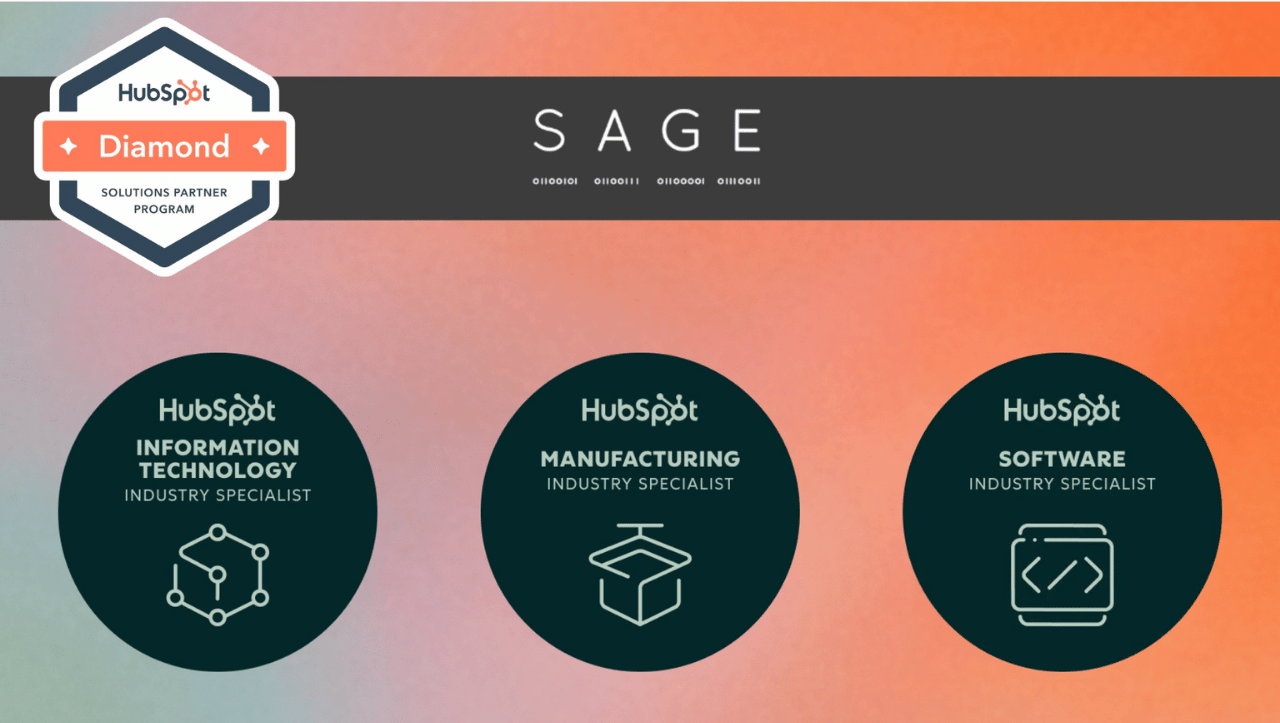
SAGE Marketing, a HubSpot Diamond Solutions Partner, has been recognized by HubSpot with three Industry Specialist Badges across Manufacturing, Software, and IT. This achievement highlights SAGE’s proven expertise in delivering high-impact HubSpot solutions for complex B2B organizations across technical and fast-evolving industries.

The Industry Specialist Badges are awarded to partners who demonstrate deep industry knowledge, strong implementation capabilities, and a consistent track record of delivering measurable business outcomes through HubSpot. Receiving three badges underscores SAGE’s cross-sector specialisation and its ability to support diverse enterprise needs at scale.

This recognition reflects SAGE Marketing’s focus on helping organizations unify marketing, sales, and customer data into scalable revenue operations systems. From CRM strategy and migrations to automation, integrations, reporting, and RevOps optimization, SAGE enables clients to turn HubSpot into a central growth engine.

The feature on Digital Agency Network further reinforces SAGE’s position as a trusted HubSpot partner for B2B companies in manufacturing, software, and IT seeking to improve efficiency, alignment, and growth through data-driven operations.

More details here.

The LinkedIn Playbook for Tech Start-ups: 10 Tips That Drive Visibility, Credibility, and Pipeline

Aliza Hughes
written by Aliza Hughes Head of Social Media

Aliza is a seasoned content and social media strategist with over a decade of experience humanizing B2B tech brands through organic growth and executive thought leadership.

Sarit<br> Lamerovich
reviewed by Sarit
Lamerovich
Founder/CEO

Sarit founded SAGE to allow technology companies to take innovation to the next business level and fulfill the entrepreneur’s dream to change the world by building market recognition, increasinge customer awareness and improvinge the foundation for strong and sustainable revenue growth.

7 min read
Share
Why Partner with SAGE Marketing?
100+ B2B tech companies and startups — we literally grow unicorns.
No office, no walls — we work inside your world, embedded in your team.
Full-stack marketing approach: strategy, storytelling, content, HubSpot and execution under one roof.
Let’s Build Something Remarkable!
Whether you’re launching, scaling, or rebranding —
we’ll help you connect,
engage, and grow.
Contact us
client logo client logo client logo client logo client logo client logo
LinkedIn Startups startups marketing Social Media

Key Takeaways

  • LinkedIn consistently outperforms other social platforms for early-stage B2B tech companies.
  • A strong foundation is what separates startups that build credibility from those that get scrolled past.
  • Content strategy for LinkedIn is about posting with a consistent angle that resonates with your ICP.
  • Meaningful engagement and strategic network growth convert connections into conversations, and conversations into pipeline.
  • SAGE Marketing helps early-stage B2B tech startups build a LinkedIn presence that converts, not just collects followers.

Why LinkedIn Is the Right Channel for Early-Stage B2B Tech Startups

Most early-stage tech startups either don’t know where to get started or spread themselves thin trying to show up everywhere at once. Spoiler: for B2B tech companies, one platform consistently delivers more than the rest: LinkedIn.

The reason is straightforward: LinkedIn is where your buyers actually are. According to LinkedIn’s own data, four out of five of its members drive business decisions. That is not a general audience you are hoping to convert. That is a platform designed specifically around professional identity, industry conversation, and business intent.

For early-stage companies, that context is everything. You are not trying to build a massive audience, you are trying to get in front of the specific operators, heads of, and decision-makers who already feel the problem you solve. Because LinkedIn’s network is organized around professional roles and industries, organic content naturally travels through those channels. You do not need a paid budget to reach relevant people. You need the right content and a presence that earns attention.

There is also a trust dynamic unique to LinkedIn. When a prospect sees your founder(s) posting thoughtfully about a problem in their industry, it builds credibility in a way that a cold email or a Google ad simply cannot. Content on LinkedIn performs as social proof at scale. When your network engages with a post, LinkedIn distributes into the feeds of their connections. Your content reaches people who have never heard of your startup, but it comes introduced by someone they already trust.

10 Tips That Drive Visibility, Credibility, and Pipeline

  1. Treat your profile(s) as a dynamic portfolio: Your LinkedIn profile doesn’t have to serve one audience forever. Update it based on your current goal, whether that’s attracting investors, winning customers, or hiring talent.
  2. Make sure your company page answers the question of what problem you solve: A prospect who lands on your page after seeing a post or receiving an outreach should immediately understand who you help and how.
  3. Optimize your founder profile for your audience: Your headline, summary, and featured section should speak directly to the world your ICP lives in. Buyers research founders before they respond to outreach, and first impressions form fast.
  4. Define your content angle before you think about cadence: A consistent perspective is what builds a following that trusts you over time. Two focused posts a week will outperform daily posting that wanders every time.
     
  5. Write posts that make the right reader feel seen: Problem-framing content that names a specific pain point with precision generates far more engagement than broad observations or product announcements. If your post could have been written by any company in any category, it’s too vague.
  6. Pick a tight community and show up there consistently: When the same name keeps appearing with something worth reading, people start to pay attention.
  7. Treat comments as seriously as original posts: A quality comment on a high-traffic post can generate hundreds or even thousands of impressions on its own, with the added advantage that the original poster and every other commenter sees it too. A few strong comments per day can match the visibility of an original post.
  8. But only comment when you’re adding something: Generic responses like “great point” or “totally agree” get ignored and can actually signal low quality to LinkedIn’s algorithm. A specific data point, a counterintuitive observation, or a short story that extends the conversation is what drives profile visits from the right people.
  9. Watch saves and sends, not just likes: Likes often mean your content is entertaining; saves and sends mean it’s genuinely useful. And for a B2B audience, useful is what builds trust and drives inbound interest. If you’re getting plenty of likes but few saves or sends, that’s a signal worth acting on.
  10. Build a strong network, not a big one: A hundred connections who recognize your name and trust your perspective will drive more pipeline than a thousand passive followers who never engage. The goal is a network where your content lands with people who are primed to care about what you do. 

The Foundation: Profile and Company Page Setup That Works

Before any content strategy makes sense, the foundation has to be in place. 

Your company page is often the first thing a prospect checks after a cold outreach, a referral, or a piece of content catches their attention. If it is sparse, generic, or visually inconsistent, the credibility gap widens immediately. A sharp company page communicates your value proposition in plain language with a clear answer to the question: what problem do you solve, and is it relevant to me?

That means your tagline and about section need to speak directly to your ideal customer profile. If you build compliance automation for mid-market fintech companies, say that. If you help logistics operations teams reduce manual work through integrations, say that. Brevity beats buzzwords at every stage, but especially for early stage startups still building recognition.

Founder and team profiles deserve the same attention. Your founder’s LinkedIn profile is arguably the most visited page in your company’s early LinkedIn presence. Buyers research founders. They look at experience, point of view, and signals of domain authority. A profile photo from 2015, a generic headline, and an empty featured section tells its own story – and not the one you want.

The practical fixes that matter on personal profiles: 

  • Update headlines to reflect your current role and value, not just your title. 
  • Write a summary that connects your background to why you built this company. 
  • Add a post to the featured section that links somewhere useful, like a product demo, a case study, or a recent article.

Visual consistency across the company page and team profiles also signals professionalism. Matching banner images, a consistent brand palette, and a clean logo treatment go further than most founders expect. Prospects are making fast judgments. The visual layer either builds or breaks trust in seconds.

This is the groundwork that makes every content investment more effective. Skip it, and even great content loses some of its impact.

One thing most founders don’t think about: your LinkedIn profile isn’t permanent, and it doesn’t have to serve only one audience. If you’re actively fundraising, your profile should lean toward signaling credibility to investors – emphasizing traction, vision, and category leadership. If your priority is pipeline, your profile should speak to your ICP’s daily pain.

The mistake isn’t optimizing for one or the other. It’s forgetting that you can switch back and forth. LinkedIn makes it easy to update. Most founders just don’t build the habit of asking: who am I trying to reach right now, and does this profile reflect that?

Content That Connects With B2B Decision-Makers

Now you’re thinking… “my foundation is solid but what do I actually post? 

The start-ups that build real traction on LinkedIn are not the ones posting the most. They are the ones posting with the clearest angle. 

Before thinking about formats or cadence, define your content perspective – the specific lens through which your company sees the problems your buyers face. That perspective, held consistently, is what builds a following that trusts you.

For early-stage B2B tech companies, a few content types tend to perform well: 

Founder-led insights – observations, opinions, and lessons drawn from direct experience – carry authority and authenticity that brand content rarely achieves. These posts feel human, they invite response, and they position the founder as someone worth knowing before any sales conversation starts.

Problem-framing content also resonates strongly with decision-makers. Posts that articulate a pain point with precision – the kind where a reader thinks “this is exactly what I deal with” – generate engagement and shares because they create recognition.

Customer and case stories, even brief ones, serve as social proof. A short post outlining what a customer was dealing with, what changed, and what the result was does more to build buyer confidence than a product feature announcement.

Data points, industry observations, and contrarian takes round out a content mix that keeps the feed interesting without requiring a full content team to execute. The key discipline is relevance. Every post should have a clear connection to the problems your ICP cares about. Posts that drift from that focus dilute the signal your content is building over time.

Consistency of angle matters more than consistency of volume. Two posts a week that stay on-topic outperform daily posting that wanders.

Building Strategic Visibility: Engagement and Network Growth

Posting well is only part of a Linkedin growth strategy. The other (some would argue even more important) part is how you show up in other people’s conversations.

LinkedIn’s algorithm rewards engagement, which means that commenting thoughtfully on posts from industry voices, potential buyers, and adjacent communities extends your reach significantly. A well-placed comment on a high-traffic post from someone in your target industry can introduce your perspective to thousands of people who have never seen your company page.

The comment itself matters more than most people realize. Generic agreements like “great point,” “totally agree,” “this is so important” get ignored. What drives visibility is a comment that adds something: a specific data point, a counterintuitive observation, a short story that extends the original post’s idea. Comments like that get replies, get likes, and signal to LinkedIn that the conversation is worth distributing further. They also signal to the person reading it that you’re someone worth knowing. 

What many people don’t realize is that a comment with strong engagement can accumulate hundreds or even thousands of impressions on its own. With one key difference: the original poster sees it, every other commenter sees it, and everyone who engaged with that post gets exposed to your name and point of view. A few quality comments per day can generate as much visibility as posting original content!

Network growth follows the same logic. Adding connections strategically – founders in adjacent spaces, operators in your target vertical, analysts who cover your category – builds the audience that will actually see and amplify your content. The goal is not a large, passive network. It is a smaller, more engaged one where your name carries recognition. A hundred connections who know what you do and trust your perspective will drive more pipeline than a thousand who accepted your request and never looked at your profile again.

The framing that matters here is turning connections into conversations. Follower counts are not pipeline. A smaller, more engaged network of people who recognize your name and trust your perspective will drive more business than a large, passive audience that never interacts. Start-up Linkedin marketing done well is relationship-first, not broadcast-first.

Measuring What’s Working (Without Getting Distracted by Vanity Metrics)

Follower count is easy to watch. It is also one of the least useful metrics for an early-stage start-up trying to understand whether its LinkedIn activity is actually moving the business forward.

The metrics that tell a real story are more specific and more honest.

Engagement rate over impressions. A post reaching 200 people with 15 comments is more valuable than one reaching 2,000 with 5 likes. Impressions tell you how far content traveled. Engagement rate tells you whether it landed.

Saves and sends are the most underrated signals on the platform. A save means someone bookmarked the post to return to later. A send means they forwarded it directly to a colleague. Both are strong indicators of genuine utility, and LinkedIn’s algorithm treats them as such, using them as signals to keep distributing content to a wider audience.

But the more important implication is strategic. If your posts are getting lots of likes but few saves or sends, that’s a meaningful signal about your content angle. Likes often mean entertaining. Saves and sends mean useful. For a B2B audience, useful is what builds trust, drives return visits, and eventually generates inbound interest. A content strategy optimized for likes can feel like it’s working while quietly missing the people you actually want to reach.

Profile views are worth tracking for a different reason. A spike in profile views after a specific post tells you that content resonated enough to prompt research. That’s a prospect moving from passive reader to active interest. Pay attention to which posts trigger that pattern. It tells you more about what your ICP cares about than any engagement metric will.

Inbound connection requests from within your ICP are another signal the system is working. When prospects start reaching out rather than the other way around, your content is doing its job.

Over time, the most important measure is the link between LinkedIn activity and pipeline. That means tracking where inbound leads are coming from, noting whether prospects mention a post during early conversations, and paying attention to whether deals with LinkedIn-active prospects close differently than cold outbound. These connections are harder to quantify but they tell the real story. A LinkedIn strategy that is working shows up in conversations, in inbound interest, and eventually in revenue.

FAQ

How often should an early-stage startup post on LinkedIn to see results?

One to two times per week is a realistic and effective cadence for most early-stage teams. Consistency matters more than volume. Posting regularly with a clear, relevant angle builds more traction over time than bursts of high-frequency content followed by long gaps. Quality and focus should drive the schedule, not an arbitrary posting target. This is true for both company pages and personal profiles.

Should the founder or the company page be the main LinkedIn voice for a B2B startup?

For early-stage companies, the founder’s personal profile almost always outperforms the company page on reach and engagement. People connect with people. The company page still matters for credibility and discoverability, but the founder’s voice builds trust faster. Ideally, both work together: founder posts drive visibility, the company page reinforces legitimacy.

What types of LinkedIn posts drive the most engagement for B2B tech companies?

Posts that frame a specific problem your buyers recognize tend to generate the strongest engagement. Personal experience and founder perspective outperform promotional content consistently. The common thread is relevance to your ICP’s actual day-to-day challenges – content that makes the right reader feel seen.

How long does it take for a LinkedIn strategy to show measurable results for a startup?

Expect a meaningful signal within 60 to 90 days of consistent, focused activity. Early indicators include increased profile views, inbound connection requests from your ICP, and engagement on content. Pipeline impact typically takes longer – three to six months is a realistic window for a linkedin content strategy to begin influencing inbound conversations and buyer awareness.

Aliza Hughes Head of Social Media
About
the author
Aliza is a seasoned content and social media strategist with over a decade of experience humanizing B2B tech brands through organic growth and executive thought leadership.
Learn more

Startup Demand Generation Playbook: From Awareness to Sales-Ready Leads

Shlomit<br> Hertz
written by Shlomit
Hertz
CMO-as-a-Service

Today, as CMO-as-a-Service at SAGE Marketing, Shlomit partners with technology companies to build powerful brands, accelerate demand generation, and connect innovation with results. Her approach is creative, data-driven, and always focused on what truly matters — turning strategy into measurable success.

Sarit<br> Lamerovich
reviewed by Sarit
Lamerovich
Founder/CEO

Sarit founded SAGE to allow technology companies to take innovation to the next business level and fulfill the entrepreneur’s dream to change the world by building market recognition, increasinge customer awareness and improvinge the foundation for strong and sustainable revenue growth.

10 min read
Share
Why Partner with SAGE Marketing?
100+ B2B tech companies and startups — we literally grow unicorns.
No office, no walls — we work inside your world, embedded in your team.
Full-stack marketing approach: strategy, storytelling, content, HubSpot and execution under one roof.
Let’s Build Something Remarkable!
Whether you’re launching, scaling, or rebranding —
we’ll help you connect,
engage, and grow.
Contact us
client logo client logo client logo client logo client logo client logo
blogs startups marketing lead generation startups in uk

Key Takeaways

  • Demand generation ≠ lead generation. Demand gen creates market-wide awareness and intent; lead gen captures it. You need both, in that order.
  • Startups waste budget by skipping the top of funnel. Focusing only on conversion tactics means you’re constantly fishing the same small pond.
  • Your demand gen tactics should match your stage. What works at pre-seed looks nothing like what works at Series B.
  • The metrics that matter are pipeline and revenue, not impressions, clicks, or even MQL volume in isolation.
  • Demand gen compounds over time. The content, trust, and brand equity you build today lowers your cost-per-pipeline-dollar for years to come.

There’s a moment every B2B startup knows well. You’ve built something genuinely valuable. Your early customers love it. But the pipeline is thin, sales cycles feel unpredictable, and you’re not entirely sure why some months are great, and others feel like shouting into a void.

The answer is almost always the same: your demand generation strategy isn’t working yet, or it doesn’t exist.

This playbook is designed to fix that. Whether you’re pre-Series A or scaling toward Series C, here’s everything you need to know about building a demand gen engine that creates pipeline, not just noise.

What Is Demand Generation (And Why Startups Get It Wrong)

Let’s start with a definition that matters in practice. Demand generation is the set of marketing activities that create awareness, build buyer preference, and drive qualified pipeline across the entire buyer journey, not just at the point of capture. Lead generation is a subset of that: the tactical work of converting known interest into a contact record. An MQL (Marketing Qualified Lead) is someone who’s shown enough intent to be worth a follow-up. An SQL (Sales Qualified Lead) is someone the sales team has validated as a real opportunity.

Most startups collapse all of these into one bucket and call it “marketing.” The result? They spend heavily on paid search and gated eBooks, pull in a few hundred form fills, and then wonder why barely any of them turn into real pipeline. The problem isn’t the tactics, it’s that they’re only fishing at the bottom of a funnel they haven’t actually built. True demand gen for startups means doing the upstream work first: getting your ICP to know you exist, understand why you’re different, and trust that you can solve their problem before they ever fill out a form. Think of it this way: if lead gen is harvesting, demand gen is farming. You can’t harvest what you haven’t grown.

The Startup Demand Gen Funnel: Stages and What to Do at Each

A B2B demand generation funnel isn’t a straight line – it’s a system. Here’s how to think about each stage and what your job is at every step.

Top of Funnel (Awareness)

At TOFU, your buyers don’t yet know you exist, or they know of you but haven’t formed any real opinion. The goal here isn’t conversions, it’s familiarity and framing. You want the right people (your ICP) to associate your brand with the problem you solve.

What to do: Publish high-value thought leadership on LinkedIn. Build an SEO content programme targeting informational queries your buyers are actively Googling. Consider podcast sponsorships or co-marketing with complementary tools. Run brand-awareness campaigns on LinkedIn or Meta with short, insight-led creative, not product demos. The rule at TOFU: be useful before you’re promotional.

In a crowded B2B landscape, the startups that win on demand gen aren’t always the ones with the biggest budgets – they’re the ones with the boldest ideas. Creativity isn’t a nice-to-have in your demand gen playbook; it’s a competitive differentiator. When every competitor is running the same LinkedIn carousel ads, gating the same ebooks, and sending the same “just checking in” sequences, the bar for standing out is genuinely low. The startups that break through are the ones willing to experiment an unexpected content format, a campaign built around a sharp contrarian take, a webinar that entertains as much as it educates, or a piece of original research that gets shared because it actually says something new. Out-of-the-box ideation isn’t about being creative for creativity’s sake; it’s about giving your ICP a reason to stop scrolling, pay attention, and remember you. In demand gen, memorable is measurable – it shows up in your brand search volume, your email open rates, your social engagement, and ultimately, your pipeline. 

Why it matters for startups especially: Enterprises can lean on brand recognition. You can’t. TOFU is where you start closing that gap.

Middle of Funnel (Consideration)

Buyers at MOFU are problem-aware and solution-curious. They’re comparing approaches, reading reviews, and trying to understand what “good” looks like. Your job is to make sure you’re in that consideration set, and that you’re positioned better than the alternatives.

What to do: Create comparison content and ROI-focused case studies. Run targeted retargeting campaigns to website visitors. Build email nurture sequences that don’t just pitch but educate. Host webinars that tackle real problems in your space. This is also where strong B2B messaging pays dividends – buyers need to feel that you get their world.

Bottom of Funnel (Decision)

BOFU buyers are ready to choose. They’ve done their research. Now they’re evaluating vendors and looking for reasons to trust, or disqualify.

What to do: Make your demo request process frictionless. Build competitive comparison landing pages. Use social proof heavily such as: customer quotes, case studies, G2 badges. Offer ROI calculators or free pilots where appropriate. Arm your sales team with content that addresses the final objections that live between MQL and closed-won.

The critical insight: BOFU volume is a lagging indicator of your TOFU work. The pipeline you’re closing in Q3 is the awareness you built in Q1. Startups that only invest in BOFU are mortgaging their future pipeline.

Demand Gen Tactics Ranked by Startup Stage

Not every tactic makes sense at every stage. Here’s a practical breakdown of what to focus on – and what to expect.

Pre-Seed to Seed (0–18 months)

Timeline to results: 6–12 months for meaningful inbound traction Expected MQL volume: Low (10–30/month is realistic and healthy) Budget: $5K–$15K/month ROI indicators: Branded search volume growth, direct traffic, reply rates on outbound improving

At this stage, your job is to establish a point of view in the market. Focus on founder-led content on LinkedIn, 2–3 high-quality SEO blog posts per month, and a clean nurture sequence for anyone who opts in. Don’t spread thin across every channel. Pick one social platform and own it. Build your positioning before you scale any paid media.

Series A (18 months–3 years)

Timeline to results: 3–6 months to see paid channel contributions Expected MQL volume: 50–150/month Budget: $20K–$60K/month ROI indicators: MQL-to-SQL conversion rate, cost-per-MQL, pipeline created from marketing

This is where you start diversifying. Introduce LinkedIn paid campaigns targeting your ICP with a mix of awareness and conversion-focused creative. Launch a webinar series or partner with analysts in your space. Invest in mid-funnel content such as: case studies, comparison guides, ROI tools. Start building an ABM (Account-Based Marketing) programme for your top-tier target accounts alongside your broad demand gen motion.

Series B and Beyond

Timeline to results: Optimisation cycles of 30–60 days Expected MQL volume: 200–500+/month Budget: $80K–$250K+/month ROI indicators: Pipeline coverage ratio, win rate by channel, revenue attributed to marketing

At Series B, the question shifts from “does our demand gen work?” to “how do we scale what’s working?” This is the stage for full-funnel paid programmes, intent data tools (like Bombora or 6sense), aggressive ABM targeting named accounts, and deep sales-marketing alignment on pipeline metrics. A specialist B2B demand generation agency or dedicated demand gen function becomes essential here.

How Demand Gen Success Is Measured

This is where too many startups go wrong: they track the wrong things, feel good about the wrong numbers, and then can’t explain why the pipeline is still thin.

The Metrics That Actually Matter

MQL Volume – How many marketing-qualified leads are you generating each month? This is a directional metric, not a success metric on its own.

MQL-to-SQL Conversion Rate – Of the MQLs you’re generating, how many does sales actually want to work? This number tells you whether your demand gen is attracting the right people or just filling the top of the funnel with noise. Industry benchmarks vary, but a healthy B2B startup should be aiming for 20–40%.

Pipeline Generated from Marketing – The dollar value of opportunities that originated from, or were influenced by, marketing activity. This is the number your CFO cares about.

Revenue Attributed to Marketing – What percentage of closed-won revenue can be traced back to marketing touches? This is the ultimate test of whether your startup demand generation strategy is working.

CRM tools like HubSpot make this tangible: by tracking multi-touch attribution across your campaigns, emails, and content, you can see exactly which marketing activities are generating pipeline and which are burning budget without impact – so you can double down on what works and cut what doesn’t.

The Common Mistake: Vanity Metrics

Clicks. Impressions. Follower counts. These metrics feel good to report, but they tell you nothing about pipeline health. The classic trap is a startup that celebrates 50,000 LinkedIn impressions while their MQL-to-SQL rate sits at 8% and sales is complaining about lead quality. Track what moves revenue, not what looks good in a slide deck.

A Simple Framework for Tying Demand Gen to Revenue

Start with your revenue target and work backwards:

  1. Revenue goal → Pipeline needed (divide by your average close rate)
  2. Pipeline needed → SQLs needed (divide by average deal size)
  3. SQLs needed → MQLs needed (divide by MQL-to-SQL conversion rate)
  4. MQLs needed → channel mix and budget required

This framework turns demand gen from a cost centre conversation into a growth investment conversation, and it gives you a clear, defensible way to present marketing’s contribution. If you’re building this infrastructure from scratch, SAGE Marketing’s guide to building a lead generation machine is a strong companion resource.

FAQ

What is demand generation vs lead generation?

Demand generation is the broader strategy of creating market awareness, building brand preference, and nurturing buyers across the full funnel long before they raise their hand. Lead generation is the tactical layer focused on capturing that interest as a named contact. You need demand gen to make lead gen sustainable. Without it, you’re only harvesting from an ever-shrinking pool of in-market buyers.

How much should a startup spend on demand gen?

There’s no universal answer, but a useful rule of thumb for B2B startups is to allocate 10–20% of ARR to marketing, with demand gen accounting for 40–60% of that budget. At seed stage, this might mean $8K–$15K/month. At Series A, $25K–$60K/month. The more important question isn’t how much, it’s whether you’re spending on the right mix of awareness, consideration, and conversion.

How long does demand gen take to show results?

Longer than most founders want to hear. Paid channels can show early signals in 60–90 days. Organic and content-led strategies typically take 6–12 months to build meaningful momentum. ABM programmes need at least one full quarter before drawing conclusions. This is why starting early matters: the startups that invest in demand gen at Series A are the ones with compounding pipeline advantages at Series B.

What channels work best at different startup stages?

Early stage: LinkedIn organic (founder content), SEO content, targeted outbound with demand gen support. Growth stage: LinkedIn paid, email nurture, webinars, retargeting, and selective ABM. Scale stage: full-funnel paid, intent data platforms, channel partnerships, and analyst relations. The universal truth across all stages: pick fewer channels and do them well before expanding.

Ready to Build a Demand Gen Engine That Actually Works?

The startup demand gen playbook isn’t complicated in theory — but it requires the right strategy, the right sequencing, and consistent execution to deliver results. The startups that figure this out early build a compounding advantage that’s genuinely hard for competitors to replicate.

At SAGE, we specialise in B2B demand generation and ABM for tech startups from seed through Series C. Whether you’re building your demand gen programme from scratch or trying to fix a funnel that’s underperforming, we help you build the strategic foundation, execute the right tactics at the right stage, and measure what matters with the right tools.

Let’s talk about your demand gen strategy

Shlomit
Hertz
CMO-as-a-Service
About
the author
Today, as CMO-as-a-Service at SAGE Marketing, Shlomit partners with technology companies to build powerful brands, accelerate demand generation, and connect innovation with results. Her approach is creative, data-driven, and always focused on what truly matters — turning strategy into measurable success.
Learn more

Most Effective Data-Driven Marketing Strategies for FinTech Startups

Shlomit<br> Hertz
written by Shlomit
Hertz
CMO-as-a-Service

Today, as CMO-as-a-Service at SAGE Marketing, Shlomit partners with technology companies to build powerful brands, accelerate demand generation, and connect innovation with results. Her approach is creative, data-driven, and always focused on what truly matters — turning strategy into measurable success.

Sarit<br> Lamerovich
reviewed by Sarit
Lamerovich
Founder/CEO

Sarit founded SAGE to allow technology companies to take innovation to the next business level and fulfill the entrepreneur’s dream to change the world by building market recognition, increasinge customer awareness and improvinge the foundation for strong and sustainable revenue growth.

10 min read
Share
Why Partner with SAGE Marketing?
100+ B2B tech companies and startups — we literally grow unicorns.
No office, no walls — we work inside your world, embedded in your team.
Full-stack marketing approach: strategy, storytelling, content, HubSpot and execution under one roof.
Let’s Build Something Remarkable!
Whether you’re launching, scaling, or rebranding —
we’ll help you connect,
engage, and grow.
Contact us
client logo client logo client logo client logo client logo client logo
Cmo as a service startups marketing lead generation

Key Takeaways

  • A data-driven marketing strategy lets FinTech startups pinpoint exactly which channels, messages, and audiences drive growth – eliminating costly guesswork.
  • Trust is the core currency in FinTech; content and personalization strategies built on behavioral data are among the most powerful tools for earning it.
  • B2B FinTech marketing demands account-level intelligence – firmographic and intent data are essential for targeting decision-makers with precision.
  • Tracking the right KPIs (CAC, LTV, MQL-to-SQL rate, and pipeline velocity) is non-negotiable for scaling FinTech marketing programs efficiently.
  • Startups don’t need an enterprise budget to run sophisticated data-driven marketing – the right stack of lean, integrated tools is more than enough.

In the FinTech space, every marketing decision carries real financial weight. Budgets are tight, regulatory scrutiny is high, competition is fierce, and the cost of getting it wrong – whether that’s chasing the wrong audience or spending on channels that don’t convert – compounds fast. For FinTech startups trying to carve out market share, gut instinct is not a strategy. Data is.

This guide breaks down the most effective data-driven marketing strategies available to FinTech startups today: what they are, why they work, how to measure them, and how to build the infrastructure to run them without draining your runway.

What Is Data-Driven Marketing for FinTech Startups?

Data-driven marketing is the practice of using customer data, behavioral analytics, and performance metrics to inform every stage of the marketing process – from audience segmentation and channel selection to creative testing and campaign optimization. Rather than relying on broad assumptions about what might resonate, data-driven marketers build strategies on evidence: who is engaging, where, when, and why.

For FinTech startups specifically, data-driven marketing is not a luxury – it is the prerequisite for survival. FinTech operates in one of the highest-stakes marketing environments across any sector. Customer acquisition costs in FinTech tech solutions can exceed $700 per user. Trust is harder to build and easier to lose than in almost any other industry. Products are complex, regulated, and often difficult to differentiate at first glance. A strong FinTech marketing strategy grounded in data allows startups to move beyond generic messaging, identify their highest-value segments early, and allocate limited resources toward the channels and tactics that actually convert. Without it, startups are competing on hope in a space where precision wins.

Why FinTech Startups Can’t Afford to Market Without Data

Marketing without data in the FinTech space is not just inefficient, it is actively irresponsible to growth. When startups rely on intuition instead of insight, they tend to overbuild on brand awareness campaigns that feel impressive but produce no measurable pipeline. They invest in channels because a competitor appears to be there, rather than because the data supports it. They create content for audiences that were never their buyers. The result is a slow, expensive drain on marketing budgets with little to show for it at the board level.

Beyond wasted spend, there is a deeper cost: the missed opportunity to understand the customer journey. FinTech buyers – whether individual consumers or enterprise CFOs – go through complex, multi-touch decision processes. Without data stitching those touchpoints together, startups cannot see what is actually driving conversions, which means they cannot replicate their wins or fix their leaks. A Fintech startup marketing program without data has no feedback loop. And in a category where growth compounds on efficiency, that feedback loop is everything.

Top Data-Driven Marketing Strategies for FinTech Startups

The strategies below are frameworks and approaches that high-performing FinTech marketing teams are actively using to acquire customers, build pipeline, and grow efficiently. Each one is rooted in data, executable on a startup budget, and directly applicable to both consumer and B2B FinTech marketing contexts.

1. Behavioral Segmentation and Precision Audience Targeting

The days of building a campaign around a job title and a geography and hoping the right person sees it are over. Modern FinTech buyers are too sophisticated, and the competition too well-funded, for broad-brush targeting to move the needle. Behavioral segmentation allows startups to build audience cohorts based on how users behave, the pages they visit, the features they engage with, the content they consume, the emails they open, and the moments they drop off. When layered with firmographic data (for B2B) or demographic signals (for B2C), it becomes one of the most precise and cost-efficient targeting approaches available to any growth-stage team.

In practice, this means using your CRM, marketing automation platform, and website analytics to build dynamic segments that evolve as user behavior evolves. A prospect who has visited your pricing page three times in two weeks is a fundamentally different conversation than one who downloaded a whitepaper six months ago and went quiet. Treating them identically wastes budget and kills relevance. Data-driven segmentation ensures every audience receives messaging calibrated to where they are in the decision journey – which translates directly into higher engagement, lower CAC, and better conversion rates across every channel.

2. SEO/ GEO – AI Driven Content Marketing

In FinTech, content is a trust mechanism. Financial products require education and decision-makers want to understand before they commit. SEO-led content marketing allows startups to capture high-intent search traffic from buyers who are actively researching solutions, and to build authority in a space where credibility is everything.

This now means showing up in two places: traditional search engines and AI-powered answers. As more buyers turn to tools like ChatGPT, Claude, and Perplexity to research financial solutions, your content needs to be what these models surface and cite. GEO (Generative Engine Optimisation) is the emerging discipline of structuring content so it performs in both environments – clear entity definitions, direct answers to specific questions, and presence on high-authority domains that AI models learn from and retrieve.

A data-driven content strategy means using keyword research, competitor gap analysis, and search intent data to build content that answers the specific questions your ideal customer is asking. This goes beyond publishing blogs. It means mapping content to the full funnel: from awareness articles that bring new audiences in, comparison and use-case pages that support evaluation, and ROI-focused case studies that close deals. When you track content performance at the keyword, page, and conversion level, you can double down on what is working and ruthlessly cut what is not. For more on how to build this engine, see our guide on how to build a data-driven content strategy.

3. Account-Based Marketing (ABM) for B2B FinTech

For B2B FinTech startups targeting enterprise or mid-market clients such as; banks, insurance companies, payment departments, or CFOs and other related finance executives; account-based marketing is arguably the highest-ROI strategy available. Rather than casting a wide net and hoping qualified leads appear, ABM flips the model: you identify a defined list of target accounts, build deep intelligence on them, and coordinate highly personalized outreach across channels.

Data is what makes ABM work at scale. Intent data platforms (such as Bombora or G2) reveal which companies are actively researching solutions like yours. Firmographic data helps you prioritize accounts by size, industry, and growth stage. Engagement data from your own website shows you which companies are already in your orbit. Together, these signals allow your sales and marketing teams to focus energy where it is most likely to pay off, and to personalize outreach with the kind of specificity that cuts through inbox noise. For a deeper look at building this pipeline systematically, see our article on building a lead generation machine.

4. Personalized Email and Lifecycle Marketing

Email remains one of the highest-ROI channels in FinTech marketing, particularly for nurturing leads through long and complex sales cycles. But the key word is personalized. Generic email blasts the same message sent to your entire list will produce diminishing returns and damage deliverability. Data-driven lifecycle marketing means building automated email sequences that respond to user behavior in real time.

When a prospect downloads a guide, they receive a follow-up tailored to that topic. When a trial user hasn’t logged in for five days, they receive a re-engagement sequence. When an enterprise lead from a target account visits your enterprise pricing page, sales is alerted and marketing sequences escalate. Every trigger, every message, and every send time is informed by data, and the result is a marketing program that feels genuinely useful to the recipient rather than intrusive. This is how FinTech startups build the trust they need to convert sophisticated buyers.

5. Paid Media with Closed-Loop Attribution

Paid acquisition is expensive in FinTech, which makes closed-loop attribution the ability to track exactly which ad, campaign, or channel produced a customer. Without it, you are optimizing toward vanity metrics: clicks, impressions, and cost per lead that may have no relationship with actual revenue.

A data-driven approach to paid media starts with connecting your ad platforms (Google, LinkedIn, Meta) to your CRM so that conversions are tracked all the way through to closed-won revenue. It means using UTM parameters, building multi-touch attribution models that reflect how your buyers behave, and running structured A/B tests on creative and messaging rather than making changes based on feel. When you know which campaigns are producing pipeline and which are burning budget, you can reallocate spend with confidence and make a compelling case for increased investment when the numbers support it.

6. Brand Positioning as a Growth Lever

Data-driven marketing is not only about performance channels. Brand positioning is the story you tell about who you are, who you are for, and how you can help – is one of the most powerful and underused growth levers in FinTech startup marketing. Startups that define a sharp, differentiated position in the market attract better-fit customers, command more trust, and reduce the friction in every downstream marketing motion.

Data plays a critical role here too: win/loss analysis, customer interviews, NPS data, and competitive research all feed into a positioning strategy grounded in reality rather than aspiration. When your messaging reflects exactly what your best customers value about you, everything else – content, paid media, sales enablement – becomes more effective. For a structured approach to this, our guide on B2B brand positioning is worth reading alongside this one.

How to Measure Your FinTech Marketing Performance

Tracking the right metrics is what separates a marketing team that grows from one that simply spends. For FinTech startups, these are the KPIs that matter:

  • Customer Acquisition Cost (CAC): Total marketing and sales spend divided by new customers acquired. The single most important efficiency metric.
  • Customer Lifetime Value (LTV): Projected revenue per customer over the full relationship. The LTV:CAC ratio tells you whether your acquisition economics are sustainable.
  • MQL to SQL Conversion Rate: The percentage of marketing-qualified leads that become sales-qualified. A low rate signals a targeting or qualification problem.
  • Pipeline Velocity: How quickly leads move through the funnel. Slower velocity often points to messaging gaps or misalignment between marketing and sales.
  • Organic Traffic and Keyword Rankings: For content-heavy programs, these indicate the long-term compounding value of SEO investment.
  • Email Engagement Rates (Open, Click, Reply): A signal of relevance and list quality.
  • Return on Ad Spend (ROAS) by Channel: Essential for reallocating paid budgets toward highest-performing channels.
  • Churn Rate: In subscription-based FinTech models, marketing cannot outrun a leaky bucket. Retention metrics belong in every marketing dashboard.

How to Build a Data-Driven Marketing Stack on a Startup Budget

You do not need an enterprise marketing budget to run a data-driven program. What you need is the right combination of integrated tools each one earning its keep and a commitment to keeping your data clean and connected.

CRM: HubSpot is the most practical starting point for most FinTech startups. It connects marketing, sales, and customer data in one place and makes attribution far simpler.

Website Analytics: Google Analytics 4 is free and, when configured correctly with conversion tracking and funnel visualization, is more powerful than most startups use it for. For product-led companies, Mixpanel or Amplitude offer deeper behavioral analytics.

Marketing Automation: HubSpot’s marketing tools cover most needs at the startup stage. For more sophisticated email and lifecycle programs, ActiveCampaign offers strong functionality at a competitive price point.

SEO and Content Intelligence: Ahrefs or Semrush for keyword research, competitor analysis, and content gap identification. Both offer startup-accessible pricing tiers.

Intent Data (B2B): G2 Buyer Intent or a basic Bombora subscription gives ABM programs the signal layer they need to prioritize outreach without wasting sales time.

Attribution: UTM parameters in every link, combined with HubSpot’s built-in attribution reporting, is sufficient for most early-stage programs. As you scale, tools like Triple Whale or Northbeam can add multi-touch sophistication.

Ad Platforms: LinkedIn for B2B FinTech targeting by title and company; Google for high-intent search capture; Meta for retargeting and awareness plays in B2C contexts. Also worth investigating online FinTech journals.

The key is integration. Siloed tools produce siloed data. When your CRM, analytics, automation, and ad platforms share data consistently, you gain the connected view of the customer journey that makes every strategy on this list work harder. For more on how top-tier B2B marketing agencies for FinTech companies approach this, the comparison in that guide is a useful reference.

FAQ

What is data-driven marketing and how does it differ from traditional marketing?

Data-driven marketing uses customer data, behavioral analytics, and performance metrics to guide strategy and creative decisions at every stage. Traditional marketing relies more heavily on intuition, broad demographics, and channel conventions. The difference is precision: data-driven programs can identify which specific tactics are producing revenue and optimize accordingly, rather than spreading budget across what feels right.

Which marketing channels work best for FinTech startups?

It depends on your model. B2B FinTech startups typically see the strongest ROI from SEO-led content, LinkedIn advertising, and ABM. B2C FinTechs often find success with paid search (Google), influencer partnerships, and community-building. The most important step is running disciplined channel experiments early and following the conversion data, not assumptions about where your audience should be.

How much should a FinTech startup spend on marketing?

Most early-stage B2B FinTech startups allocate between 15% and 25% of ARR to marketing, with a heavier weighting toward content and organic in the early stages to build durable assets. Paid spend should scale only once you have a clear view of your CAC and LTV. Spending more without attribution infrastructure in place accelerates waste, not growth.

What content formats perform best in FinTech marketing?

Long-form SEO articles, data-driven reports, customer case studies, and ROI calculators consistently outperform in FinTech. Buyers are sophisticated and risk-averse – they want evidence, not enthusiasm. In B2B specifically, case studies and comparison content targeting high-intent search queries tend to drive the strongest pipeline contribution.

How long does it take to see results from a data-driven FinTech marketing strategy?

Paid channels can deliver results within weeks, but often at high initial CAC while optimization cycles run. SEO and content programs typically require three to six months to build meaningful organic traffic. ABM and lifecycle programs deliver results on a timeline aligned to your sales cycle – which in enterprise FinTech can be six to eighteen months. The compounding effect of data-driven programs means early investment pays disproportionate dividends over time.

Shlomit
Hertz
CMO-as-a-Service
About
the author
Today, as CMO-as-a-Service at SAGE Marketing, Shlomit partners with technology companies to build powerful brands, accelerate demand generation, and connect innovation with results. Her approach is creative, data-driven, and always focused on what truly matters — turning strategy into measurable success.
Learn more

The 8 Best Organic Reddit Marketing Agencies of 2026

Aliza Hughes
written by Aliza Hughes Head of Social Media

Aliza is a seasoned content and social media strategist with over a decade of experience humanizing B2B tech brands through organic growth and executive thought leadership.

Sarit<br> Lamerovich
reviewed by Sarit
Lamerovich
Founder/CEO

Sarit founded SAGE to allow technology companies to take innovation to the next business level and fulfill the entrepreneur’s dream to change the world by building market recognition, increasinge customer awareness and improvinge the foundation for strong and sustainable revenue growth.

7 min read
Share
Why Partner with SAGE Marketing?
100+ B2B tech companies and startups — we literally grow unicorns.
No office, no walls — we work inside your world, embedded in your team.
Full-stack marketing approach: strategy, storytelling, content, HubSpot and execution under one roof.
Let’s Build Something Remarkable!
Whether you’re launching, scaling, or rebranding —
we’ll help you connect,
engage, and grow.
Contact us
client logo client logo client logo client logo client logo client logo
Social Media

Reddit is not like other social media platforms. It’s a sprawling network of highly engaged, fiercely opinionated communities that can make or break a brand in a single thread. For startup founders and marketing decision-makers looking to tap into Reddit’s massive audience (over 100 million daily active users!) the difference between a campaign that resonates and one that gets publicly roasted often comes down to one thing: who’s running it.

That’s why choosing the right Reddit marketing agency matters more than most people realize. Unlike Instagram or LinkedIn, Reddit has its own rules, its own culture, and its own immune system against anything that feels like a sales pitch. The agencies that succeed here understand how to navigate the Reddit maze.

This list was put together to help you find a partner who understands these complexities. Whether you’re looking to build brand awareness in a niche subreddit, drive traffic through genuine community engagement, or develop a long-term Reddit marketing strategy, these are the agencies worth knowing in 2026.

Why Organic Reddit Marketing Requires Specialized Expertise

Reddit’s culture is fundamentally different from every other major platform. At its core, it is a community-first environment. Subreddits are not audiences waiting to be marketed to. They are tight-knit groups with shared interests, established norms, and a deeply ingrained skepticism toward brands. Users come to Reddit to ask questions and get responses from people who have actual insights, not to be sold to. And when they sense a marketing play, they say so – loudly, publicly, and with downvotes.

This anti-advertising sentiment isn’t just a quirk of the platform. Reddit’s upvote and downvote system is essentially a community-powered quality filter. Content that feels authentic, useful, or genuinely entertaining rises with upvotes. Content that feels promotional gets buried, or worse, triggers a thread full of criticism that becomes more visible than your original post. For brands that aren’t prepared for that dynamic, Reddit can be a very expensive lesson.

Generic social media agencies tend to fail on Reddit for a predictable set of reasons. They import strategies that work on other platforms – polished visuals, branded copy, influencer-style language – and apply them wholesale to a platform that rejects exactly that aesthetic. They treat subreddits as ad placements rather than communities. They post without understanding the specific culture of a given subreddit, which can vary enormously even within the same broad topic. And they often don’t engage at all after posting, missing the conversational back-and-forth that Reddit rewards.

Organic Reddit marketing, done well, requires a completely different approach. It starts with deep platform literacy – knowing not just how Reddit works in general, but how individual subreddits operate, what their moderators expect, what kinds of content have historically performed well, and where the line is between valuable contribution and thinly veiled promotion. It requires writing that sounds like a human being. It requires patience, because building credibility on Reddit is a slow game. And it requires the ability to respond authentically when the community engages back.

The best Reddit marketing agencies have the proven experience that separates genuine Reddit expertise from agencies that are simply adding the platform to their service list.

What to Look for When Choosing a Reddit Marketing Agency

With more agencies claiming Reddit expertise than ever before, knowing how to evaluate them is critical. Here are the key criteria that separate genuinely capable partners from those who are learning on your budget.

Reddit-Native Experience

The first question to ask any agency is simple: how long have you actually been working on Reddit, and what does that work look like? Look for agencies that can point to specific subreddit campaigns, demonstrate knowledge of Reddit’s content policies, and speak fluently about the platform’s culture. An agency that leads with Reddit’s paid ad formats but struggles to discuss organic strategy is likely more comfortable on platforms they know better.

Subreddit Strategy and Research

Effective organic Reddit marketing begins with knowing exactly where to show up. A strong agency will conduct thorough subreddit research before any content is created, identifying the communities where your target audience is most active, understanding the rules and tone of each subreddit, and mapping out a strategic approach to engagement.

Creative Approach

Reddit content has a distinct voice. It tends to be direct, self-aware, and genuinely useful or entertaining. The best Reddit marketing services understand how to create content that fits natively into a Reddit feed, not content that’s been repurposed from another channel. Ask to see examples of past Reddit content and evaluate honestly whether it looks like something a real Redditor would post, or something a marketing team produced.

Community Management Capabilities

Posting is only the beginning. Reddit is a conversation platform, and how an agency handles the comment section matters as much as the post itself. Look for agencies that have dedicated community managers who can respond thoughtfully, handle criticism gracefully, and keep a thread moving in a positive direction. Ignoring comments, or responding with canned corporate language, can undo a well-crafted post in minutes.

Reporting and Measurement

A credible Reddit advertising agency should be able to define what success looks like before a campaign begins and report against those metrics clearly. Organic Reddit metrics worth tracking include upvote rate, comment volume and sentiment, subreddit reach, referral traffic, and mentions within key communities.

Cultural Fluency and Transparency

The best agencies are honest about what Reddit can and can’t do. They’ll tell you if your product isn’t a good fit for a particular subreddit. They’ll flag risks before they become problems. And they’ll treat you as a partner in the strategy, not just an account to manage. That kind of transparency is a reliable signal of an agency that actually knows what they’re doing.

1. SAGE Marketing

Core Specialty: Full-service Reddit marketing – organic community strategy, content, paid ads, and thought leadership

Best For: B2B tech companies and startups looking to build authority on social media, as well as LLM and AI visibility

SAGE Marketing brings something most Reddit agencies can’t offer – a full marketing 360 degrees approach. As a full-service marketing agency specializing in the B2B tech ecosystem, SAGE understands that Reddit isn’t a standalone tactic. It’s one layer of a broader go-to-market strategy that needs to work in concert with content, positioning, and demand generation.

That strategic orientation is what sets SAGE apart. Where many agencies treat Reddit as a community management exercise, SAGE approaches it as a data-driven growth channel – mapping subreddit opportunities to specific business objectives, building content strategies that reflect how technical buyers actually think and speak, and measuring results against metrics that connect to pipeline, not just platform engagement.

For companies looking to build credibility in global markets, SAGE offers something particularly valuable: an understanding of what it takes to establish trust with English-speaking Reddit communities that are often skeptical of brand-new players. The agency’s broader experience in international positioning translates directly into Reddit strategies that feel native rather than imported.

What Makes Them Stand Out on Reddit: A rigorous, strategy-first approach that ties Reddit activity to real business outcomes, backed by the kind of deep tech industry knowledge that makes community participation genuinely credible.

2. Foundation

Core Specialty: B2B content strategy and organic Reddit marketing

Best For: B2B brands, software companies, and “boring industry” businesses looking to build authority on Reddit

Foundation has been operating as a Reddit-focused agency since 2019, making it one of the earliest agencies to treat the platform as a serious B2B marketing channel. Their approach is rooted in content strategy, using Reddit as both a distribution platform and a research tool to understand how target audiences actually talk about problems, products, and purchasing decisions. Foundation is a strong fit for companies that want Reddit integrated into a broader content and SEO strategy rather than treated as a siloed community play.

What Makes Them Stand Out on Reddit: Long-running Reddit expertise with a content-first methodology that connects subreddit activity to search visibility and thought leadership.

3. Growffic

Core Specialty: Organic Reddit marketing with a focus on LLM and AI search visibility

Best For: B2B, SaaS, ecommerce, and healthcare brands looking to build presence across both Reddit and emerging AI-driven search platforms

Growffic brings a forward-looking angle to Reddit marketing, recognizing that Reddit discussions increasingly influence how large language models surface and recommend brands. Their organic approach focuses on sparking genuine conversations in relevant subreddits, with an eye toward the long-term visibility that well-placed Reddit content can generate across Google and AI-powered discovery platforms.

What Makes Them Stand Out on Reddit: A dual focus on Reddit community engagement and LLM citation visibility, making them a smart choice for brands thinking beyond traditional search.

4. SociallyIn

Core Specialty: Reddit community management, brand safety, and organic growth combined with paid social

Best For: Brands that need active community management and reputation protection alongside growth

SociallyIn positions its Reddit offering around three priorities: keeping posts alive, getting brands found on Google and LLMs, and neutralizing negative sentiment quickly. That brand safety angle is distinctive – SociallyIn is built for clients who aren’t just trying to grow on Reddit but also need to manage how they’re perceived there. Their combination of community management and paid social capabilities makes them a good fit for brands that want both organic and paid Reddit activity managed under one roof.

What Makes Them Stand Out on Reddit: A strong emphasis on brand safety and reputation management alongside growth, with integrated paid and organic capabilities.

5. Out Origin

Core Specialty: Full-system Reddit marketing: reputation repair, organic community growth, and native paid ads

Best For: Brands that need to protect or rebuild their Reddit reputation while simultaneously building organic presence

Out Origin describes its Reddit offering as running the platform as a “full system” – covering thread removal and reputation repair at one end, and organic community growth and native paid ads at the other. That breadth makes them particularly well-suited for brands that have had a rocky Reddit history or operate in categories that attract strong community opinions. They’re a Canadian-based full-service digital agency, so Reddit sits alongside web development, SEO, and paid advertising in their broader service stack.

What Makes Them Stand Out on Reddit: The combination of reputation repair and proactive community building makes Out Origin one of the few agencies equipped to handle Reddit both defensively and offensively.

6. Single Grain

Core Specialty: Performance-driven Reddit marketing integrated with broader paid and organic growth strategy

Best For: Growth-stage companies looking to scale Reddit as part of a multi-channel performance marketing program

Single Grain is a well-established performance marketing agency that has added Reddit to a service offering that also covers SEO, paid advertising, content marketing, and conversion rate optimization. Their Reddit work sits within a “Search Everywhere Optimization” framework – the idea that brands need to show up authentically across all the places their audiences search and discover, with Reddit being an increasingly important node in that ecosystem. Best suited for brands that want Reddit integrated into a broader growth program rather than managed in isolation.

What Makes Them Stand Out on Reddit: Deep performance marketing infrastructure that connects Reddit activity to measurable growth outcomes across the full funnel.

7. Llama Lead Gen

Core Specialty: Reddit marketing and advertising focused on lead generation, AMA management, and LLM visibility

Best For: B2B SaaS, cybersecurity, fintech, healthcare, and education companies focused on qualified lead generation

Llama Lead Gen blends community-native Reddit strategy with performance advertising, with a particular emphasis on driving qualified leads rather than just brand awareness. Their service includes AMA management, a Reddit format that, when done well, can generate significant community trust and organic visibility. They also track LLM session visibility as a metric, reflecting an understanding that Reddit content increasingly surfaces in AI-generated responses. Their industry focus across cybersecurity, fintech, SaaS, and healthcare makes them a strong specialist choice for regulated or technical categories.

What Makes Them Stand Out on Reddit: AMA management expertise combined with a lead generation focus and sophisticated LLM visibility tracking.

8. Growthner

Core Specialty: Reddit marketing exclusively for SaaS companies, with deep account warming and community positioning methodology

Best For: SaaS companies at any stage looking to build authentic Reddit presence without triggering community backlash

Growthner is one of the most narrowly focused agencies on this list – they work exclusively with SaaS clients, and their Reddit methodology reflects that depth. Their process starts with account setup and warming, building karma and community credibility before any product-related content is introduced. From there, they map each client’s ICP to the specific subreddits where those buyers are most active, then craft positioning that presents the product as a natural solution rather than a sales pitch. They also offer no lock-in contracts and promise results within 90 days.

What Makes Them Stand Out on Reddit: Purpose-built for SaaS, with one of the most transparent and methodical account-warming and community positioning processes in the space.

FAQs

How much does Reddit advertising cost?

Reddit’s self-serve ad platform has a minimum daily budget of $5 per campaign, though effective campaigns realistically require $50–$100 per day to give the algorithm enough data to optimize. For initial testing, most brands should budget $1,500–$3,000 per month across two to three campaigns. On a cost-per-click basis, Reddit currently runs $0.20–$4.00 CPC and $0.50–$15 CPM depending on the subreddit, targeting, and ad format, generally well below comparable placements on Meta or LinkedIn. Organic Reddit marketing, the focus of most specialized agencies, involves no direct media spend, though agency fees vary widely based on deliverables, subreddit complexity, and campaign duration.

Is Reddit marketing worth it for B2B companies?

Absolutely, but it requires a targeted approach. Reddit hosts highly active communities in areas like SaaS, cybersecurity, finance, developer tools, and entrepreneurship – all prime B2B verticals. The key is contributing genuine expertise rather than pushing products. Thought leadership content, useful resources, and transparent participation tend to perform well with B2B audiences on Reddit.

What types of brands get the best results from Reddit?

Brands that tend to thrive on Reddit share a few common traits: they have a genuine product or service worth talking about, they’re comfortable with honest conversation, and they operate in categories that Reddit users care about. Tech companies, gaming brands, consumer electronics, personal finance tools, health and wellness products, and niche DTC brands consistently see strong results..

How do Reddit agencies measure campaign success?

A strong Reddit marketing strategy ties measurement back to specific business goals from the start. Common metrics include upvote-to-downvote ratio (a signal of community reception), comment volume and sentiment analysis, click-through rates to landing pages, subreddit follower growth where relevant, and direct referral traffic from Reddit in analytics platforms. More sophisticated agencies will also track brand mention velocity across subreddits over time, giving clients a clearer picture of how their presence and perception on the platform is evolving beyond any single campaign.

Aliza Hughes Head of Social Media
About
the author
Aliza is a seasoned content and social media strategist with over a decade of experience humanizing B2B tech brands through organic growth and executive thought leadership.
Learn more