





















































How to Build a Data-Driven Content Strategy

Sarit<br> Lamerovich
written by Sarit
Lamerovich
Founder/CEO

Sarit founded SAGE to allow technology companies to take innovation to the next business level and fulfill the entrepreneur’s dream to change the world by building market recognition, increasinge customer awareness and improvinge the foundation for strong and sustainable revenue growth.

Sharon Feingold
reviewed by Sharon Feingold Brand Strategist & Storyteller

At SAGE Marketing, Sharon collaborates with CMO teams to create clear brand stories that help clients stand out in crowded markets.

10 min read
Share
Why Partner with SAGE Marketing?
100+ B2B tech companies and startups — we literally grow unicorns.
No office, no walls — we work inside your world, embedded in your team.
Full-stack marketing approach: strategy, storytelling, content, HubSpot and execution under one roof.
Let’s Build Something Remarkable!
Whether you’re launching, scaling, or rebranding —
we’ll help you connect,
engage, and grow.
Contact us
client logo client logo client logo client logo client logo client logo
Blog Start-Up Tips Marketing Sales

Data-driven content strategies use analytics to guide content creation, distribution, and improvement. This approach replaces assumptions with decisions based on real audience behavior and performance metrics. Here’s what you need to know:

Why It Matters: Data-driven strategies improve engagement, lead generation, and ROI. For example, 78% of organizations see better lead conversion through data-based marketing.

Key Steps:

  • Set Goals: Define clear objectives (e.g., lead generation, brand awareness) and align them with business outcomes.
  • Choose Metrics: Track KPIs like conversion rates, lead quality, and organic traffic to measure success.
  • Gather Data: Use tools like Google Analytics, CRM platforms, and social listening tools to understand your audience.
  • Analyze Performance: Review past content, track engagement, and use predictive analytics for future planning.
  • Create a Plan: Build a content calendar aligned with the buyer’s journey and streamline workflows for efficiency.
  • Monitor and Adjust: Continuously track performance, experiment with A/B testing, and refine your strategy.
  • Why It Works: Companies using data see higher growth, better sales, and more precise ROI tracking. For example, behavioral insights can boost sales growth by 85%.

How to Create a Data Driven Content Strategy

Setting Goals and Choosing Metrics to Track

Without well-defined goals, data becomes meaningless. Clear objectives transform scattered efforts into a focused strategy. The next step? Define your content goals and pair them with the right metrics to track progress.

Setting Clear Content Goals

A strong data-driven strategy begins with SMART goals – specific, measurable, achievable, relevant, and time-bound objectives that directly tie to business outcomes. These goals turn raw data into actionable insights.

Focus on goals that matter most to your business, such as lead generation, brand awareness, and thought leadership. For example:

  • Lead generation is a top priority for many companies. B2B marketers who blog see a 67% boost in lead generation compared to those who don’t.
  • Brand awareness is another key driver, with 83% of B2B marketers achieving their awareness goals through content marketing.
  • Thought leadership helps establish credibility, with 77% of marketers successfully building trust through content strategies.

Other objectives might include improving your organic search visibility, overcoming sales objections with educational content, or boosting engagement across digital platforms. The key is to align your goals with broader business objectives.

“Actionable goals provide a metric for success, offering a clear lens through which to view your content’s performance.” – CVM Team, Channel V Media 

Yet, only 40% of marketers align their goals with company objectives. This disconnect can waste resources and lead to campaigns that fail to deliver meaningful outcomes. To avoid this, your content goals should directly support metrics like revenue, customer acquisition costs, and other core business targets.

Picking the Right KPIs

Once your goals are in place, the next step is to identify KPIs that measure progress effectively. The right KPIs separate successful strategies from those that struggle to show value. In fact, 89% of top marketers rely on performance metrics to evaluate campaigns.

For B2B content marketing, KPIs generally fall into four categories: brand awareness, engagement, lead generation, and retention. Within these categories, some metrics stand out:

  • Conversion rates: These reveal how well your content moves prospects through the buying journey. Track both macro conversions (e.g., demo requests) and micro conversions (e.g., newsletter signups) for a complete picture.
  • Lead quality: Generating a high volume of unqualified leads wastes resources. Metrics like lead scoring and qualification rates show whether your leads are progressing through the sales funnel.
  • Organic website traffic: With 53% of all business website traffic coming from organic search, this metric is a reliable indicator of your content’s search performance.
  • Social media engagement: With 40% of B2B buyers using social media as part of their research, these metrics can directly influence purchasing decisions.

Here’s a quick look at some critical KPIs:

Key B2B Content Marketing KPIsWhat They Measure
Marketing Qualified Leads (MQLs)Prospects ready for deeper sales conversations
Conversion RatePercentage of users taking desired actions (e.g., downloads, demos)
Customer Acquisition Cost (CAC)Cost to acquire a single customer
Pipeline VelocitySpeed at which leads move through the funnel
Customer Lifetime ValueRevenue generated over the customer’s relationship with your business

“Leads are the metric that, as marketers, we have to rely on. Because leads mean money.” – Kipp Bodhar, inbound marketing strategist for HubSpot 

Focusing on What Matters

Not all metrics are created equal. Measuring everything can dilute focus, so prioritize those that offer actionable insights. Leading indicators (e.g., website traffic, social engagement) predict future performance, while lagging indicators (e.g., revenue, customer acquisition) reflect past results.

Real-time tracking is becoming increasingly important. Use software tools to monitor KPIs consistently and adjust quickly if performance veers off course. This agility ensures your strategy stays aligned with business goals.

As Rebecca Lieb, a strategic advisor, explains:

“It makes no difference whatsoever what MY most important content marketing metric is – the real question is: what metric, what key performance indicator is most important to your business? No two marketers’ objectives are exactly alike. What matters is aligning against business goals, not all the abstract things you can measure.” – Rebecca Lieb, former digital advertising and media analyst for Altimeter Group 

A quarterly review of your KPIs ensures they stay relevant. Content marketing evolves rapidly, and metrics that were useful yesterday may no longer serve your goals tomorrow. Regular reviews help keep your strategy on track and aligned with your business objectives.

Gathering and Studying Audience and Content Data

Once you’ve set clear goals and defined your metrics, the next step is collecting and analyzing data to guide your content strategy. Solid data forms the backbone of all smart content decisions, so it’s crucial to know where to look and how to interpret the information effectively.

Where to Get Your Data

You can pull valuable insights from a variety of sources, including analytics tools like Google Analytics, CRM platforms, customer feedback, and social listening tools such as BuzzSumo. Here’s how each can play a role:

  • Website analytics platforms: These tools track how visitors interact with your site, highlighting which pages drive conversions and where users tend to drop off. This helps you identify what resonates with your audience and what might need tweaking.
  • CRM platforms: By mapping the buyer’s journey from initial contact to purchase, CRM tools reveal which content influences decisions and where targeted messaging could make a difference.
  • Surveys and polls: These provide direct insights into customer perceptions and unmet needs, offering a clear glimpse into how your audience views your brand.
  • Social listening tools: Monitoring online conversations uncovers trending topics, common questions, and challenges your audience faces.
  • Keyword research: Search engine data highlights what your audience is actively searching for, exposing content gaps you can fill.
  • Competitor analysis: By studying your competitors’ content, you can pinpoint opportunities they’ve missed and create content with a fresh perspective.
  • Industry publications: Staying updated with relevant newsfeeds keeps you informed about trends and seasonal shifts in interests.

Once you’ve identified these sources, the next step is to analyze how your existing content is performing to uncover patterns.

Reviewing Past Content Performance

Looking back at how your content has performed can reveal which topics and formats consistently engage your audience. By tracking engagement through content metadata, you can spot trends and refine your strategy.

  • Traffic patterns: These show whether your content generates steady interest, spikes during specific seasons, or fades over time. For example, evergreen content often performs well consistently, while some topics may only draw attention during certain times of the year.
  • Engagement metrics: Metrics like time spent on a page, social shares, and the quality of comments provide a clear picture of how well your content connects with readers. Headlines with numbers, for instance, tend to grab 20% more attention than generic ones.
  • Conversion tracking: This links content performance to tangible business outcomes, helping you focus on pieces that drive results. It’s also helpful to see how different formats perform across platforms; for example, LinkedIn accounts for over 50% of social traffic to many B2B websites and blogs.
  • A/B testing: Testing variations of headlines, formats, CTAs, or content length allows you to fine-tune individual elements for better performance.

These insights help you optimize your strategy before moving on to predictive analytics for future planning.

Using Predictive Analytics Tools

Predictive analytics takes historical data and turns it into actionable forecasts about audience behavior and content performance. By using statistical models and machine learning, these tools uncover patterns you might otherwise miss.

AI-powered platforms can analyze massive datasets to predict trends, anticipate seasonal shifts, and spot emerging topics. Here are a few examples of tools that can help:

PlatformG2 RatingKey Strengths
Adobe Analytics4.1/5 (1,000+ reviews)Real-time insights and advanced segmentation
Alteryx4.6/5 (600+ reviews)Data preparation and machine learning features
SAP Analytics Cloud4.2/5 (500+ reviews)Enterprise-level forecasting and planning

These tools allow you to allocate resources more effectively by predicting which topics will gain traction before they peak.

Predictive analytics also powers personalization engines, enabling you to tailor content to specific audience segments. Hyper-personalized content has been shown to increase engagement rates by up to 202%.

To make the most of these tools, start by assessing your data needs, collecting relevant historical information, and choosing platforms that integrate seamlessly with your current systems. Combining AI-driven insights with human creativity ensures your strategy remains both data-informed and imaginative. Regularly reviewing and refining these insights will keep your content strategy sharp and effective.

Building and Running Your Content Plan

Now that you’ve gathered insights about your audience and content performance, it’s time to put those findings into action. This phase is where strategy meets execution, turning data into content that not only grabs attention but also delivers measurable results for your business.

Creating a Data-Based Content Calendar

A content calendar is the foundation of any successful strategy, aligning each piece of content with specific stages of the buyer’s journey. Surprisingly, many B2B marketers don’t use a structured plan, so having one immediately gives you an edge.

Start by mapping your content to the sales funnel. You’ll need materials for every stage:

  • Awareness: Address broad industry challenges to attract attention.
  • Consideration: Showcase your expertise with in-depth, solution-focused content.
  • Decision: Highlight your value proposition with clear, persuasive messaging.

Consistency is key. Research shows that B2B companies publishing 11+ blog posts per month see three times more traffic than those posting less frequently. But don’t just focus on volume – make sure your calendar includes details like target keywords, buyer personas, content formats, distribution channels, and success metrics.

For example, HubSpot organizes its content around themes like inbound marketing and automation to maintain consistent messaging. On the other hand, LinkedIn leaves room in its calendar for trending topics, ensuring it stays relevant. You should also plan for reactive content that addresses breaking news or shifts in your market.

Once your calendar is ready, focus on streamlining your production process.

Setting Up Your Content Workflow

A well-defined workflow ensures your content calendar moves from planning to execution smoothly. Begin by documenting your current process to identify any bottlenecks. Use project management tools like Notion, Airtable, or Google Sheets to create trigger points that kick off content production when needed.

Leverage automation and AI tools to handle repetitive tasks like summarizing content, extracting quotes, or optimizing for SEO. This frees up your team to focus on high-level strategy and creativity.

Distribution is just as important as creation. Develop clear plans for targeting your audience segments, and integrate your Customer Data Platform (CDP) with your Content Management System (CMS). This allows you to deliver personalized content, which can boost engagement rates by up to six times for new prospects. For instance, Microsoft uses blog posts and LinkedIn articles to connect with IT professionals, while McKinsey relies on trend reports to showcase thought leadership in areas like AI and cloud computing.

With a streamlined workflow, you’re ready to track performance and fine-tune your efforts.

Tracking Performance and Making Improvements

The best strategies are dynamic, not static. Continuous monitoring and optimization are what set successful content plans apart. Yet, nearly half of marketing teams admit they don’t fully understand how their content performs.

Track key performance indicators (KPIs) like page views, unique visitors, engagement metrics, conversion rates, and time spent on page. Tools like Google Analytics and HubSpot can help you tie these metrics directly to revenue outcomes. Since 64% of B2B marketers track their sales pipeline as a key KPI, it’s crucial to align your content metrics with business results.

Review your calendar monthly to adjust for new campaigns, audience feedback, or market changes. Remember, the average B2B buyer consults 13 pieces of content before making a decision, often following a non-linear path.

Spotify offers a great example of performance tracking. By monitoring user engagement metrics like skips, plays, and shares, they continually refine their algorithms and playlists. In April 2024, this approach led to significant increases in both time spent on the platform and user interactions with recommended playlists.

Experiment with A/B testing for headlines, visuals, calls-to-action (CTAs), content length, and publishing times to see what resonates most. If you notice strong traffic but low conversions, tweak your CTAs or adjust the content structure. Keep high-performing pieces fresh by updating stats, adding new examples, or incorporating current trends to maintain their relevance and search rankings.

Finally, analyze how your content performs across different channels – social media, email, and organic search. This cross-channel insight helps you focus your efforts on where your audience is most active. Treat your content strategy as a flexible, evolving plan that adapts to your audience’s changing needs and preferences.

Best Practices for Data-Driven Content Strategies

Creating a successful data-driven content strategy involves more than just having the right tools or processes in place. It’s about fostering collaboration across your organization, safeguarding data, and building systems that adapt as your business grows and evolves.

Working with Other Teams

To truly enhance your content strategy, tap into the expertise of other departments like sales, customer service, product development, and IT. Each team offers valuable insights that can shape more effective content.

For example, customer service teams understand the common questions and challenges customers face after making a purchase. Product teams can share technical details and updates on upcoming features, helping you refine your content roadmap. Meanwhile, IT teams can provide guidance on data security requirements and technical limitations.

“In the data-driven realm, it’s a collective responsibility, not just a marketing mandate.” 

Schedule regular cross-department meetings to uncover content gaps and opportunities that might not be obvious from marketing metrics alone. These discussions often reveal critical insights that lead to more comprehensive strategies. Establishing cross-functional teams with representatives from various departments can improve communication and ensure your strategy addresses a broader range of needs.

Take this example: A B2B pharmaceutical supplier experiencing a drop in sales for a specific drug category worked with multiple teams to map out the customer journey. They discovered that most potential clients were disengaging during the late consideration stage. By addressing this with educational webinars and one-on-one consultations, they saw a major boost in sales.

When planning your content calendar, involve key stakeholders from IT, legal, sales, and customer support. Their input can help you refine your approach to data interpretation, mitigate risks, and ensure your campaigns are aligned with both customer needs and business goals.

Keeping Data Safe and Compliant

Data security is a cornerstone of any effective content strategy. Protecting customer privacy isn’t just a legal requirement – it’s essential for building trust. With regulations like GDPR affecting Israeli companies serving European customers, and a growing global focus on data protection, your strategy must prioritize compliance.

Start with data minimization: only collect the information you truly need for each campaign. This reduces both security risks and regulatory exposure while simplifying data management. Always obtain clear, explicit consent from users, explaining how their data will be used.

“Prioritise data privacy compliance and involve qualified legal counsel and/or privacy experts to enable your company to achieve and maintain compliance as the tech and legal landscapes change. This will also enable your company to produce and update comprehensive policies that evolve with laws and technologies, and to protect the company’s data, marketing operations, and enforce security with third parties.” 

Use encryption, anonymization, and tokenization to secure personal information. A Consent Management Platform (CMP) can help you manage consent, store data securely, and share consent status with partners. Regular audits of your data practices are also essential to ensure compliance measures remain effective.

Make privacy settings simple and transparent, allowing users to adjust their data-sharing preferences easily. This kind of openness strengthens customer relationships and fosters long-term loyalty. Be sure to update your privacy policy regularly to reflect changes in laws, and train your team on best practices for data compliance.

Building Systems for Continuous Improvement

Beyond collaboration and data security, continuous improvement is what keeps a data-driven strategy effective over time. It’s not a one-and-done effort.

Set up regular review cycles to evaluate what content performed well and, more importantly, why it succeeded. These reviews can also help you spot trends, shifts in audience behavior, and changes in the competitive landscape.

Create feedback loops that pull insights from social media mentions, customer service interactions, and sales team input. These insights can reveal content gaps or emerging opportunities. Automated alerts for changes in key metrics can help you respond quickly to challenges or capitalize on new opportunities.

“More regulations, more data, more systems, more partners, more uses, and more bad actors mean more threats to companies’ privacy compliance and data security. Companies need expert management of data and privacy operations, strong security policies and protocols, ongoing staff education, and robust tools to protect themselves and their customers.” 

Document lessons learned from both successful and underperforming content. This ensures that future decisions are informed by past experiences and aligned with evolving business goals.

Build flexibility into your content calendar by leaving room for reactive content that addresses industry news, customer feedback, or sudden market changes. The ability to pivot quickly can make all the difference between a strategy that thrives and one that becomes irrelevant.

Lastly, invest in ongoing training for your team. Stay updated on new tools, techniques, and industry trends to keep your strategy sharp and effective in a fast-changing landscape.

Crafting a data-driven content strategy isn’t just about collecting numbers; it’s about turning those numbers into meaningful business growth. That’s where SAGE Marketing steps in, helping B2B tech companies transform raw data into impactful, measurable outcomes. Let’s dive into how SAGE bridges the gap between data and strategy.

CMO-as-a-Service for Content Strategy

SAGE Marketing’s CMO-as-a-Service model offers fractional CMO expertise, giving businesses access to high-level strategic guidance without the expense of hiring a full-time executive. This is especially valuable for startups that excel at gathering data but may struggle to translate it into actionable content strategies. By assembling marketing teams led by seasoned experts, SAGE ensures that every content initiative is not only data-informed but also tightly aligned with overall business goals.

Marketing Automation Expertise

As a HubSpot Diamond Partner, SAGE Marketing leverages top-tier marketing automation tools to amplify content performance. HubSpot’s automation capabilities can increase leads by up to 80% and improve sales productivity by 14%. SAGE uses these tools to implement trigger-based emails, create customized dashboards, and deliver highly targeted personalization – all of which drive lead generation and improve search engine visibility.

“It’s a pleasure to work with SAGE on HS, cause they provide a 360 service for all inbound marketing activities and sales enablement processes. They are the only ones who really know how to make HubSpot work for the specific needs of your company.”
– Tatiana Schertsovsky, Marketing Manager at LeapXpert 

But SAGE doesn’t stop at automation. They also craft tailored solutions to propel businesses forward.

Custom Solutions for Growing Companies

SAGE Marketing understands that every company faces unique challenges, so they create strategies designed to address specific needs. Their results speak volumes: Radiflow saw a 172% increase in business opportunities, while Gaviti doubled its growth to become a leading fintech brand. For companies looking to expand their footprint, SAGE has helped Tadiran Group grow its global presence and enabled Airwayz to boost efficiency and revenue after migrating from Zoho to HubSpot.

“Switching to HubSpot transformed the way we work – better insights, smoother operations, and faster results.”
– Tal Shpigel Shtauber, Head of Marketing at Airwayz 

SAGE’s support goes beyond strategy. From the Startup Marketing Kit for early-stage businesses to enterprise-level guidance, their solutions scale alongside a company’s growth. For example, at trade shows, SAGE’s strategic planning helped 3DSignals generate over 5,000 contacts, secure 15 strategic meetings, and create 10 new business opportunities.

“I could not tell our story the way that SAGE did. You can close your eyes and fall backward; more than one person will catch you.”
– Gady Vekslar, Chief Executive Officer at Thinkz 

Key Takeaways

To build a winning data-driven content strategy, focus on clear goals, actionable insights, and constant refinement. This approach bridges B2B companies with their audience, fostering growth. Achieving success demands dedication, the right tools, and expert guidance.

Main Steps Summary

Start by defining your goals and identifying key performance indicators (KPIs). Whether you’re aiming to generate leads, improve conversion rates, or enhance brand awareness, these metrics will steer your decisions.

Next, dive into data collection and analysis. Pull insights from sources like CRM systems, sales calls, support tickets, and LinkedIn profiles to understand your audience better. Use tools like Google Analytics  and HubSpot, to explore search intent and buyer behavior.

From there, develop a content plan. Base your strategy on the insights you’ve gathered, ensuring your content is tailored for effective distribution.

Finally, monitor performance continuously. Use A/B testing and feedback loops to refine your approach over time. Together, these steps create a solid framework for a successful data-driven strategy.

Why Data-Driven Content Works

The numbers speak for themselves: 82% of top-performing marketers credit their success to a deep understanding of their audience, while 60% of customers say thought leadership boosts their confidence in unfamiliar brands.

Data-driven content removes the guesswork by focusing on actual audience behavior. It highlights opportunities like high-traffic pages with low conversion rates, reveals gaps in your sales funnel, and identifies the content formats that engage your audience most effectively. Companies that regularly track metrics and adjust their strategies based on real-time data often achieve long-term success, as they can quickly adapt to market shifts.

For many B2B tech firms, the challenge lies in turning data into actionable steps. With 26% of CMOs identifying marketing data and analytics as a major skill gap, working with experts who excel in both technical and strategic areas can significantly accelerate progress.

The best data-driven strategies combine insights with intuition, prioritize the audience’s needs, and respect their time by guiding them through the buyer’s journey efficiently. When done right, this approach not only improves metrics but also strengthens relationships and drives sustainable growth. It equips your strategy to adapt seamlessly to evolving market conditions.

FAQs

How can I align my content strategy with my business goals effectively?

To make sure your content strategy works hand-in-hand with your business goals, start by setting specific, measurable objectives that align with your company’s mission. For instance, if boosting sales is your aim, focus on crafting content that generates leads and nurtures potential customers.

Keep an eye on your strategy by regularly reviewing it to match shifting business priorities and market dynamics. Leverage data insights to monitor performance and tweak your approach when necessary. It’s also essential to link your content efforts to tangible business results – like increased revenue, better customer retention, or heightened brand awareness – to gauge success effectively.

When your content initiatives are closely tied to your overall goals, every piece you create becomes a meaningful step toward driving your company’s growth and influence.

What are the best tools to collect and analyze data for improving my content strategy?

To craft a content strategy that’s guided by data, having the right tools in your arsenal is key. Start with Google Analytics – it’s great for understanding audience behavior, traffic patterns, and how your content is performing. If you’re looking for more in-depth insights, platforms like HubSpot. These tools provide details on keyword performance, competitor tactics, and essential SEO metrics.

By using these tools, you can make smarter decisions – spot trends, fine-tune your content to meet audience needs, and track results that matter. Incorporating these insights allows you to adjust your strategy for stronger engagement and improved ROI.

How Predictive Analytics Enhances Your Content Strategy

Predictive analytics takes the guesswork out of content creation by diving into historical data to uncover trends and patterns. It helps you understand what truly connects with your audience, so you can design messages and visuals that grab attention across different platforms.

Armed with these insights, you can fine-tune your content planning by zeroing in on topics that deliver the most value. Predictive analytics also helps you anticipate audience behaviors, making it easier to create content that resonates. The result? Better engagement and tangible results, like higher lead conversions and more engaged product users. A data-driven strategy ensures your efforts are not just well-informed but also effective.


Sarit
Lamerovich
Founder/CEO
About
the author
Sarit founded SAGE to allow technology companies to take innovation to the next business level and fulfill the entrepreneur’s dream to change the world by building market recognition, increasinge customer awareness and improvinge the foundation for strong and sustainable revenue growth.
Learn more

Struggling to Build Your Marketing Dream Team? This is How Marketing Team-as-a-Service Can Fuel Your Startup Growth

Itay Lev
written by Itay Lev CMO as a Service

At SAGE Marketing, Itay’s approach is practical, data-driven, and highly collaborative - blending strategy, execution, and coaching to help startup teams grow smarter, faster, and more efficiently.

Sarit<br> Lamerovich
reviewed by Sarit
Lamerovich
Founder/CEO

Sarit founded SAGE to allow technology companies to take innovation to the next business level and fulfill the entrepreneur’s dream to change the world by building market recognition, increasinge customer awareness and improvinge the foundation for strong and sustainable revenue growth.

15 min read
Share
Why Partner with SAGE Marketing?
100+ B2B tech companies and startups — we literally grow unicorns.
No office, no walls — we work inside your world, embedded in your team.
Full-stack marketing approach: strategy, storytelling, content, HubSpot and execution under one roof.
Let’s Build Something Remarkable!
Whether you’re launching, scaling, or rebranding —
we’ll help you connect,
engage, and grow.
Contact us
client logo client logo client logo client logo client logo client logo
Growth Blog Start-Up Tips Marketing

They say ideas are a dime a dozen in the startup world. What separates the fleeting spark from the world-changing phenomenon? Bold vision and excellent execution. Execution though is a multifaceted beast. While most start-up founders focus on R&D, meticulously crafting their groundbreaking product or service, a critical, yet often overlooked collaborator is essential for achieving liftoff: Marketing.

Think of it this way: imagine pouring years of blood, sweat, and tears into building a revolutionary engine. You’ve conducted countless tests, optimized every component for peak performance, and the results are undeniable – you’ve built a machine unlike anything the world has ever seen. But here’s the catch: it’s hidden away in your garage. Without a way to showcase its potential, connect with those who need it most, and establish its value proposition, your innovation remains just that – a potential marvel gathering dust.

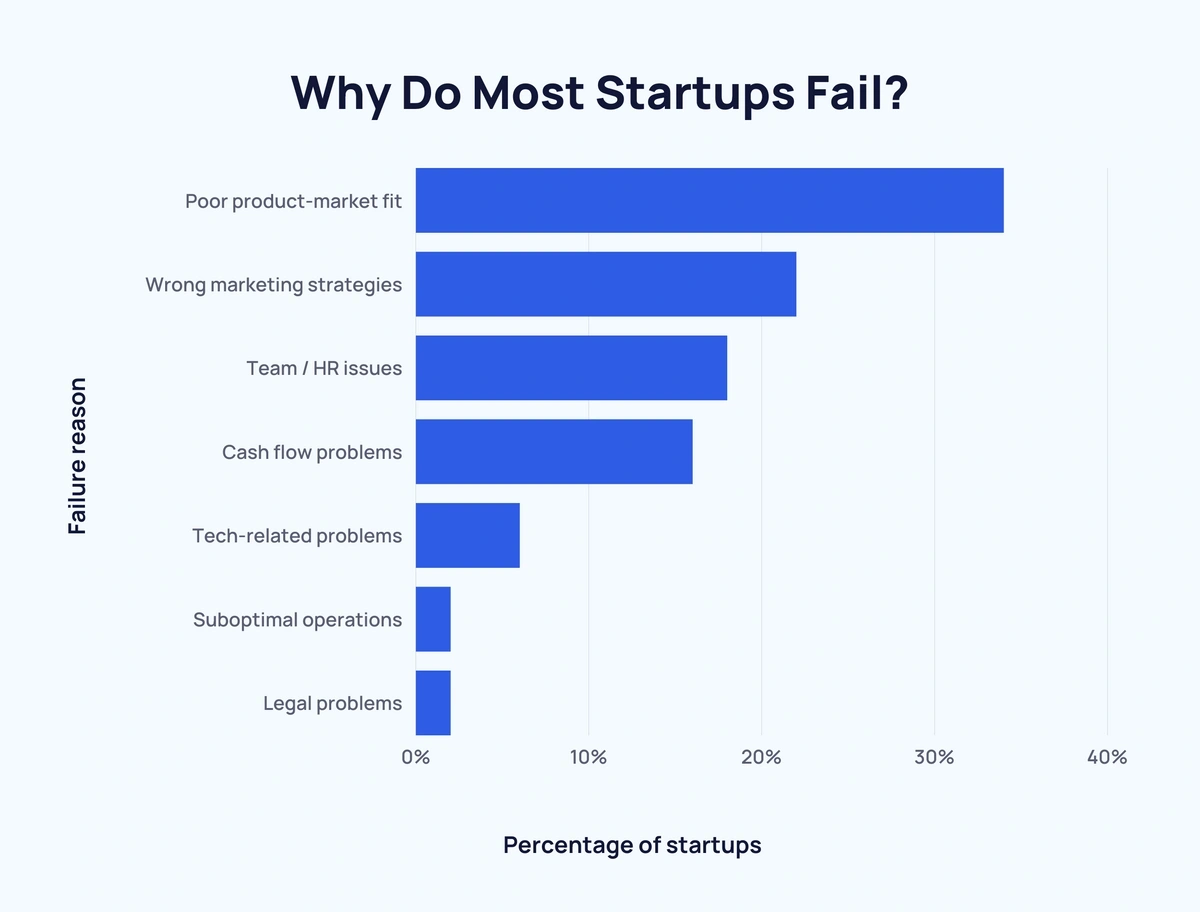
Here’s the startling statistic for 2024: 34% of startup failures are due to a poor product-market fit. In other words, they built something no one wanted. An additional 22% of failed businesses didn’t implement the correct marketing strategies. Investing in marketing from the get-go isn’t about selling a dream – it’s about conducting vital market research to ensure you’re building a dream that resonates with a real audience.


Sources: Failory, Business News Daily, Investopedia, CB Insights, Review 42


Why Marketing is Essential for Startups

Marketing, much like R&D, thrives on deep research and data-driven insights. A study by Marketing Profs shows that companies with strong marketing and sales alignment achieve win rates that are 38% higher than those without. Through surveys, social media analytics, and a keen understanding of customer demographics and buying behaviors, marketing paints a vivid picture of your ideal customer. This allows you to refine your product development process, ensuring you’re solving a problem for a real, addressable market.

But gathering intel is just the first step. Effective marketing strategies are the launchpad that propels your creation into the world. Content marketing, social media campaigns, and strategic partnerships can build brand awareness, generate leads, and foster a community around your product or service. Imagine – instead of a lonely engine in your garage, you have a bunch of enthusiastic early adopters eagerly awaiting its release.

That’s the power of marketing. It’s the voice that announces your arrival, the storyteller that weaves a narrative around your innovation, and the strategist that orchestrates a winning entrance into your target market. 


Building Your Marketing Muscle

You’ve poured your heart and soul into crafting a revolutionary product, assembled a team of passionate believers, and now you’re ready to take on the world cause now you know how marketing is important to you. There’s just one thing that trips up even the most promising ventures: building a rockstar marketing team.

The truth is brutal: attracting and retaining top marketing talent is fierce competition. Established players dangle hefty salaries and dazzling perks, while you’re still figuring out your ping-pong table budget. And let’s not forget the significant time and resources it takes to recruit, onboard, and train a dream team from scratch.

But what if there was a way to bypass the struggle and fast-track your marketing success? Introducing Marketing Team-as-a-Service (MTaaS) – your secret weapon for assembling a high-performing marketing dream team without the recruitment headaches.


Why MTaaS is the Marketing Superhero Your Startup Needs

Imagine having a team of experienced marketing professionals readily available to support your go-to-market strategy with streamlined onboarding for immediate impact. MTaaS providers offer access to specialists across various marketing disciplines, from CMOs who craft comprehensive strategic marketing plans and manage the whole team to content creators and SEO experts who elevate your online presence, brand strategists who build your brand voice, and even designers and developers who bring your marketing vision to life.

Here’s how MTaaS can be your startup’s secret growth weapon:

  • Scalability on demand. Forget rigid team structures and wasted resources. MTaaS allows you to scale your marketing team up or down as your needs evolve. Need a pre-launch content marketing blitz to build brand awareness? We’ve got content gurus ready to craft captivating blog posts and infographics. Targeting a new market segment that requires laser-focused social media strategies? Our social media wizards are ready to enroll.
  • Expertise you can’t afford (yet). Building an in-house team with a breadth of marketing expertise can cost a fortune. MTaaS provides access to specialists you might not be able to afford to hire individually, giving your startup a competitive edge without breaking the bank. Imagine having a part-time Product Led Growth (PLG) specialist on your team analyzing user behavior and optimizing your product customer journey for maximum conversions – all without the hefty price tag of a full-time PLG expert.
  • Faster time to market. Time is of the essence in the fast-paced startup world. MTaaS gets you started with a pre-vetted team of experts who can hit the ground running. This allows you to develop strategies quicker, gather valuable data, and refine your tactics for maximum impact.
  • Cost-effectiveness. MTaaS eliminates the high cost of recruitment, onboarding, and employee benefits. You only pay for the services you need, maximizing your marketing budget and ensuring every dollar goes towards achieving your marketing goals.


Is MTaaS Right for Your Startup?

If you find yourself resonating with any of these scenarios, then MTaaS might be your perfect match:

  • You’re a bootstrapped startup with limited marketing resources. Every penny counts, and you can’t afford the gamble of hiring the wrong marketing talent.
  • Your team lacks in-house marketing expertise. Your developers are brilliant, and your product people are phenomenal, but marketing isn’t necessarily their forte.
  • You need to launch marketing campaigns quickly and efficiently. You have a limited window of opportunity to capture market share, and you can’t afford to waste time building a team from scratch.
  • You’re unsure of the specific marketing skills you need for your current growth stage. Are you prioritizing brand awareness, lead generation, or market education? MTaaS providers can help you identify the right skill sets to achieve your specific goals.

Building Your Marketing Dream Team, Simplified

MTaaS providers handle the recruitment, vetting, and management of your outsourced marketing team. They ensure a smooth integration with your existing team, providing clear communication and consistent progress updates. But most importantly, they free you, the founder, to focus on what matters most – building your game-changing product and steering your startup toward revolutionary success. 

Now that you are convinced, here’s the exciting part: bringing your dream marketing team to life! 

SAGE Marketing is a leading provider of MTaaS solutions, offering access to a comprehensive pool of marketing specialists ready to tackle your unique challenges.  Whether you need a full-fledged marketing strategy overhaul or targeted specialists to boost specific areas, SAGE Marketing can create a customized MTaaS solution that perfectly aligns with your goals and budget.

Itay Lev CMO as a Service
About
the author
At SAGE Marketing, Itay’s approach is practical, data-driven, and highly collaborative - blending strategy, execution, and coaching to help startup teams grow smarter, faster, and more efficiently.
Learn more

Top Marketing KPIs for Tech Companies in 2025

Sarit<br> Lamerovich
written by Sarit
Lamerovich
Founder/CEO

Sarit founded SAGE to allow technology companies to take innovation to the next business level and fulfill the entrepreneur’s dream to change the world by building market recognition, increasinge customer awareness and improvinge the foundation for strong and sustainable revenue growth.

Itay Lev
reviewed by Itay Lev CMO as a Service

At SAGE Marketing, Itay’s approach is practical, data-driven, and highly collaborative - blending strategy, execution, and coaching to help startup teams grow smarter, faster, and more efficiently.

10 min read
Share
Why Partner with SAGE Marketing?
100+ B2B tech companies and startups — we literally grow unicorns.
No office, no walls — we work inside your world, embedded in your team.
Full-stack marketing approach: strategy, storytelling, content, HubSpot and execution under one roof.
Let’s Build Something Remarkable!
Whether you’re launching, scaling, or rebranding —
we’ll help you connect,
engage, and grow.
Contact us
client logo client logo client logo client logo client logo client logo
Blog Start-Up Tips Marketing

Want to grow your B2B tech company in Israel? Start by tracking the right marketing KPIs.

Here’s why it matters:

  • Customer Acquisition Costs (CAC) are rising – up 60% in the past five years.
  • Lead-to-Customer Conversion Rates show how well your funnel works.
  • Customer Lifetime Value (CLV) helps you focus on long-term growth.

In Israel’s fast-paced tech scene, where 25% of startups focus on AI and digital-first behavior dominates, KPIs are your roadmap to smarter decisions.

Use tools like HubSpot or Adobe Marketo to track metrics, and leverage AI for real-time insights. By focusing on data, not intuition, you’ll reduce costs, improve ROI, and stay ahead in the competitive market.

Let’s break down the key metrics and how to use them effectively.

9 B2B Marketing KPIs That Are Best For Your Business

How to Choose the Right Marketing KPIs

Selecting the right KPIs is crucial for driving business success, especially within the dynamic tech landscape.

What Makes a Good KPI

The value of a KPI lies in how well it aligns with your business goals. Instead of just tracking activity, your metrics should provide a direct connection to those objectives.

Good KPIs don’t just measure – they provide actionable insights, help predict future trends, and are easy to track consistently. Today’s marketing leaders are shifting their focus from basic conversion metrics to indicators that clearly show return on investment (ROI).

To stay effective, focus on 10–15 key metrics that directly impact business results. This streamlined approach allows for quicker decisions and more effective communication with executives.

It’s also important to balance leading indicators (which predict future outcomes) with lagging indicators (which confirm past results). Together, they provide a full picture of performance.

Ownership is another critical factor. Assign specific team members to monitor each KPI and establish clear action plans for when metrics deviate from expectations. This accountability drives better performance.

Don’t overlook the importance of regular audits. Verifying data accuracy ensures you’re working with reliable information. Focus on metrics that allow for immediate action when something goes wrong.

To make KPI tracking truly effective, it’s important to adapt it to the unique characteristics of your local market.

In many regions, business culture emphasizes personal relationships and open communication. This can influence how KPI performance is shared and discussed. Building trust sometimes through face-to-face interactions, can be key when working with local partners.

Make sure to align your reports with local standards, including currency and date formats, to ensure clarity and relevance for your audience.

In today’s digital-first global economy, KPIs should prioritize real-time, digital metrics over outdated traditional measures. Fast-moving sectors like tech demand immediate insights that support quick, informed decisions.

Consumer preferences also vary by region. In many markets, personalized experiences and culturally relevant messaging are expected. Your KPIs should reflect how well your marketing efforts meet these expectations.

Regional market dynamics matter too. A tech hub may require very different KPIs than a more traditional or rural area. As automation and programmatic advertising grow worldwide, incorporating tools that support automated KPI tracking is becoming essential.

Finally, as sustainability becomes a global priority, especially among younger consumers consider adding environmental impact metrics to your framework. These KPIs reflect growing awareness around eco-conscious buying and social responsibility.

3 Key Marketing KPIs for Tech Companies in 2025

For B2B tech companies, these three KPIs are essential for measuring marketing success. They each offer unique insights that can drive growth and help allocate resources more effectively. Let’s break them down with examples and benchmarks relevant to the 2025 tech landscape.

Customer Acquisition Cost (CAC)

Customer Acquisition Cost (CAC) calculates how much you spend to win a new customer. This includes expenses for marketing, sales, and advertising. As acquisition costs have climbed significantly in recent years, tracking this metric has become more important than ever.

Here’s how it works: take the total marketing, sales, and advertising costs (e.g., ₪100,000 in January 2025) and divide it by the number of new customers (e.g., 50). That gives you a CAC of ₪2,000.

Over the past five years, acquisition costs have risen by 60%, making it harder to maintain profitability. A high CAC can strain cash flow and limit scalability, while a lower CAC opens the door to faster growth. For SaaS companies, a healthy lifetime value-to-CAC ratio is typically 3:1.

A great example of CAC optimization comes from Tubby Todd. By leveraging advanced analytics tools, they identified the most cost-effective marketing efforts across channels. This allowed them to cut their TikTok customer acquisition costs by 65%.

Lead-to-Customer Conversion Rate

This metric tracks what percentage of qualified leads turn into paying customers. It’s a direct reflection of how well your sales funnel and nurturing processes are working.

To calculate it, divide the number of converted customers by the total number of qualified leads, then multiply by 100. For instance, if you generate 20 qualified leads and 3 become customers, your conversion rate is 15%.

Industry benchmarks can help guide your goals. For SaaS, the median conversion rate is 3.0%, with apps and devices leading the pack at 6.2%. Timing also matters – a response within 5 minutes makes you 10 times more likely to close a deal compared to waiting 30 minutes.

Improving this KPI involves optimizing your website’s navigation and calls-to-action, tailoring content to your audience’s needs, and segmenting leads for personalized outreach. By addressing these areas, you can significantly boost your conversion rates.

Customer Lifetime Value (CLV/CLTV)

Customer Lifetime Value (CLV) estimates the total revenue a customer will generate during their relationship with your company. This metric is crucial for guiding decisions on acquisition, retention, and resource allocation.

CLV helps pinpoint high-value customers, enabling you to tailor marketing and service efforts to their needs. It also highlights strategies that promote long-term value, such as upselling, cross-selling, or improving customer satisfaction.

Retention is a game-changer for CLV. Boosting customer retention by just 5% can increase profits by 25–95%. However, many companies struggle to act on this data – while 81% track CLV, only 37% use it strategically.

Starbucks offers a compelling example of CLV optimization. Through its Rewards program, customers earn points for purchases that can be redeemed for free drinks or discounts. This not only encourages repeat visits but also increases the average spend per visit. A strong rule of thumb is to aim for a CLV that’s at least three times your CAC.

Tools and Methods for Tracking KPIs

Tracking KPIs effectively requires the right tools and processes. With marketing automation growing at an annual rate of 17.67% through 2027, businesses are seeing measurable results from these systems. Let’s break down how to build a system that provides actionable insights.

Marketing Automation Tools

Marketing automation platforms have become indispensable for B2B tech companies aiming to simplify KPI tracking. These tools deliver impressive results – 80% of users report more leads, and 77% see higher conversions. The return on investment (ROI) is notable too, averaging ₪5.44 for every shekel spent over the past two years.

HubSpot Marketing Hub is a standout solution, combining CRM, email marketing, content management, and analytics. It’s particularly effective for tracking metrics like customer acquisition cost (CAC) and lead conversion rates by tying marketing activities directly to revenue outcomes.

Best Practices for KPI Tracking

Choosing the right tools is just the beginning. The way you design and organise your dashboards can significantly influence how well your team interprets and acts on the data.

Start by mapping your customer journey to focus on KPIs that matter. Avoid getting distracted by vanity metrics that don’t contribute to real business decisions.

Keep dashboards simple and uncluttered. Aim for a single screen with no more than nine views, using consistent graph sizes and limited colours. Tailor dashboards to specific team needs for better relevance.

“You need your summary level report, and you need your detail level report. And they need to be connected.”
– Malisa N., Financial Analyst 

Schedule monthly reviews with KPI owners to ensure metrics remain relevant and data stays accurate.

Once your dashboards and metrics are in place, incorporating AI can take your KPI tracking to the next level.

Using AI for KPI Tracking

AI-powered analytics are transforming KPI tracking, offering real-time insights that 90% of managers say have led to decisive improvements.

AI platforms can provide automatic alerts and recognise patterns across various data sources. For instance, Walmart used AI-driven predictive analytics to cut forecast errors by 30%, reduce stockouts by 20%, and lower excess inventory by 15%.

Unlike traditional dashboards, which often handle only structured data, AI systems can process unstructured data from sources like chat logs, emails, and social media. This gives businesses a more comprehensive view of customer acquisition and retention efforts.

Natural Language Processing (NLP) makes it even easier by enabling users to ask questions in plain language and receive immediate answers.

“Simply ask your data questions in plain language.”
– Nikhil Jathar, CTO of AvanSaber 

Gartner predicts that by 2025, 90% of business leaders will rely on AI-generated insights for strategy, a significant jump from just 30% in 2019. Companies using AI for KPI tracking are also three times more likely to see financial gains compared to those sticking with traditional methods.

AI is particularly effective for optimising CAC, as it can identify cost-efficient marketing channels and predict which leads are most likely to convert. To successfully implement AI, start with clean, well-organised data and expand capabilities gradually as your team becomes more familiar with the technology. This approach ensures accurate data and aligns insights with broader business objectives.

How to Use KPIs to Improve Marketing Performance

Using KPIs effectively isn’t just about tracking numbers – it’s about transforming those insights into actions that drive results. With only 23% of marketers feeling confident in their KPI tracking, many tech companies are missing out on opportunities to sharpen their marketing strategies.

Turning KPI Data into Action

Collecting data is one thing, but acting on it is where the real challenge lies. Harvard Business School Professor Sunil Gupta highlights the importance of going beyond surface-level metrics:

“It isn’t enough to measure the final outcome alone. You also need to track intermediate metrics to understand where consumers might be getting stuck – essentially bottlenecks in the marketing funnel.” 

Spotting Performance Bottlenecks

Begin with regular audits of your marketing tools and strategies. Look for patterns in your data that reveal where customers are dropping off. For example, if your lead-to-customer conversion rate is slipping, analyze each step of the customer journey to pinpoint the exact problem.

Planning for Different Scenarios

Develop action plans tailored to specific KPI outcomes. If customer acquisition costs (CAC) rise unexpectedly, be ready to pause low-performing campaigns, shift budgets to better-performing channels, and reassess your targeting.

Streamlining with Integrations

Integrate your marketing platforms to improve efficiency and speed up response times.

Making Decisions in Real Time

Establish clear protocols for responding to KPI shifts. Organizations with real-time response systems see a 31% performance boost. This ties back to earlier discussions about the value of immediate insights for quick adjustments.

Once these immediate actions are in place, the focus should shift to refining and improving strategies over time.

Continuous Improvement Through KPIs

For the most successful companies, KPI analysis isn’t a once-a-month task – it’s woven into daily operations and decision-making processes.

Regular Reviews

Weekly KPI reviews can help you track trends as they happen. Companies that refresh their KPIs annually are 24% more likely to see positive year-over-year results.

Testing and Refining

Use your KPI data to experiment. A/B testing on messaging and targeting can help fine-tune strategies, especially when Return on Ad Spend (ROAS) varies.

Comparing to Industry Standards

Benchmark your KPIs against industry averages to uncover areas for improvement. For example, if your Customer Lifetime Value (CLV) lags behind, investigate whether the issue lies in acquisition quality, onboarding, or retention.

Team Collaboration

Unify marketing and sales teams around shared KPI dashboards and hold regular strategy sessions to keep everyone aligned.

Some companies are even using AI to dig deeper into their KPI data. Wayfair’s CTO Fiona Tan shared how AI revealed a surprising insight:

“We used to think that if you lost the sale on a particular product, like a sofa, it was a loss to the company. But we started looking at the data and realised that 50% to 60% of the time, when we lost a sale, it was because the customer bought something else in the same product category.” 

This discovery led Wayfair to rethink how they track lost sales, turning what seemed like failures into valuable insights about customer behavior.

Aligning KPIs with Business Goals

Aligning KPIs with your business goals ensures that every metric ties back to meaningful outcomes. The best KPIs don’t just measure activity – they drive revenue and support broader objectives.

Linking KPIs to Revenue

Every major marketing KPI should connect directly to ROI and business outcomes. For example, when analyzing CAC, also consider the long-term revenue and retention of those customers.

Executive Oversight

Strategic KPI systems benefit from executive involvement. Hervé Coureil, Chief Governance Officer at Schneider Electric, explains:

“We want our KPIs to evolve over time because we don’t want to drive our business on legacy or vanity metrics.” 

Empowering Teams

Allow frontline teams to make decisions based on KPI performance without waiting for multiple approvals. This approach can boost productivity by 19%.

Aligning Marketing and Sales

Create Service Level Agreements (SLAs) between marketing and sales teams. Define what qualifies as a lead and establish shared KPIs to focus on converting those leads into customers.

Strategic Reviews

Seventy-two percent of organizations say aligning KPIs with strategic goals is vital for effective performance management. Schedule quarterly reviews to ensure your KPIs stay relevant, especially in the fast-changing tech industry.

Companies leveraging AI to refine KPIs are three times more likely to see financial gains. Yet, only 34% of businesses are using AI for this purpose, despite 60% of managers acknowledging the need for improvement.

The takeaway? KPIs aren’t static – they should evolve alongside your business. As Hans van Bommel, founder of Passionned Group, puts it:

“KPIs should tell the story of both where your organisation is going and how it is getting there. A well-chosen set of indicators can drive real and lasting improvement.” 

Conclusion

Tech marketing isn’t easy – it’s a field where success depends on tracking the right metrics and acting on insights quickly. With 73% of CEOs believing that marketers struggle to demonstrate business credibility and drive sufficient growth, marketing teams face mounting pressure to show their worth through measurable outcomes.

From our breakdown of key performance indicators (KPIs), it’s clear that a focused set of metrics can steer strategic decisions effectively. Metrics like Customer Acquisition Cost (CAC), Lead-to-Customer Conversion Rate, Customer Lifetime Value (CLV), Marketing-Sourced Revenue, and Return on Ad Spend (ROAS) are at the core of B2B tech marketing for 2025. These aren’t just numbers; they’re the foundation for shaping strategy and achieving tangible results.

This KPI framework does more than measure success – it fuels continuous improvement. Teams that rely on data rather than intuition see revenue growth at a much faster pace. In fact, by 2026, 65% of B2B sales organizations are expected to outperform those relying on gut instinct by leveraging data-driven strategies.

The real key lies in choosing the right metrics and fostering a culture where KPIs are central to both improvement and strategic alignment. Industry experts emphasize that KPIs are essential for making informed decisions and achieving consistent revenue growth.

For Israeli tech companies, the stakes are high. Proving ROI through well-chosen KPIs isn’t just important – it’s critical for staying competitive and thriving in the market. With the right tools, strategies, and a commitment to ongoing monitoring, tech companies can shift marketing from being seen as a cost to being recognized as a true revenue driver. The tools are already within reach; it’s time to use them to fuel measurable growth.

FAQs

What’s the best way for tech companies in Israel to balance leading and lagging indicators when choosing marketing KPIs?

To strike the right balance between leading and lagging marketing KPIs, tech companies in Israel should begin by defining clear, measurable goals that align with their overall business strategy. Leading indicators, like website traffic or customer engagement, act as early predictors of future performance. On the other hand, lagging indicators, such as revenue growth or customer retention, reflect the results of past efforts.

The trick lies in using leading indicators to generate actionable insights that guide your strategy, while relying on lagging indicators to confirm its effectiveness. For instance, keeping an eye on the lead-to-customer conversion rate (a leading indicator) can help refine your campaigns, while tracking customer lifetime value (a lagging indicator) ensures steady revenue over time. By regularly analyzing both types of metrics, you can make short-term changes without losing sight of long-term goals.

How can Israeli tech companies adapt their KPI tracking to align with local business culture and practices?

Israeli tech companies should zero in on KPIs that match the fast-paced, results-oriented mindset of the local business scene. Metrics like time-to-market, customer acquisition cost (CAC), and lead-to-customer conversion rates are crucial, as they reflect the region’s focus on efficiency and measurable success.

It’s also worth monitoring employee engagement and innovation metrics, given the strong emphasis on teamwork, ownership, and creativity within Israel’s startup culture. Adding KPIs for local market share and compliance can help ensure businesses stay aligned with regional regulations and market trends. By aligning KPIs with these specific cultural and operational factors, companies can more effectively track and improve their performance within Israel’s dynamic tech ecosystem.

How can tech companies use AI tools to improve KPI tracking and make smarter decisions in 2025?

AI tools are transforming how tech companies monitor KPIs and make decisions by delivering real-time insights, predictive analytics, and automated alerts. These features empower businesses to adapt swiftly to market shifts and fine-tune their strategies with precision.

Unlike traditional dashboards, which often rely on static data, AI-powered systems continuously process live data. This allows companies to spot trends, catch anomalies early, and minimize forecasting errors. By automating repetitive tasks and offering actionable insights, these tools free up teams to focus on strategic decisions, helping them stay ahead in the fast-moving tech world.

For Israeli tech companies, using AI tools means tracking key metrics like customer acquisition cost (CAC) and conversion rates with greater accuracy, all while staying in tune with the local market. This dynamic approach supports agility and fuels growth in the ever-changing business landscape of 2025.

Sarit
Lamerovich
Founder/CEO
About
the author
Sarit founded SAGE to allow technology companies to take innovation to the next business level and fulfill the entrepreneur’s dream to change the world by building market recognition, increasinge customer awareness and improvinge the foundation for strong and sustainable revenue growth.
Learn more

6 Data-Driven Marketing Strategies for SaaS Growth

Sarit<br> Lamerovich
written by Sarit
Lamerovich
Founder/CEO

Sarit founded SAGE to allow technology companies to take innovation to the next business level and fulfill the entrepreneur’s dream to change the world by building market recognition, increasinge customer awareness and improvinge the foundation for strong and sustainable revenue growth.

Michal Samuels
reviewed by Michal Samuels CMO as a Service

A seasoned CMO-as-a-Service at SAGE Marketing, worked with global start ups to define marketing direction, improve market positioning, and support business growth.

15 min read
Share
Why Partner with SAGE Marketing?
100+ B2B tech companies and startups — we literally grow unicorns.
No office, no walls — we work inside your world, embedded in your team.
Full-stack marketing approach: strategy, storytelling, content, HubSpot and execution under one roof.
Let’s Build Something Remarkable!
Whether you’re launching, scaling, or rebranding —
we’ll help you connect,
engage, and grow.
Contact us
client logo client logo client logo client logo client logo client logo
Blog Start-Up Tips Hubspot Marketing

Let’s be real: Most “growth strategies” are recycled fluff. But the SaaS companies winning right now? They’re using real data to make smarter moves, not hunches.

Here’s the playbook (no jargon, just what works):

  • Predictive Lead Scoring: Use AI to identify leads most likely to convert, saving time and resources.
  • Personalized Account-Based Marketing (ABM): Focus on high-value accounts with tailored campaigns for better results.
  • Churn Prediction and Prevention: Spot at-risk customers early and take action to retain them.
  • Conversion Rate Optimization (CRO): Test and refine your website to improve sign-up rates.
  • Automated Customer Journey Analytics: Track user behavior across touchpoints to enhance their experience and reduce churn.
  • Unified CRM Insights with HubSpot: Centralize your sales, marketing, and customer data in one platform to create a single source of truthת enabling smarter segmentation, real-time reporting, and more effective, automated campaigns.

Why it matters:

Companies using predictive analytics are 2.9x more likely to outperform their industry in revenue.

ABM can increase deal sizes by 50% or more.

Reducing churn by just 5% can boost profits by 25-95%.

These strategies aren’t just for big players. Start small, focus on your goals, and measure your progress. The key is using your data to make smarter decisions and deliver what your customers actually want.

Ready to dive deeper? Keep reading for actionable steps to implement these strategies.

1. Predictive Lead Scoring with Data Analytics

What is Predictive Lead Scoring?

Predictive lead scoring helps pinpoint SaaS leads with the highest potential for conversion. Instead of relying on manual guesswork, it uses AI and machine learning to analyze historical data and predict which leads are most likely to convert [3].

This system processes multiple data points at once – like website activity, email engagement, demographic details, and user behavior. It assigns each lead a numerical score that reflects their likelihood of becoming a customer [3]. Plus, the AI adapts in real-time, factoring in new behaviors, such as repeated visits to the pricing page, which often signals stronger intent [3].

Now, let’s break down how to implement predictive lead scoring into your sales and marketing workflows.

Steps to Set Up Predictive Lead Scoring

Creating a predictive lead scoring system that fits seamlessly into your operations requires careful planning and execution. Here’s how to get started:

1. Data Collection and Integration
Gather data from various sources, including website analytics, CRM systems, form submissions, and even third-party platforms [3]. To train your model effectively, you’ll need data from at least 100 converted and 100 non-converted leads [5].

2. Model Building and Validation
Use machine learning tools compatible with your CRM to uncover patterns and assign weights to different behaviors. For instance, prioritize activities that indicate deeper interest, like extended time spent on key pages [3][2].

3. Automation and Workflow Integration
Set up automated processes to route high-scoring leads directly to your top sales reps. Leads with medium scores can enter personalized nurturing campaigns to increase their potential [3].

💡 Pro Tip: Use HubSpot’s Predictive Lead Scoring Tool

If you’re using HubSpot CRM, predictive scoring is already built in. HubSpot’s AI-driven lead scoring uses your historical data to automatically assign scores, without requiring a data science team. You can easily integrate it with your marketing automation workflows—automatically prioritizing hot leads, assigning them to reps, or triggering nurturing sequences for colder prospects. It’s an accessible, scalable way to operationalize your scoring system—especially for fast-moving SaaS teams.

4. Continuous Monitoring and Refinement
Evaluate your model’s performance regularly – quarterly is a good benchmark. Use KPIs and feedback from your sales team to adjust for changes like seasonal trends [5].

For instance, ABC Enterprise used predictive analytics to identify that manufacturing companies with over 1,000 employees and specific tech challenges were their most likely converters [1]. This insight allowed them to focus their efforts more strategically.

Once your system is in place, tracking its success becomes the next priority.

Key Metrics to Track

To ensure your predictive lead scoring system is delivering results, keep an eye on these key performance indicators:

  • Lead-to-Customer Conversion Rates
    Measure how well your system segments leads. High-scoring leads should convert at noticeably higher rates compared to medium or low-scoring ones.
  • Pipeline Velocity
    Assess how quickly leads move through your sales funnel. By focusing on high-potential leads, predictive scoring can speed up the sales cycle.
  • Sales Team Efficiency
    Monitor the time your sales team spends on qualified leads. Predictive scoring can reduce wasted effort – by as much as 40% in some cases [5].
  • Model Accuracy Over Time
    Compare predicted scores with actual conversion outcomes. If accuracy drops, it may be time to retrain your model or improve your data quality.

Statistics highlight the impact of predictive lead scoring. Companies using predictive analytics are 2.9 times more likely to achieve revenue growth above their industry average [4]. Additionally, 75% of businesses report higher lead conversion rates after adopting lead scoring systems, with some seeing improvements of up to 50% [6].

“Data and analytics leaders need to understand the business priorities and challenges of their organisation. Only then will they be in the right position to create compelling business cases that connect data quality improvement with key business priorities.”

But even the best predictive models can falter if the data feeding them is flawed. According to Forrester, 25% of the average B2B database contains inaccurate information, leading to potential revenue losses [1]. To safeguard your investment, implement strong data management practices, including regular cleaning, validation, and enrichment processes. These steps will ensure your predictive scoring system remains reliable and effective.

Understanding marketing automation for your B2B SaaS with Shay How

2. Personalized Account-Based Marketing (ABM)

Account-based marketing (ABM) takes a laser-focused approach by treating high-value prospects as individual markets. Instead of spreading resources broadly, ABM zeroes in on accounts with the greatest revenue potential. For instance, 91% of companies using ABM report an increase in their average deal size, with 25% seeing growth of 50% or more [9].

The magic of ABM lies in crafting personalized, data-driven strategies tailored to each account’s unique challenges and goals. This approach is especially effective in navigating the complexities of B2B sales cycles, where budgets are often under tight scrutiny.

Using Data to Personalize Your Approach

ABM starts with leveraging first-party and technographic data. First-party data – like website activity, email engagement, demo interactions, and support history – forms the backbone of your strategy. Pair this with technographic data to identify prospects already using technologies that complement your solution. For example, many Israeli SaaS companies find success targeting accounts that use Salesforce if their product integrates seamlessly with Salesforce CRM.

Intent data adds another layer by revealing when prospects are actively researching solutions. This insight allows for well-timed outreach, ensuring consistent engagement throughout the buyer journey rather than sporadic, late-stage interactions (which typically account for only about 40% of the journey) [9].

A strong personalization strategy involves three main steps:

  • Account Research and Segmentation: Group 5–10 target accounts with similar challenges and objectives. Israeli tech companies often segment by industry – like fintech, cybersecurity, or healthtech – since each sector faces distinct operational and regulatory hurdles.
  • Buyer Persona Development: Speak with your top customers to gain insights into their decision-making processes. Use this knowledge to tailor communication styles and messaging.
  • Content Customization: Adapt messaging to address specific pain points at each stage of the buyer journey. Early-stage content might highlight industry trends, while later-stage materials could focus on pricing, technical details, or testimonials from similar companies.

The payoff is clear: 80% of consumers are more likely to buy from brands offering personalized experiences [8]. For SaaS companies, this means moving beyond generic emails to create account-specific landing pages, tailored demos, and customized case studies.

ABM Campaign Best Practices

Once you’ve built a foundation of personalized insights, the next step is a coordinated, multi-channel campaign. Success hinges on close collaboration between sales and marketing teams, working toward shared goals and account-specific strategies. Companies with aligned teams often see a 32% annual revenue growth [7].

  • Multi-Channel Engagement: Reach all members of the buying committee with personalized messaging across multiple platforms. For example, a direct mail campaign by SalesLoft that included customized gifts boosted meeting attendance by 9% and created new opportunities with 20% of the recipients [10].
  • Account-Specific Content: Develop content tailored to each account’s industry, size, and challenges. For Israeli businesses, incorporating local market conditions or regulatory specifics can make your messaging more relevant.
  • Timing and Frequency Optimization: Use behavioral data to determine the best timing for outreach. If an account downloads several whitepapers in a week, it signals strong interest and warrants immediate follow-up. Lower-engagement accounts might need more nurturing before direct outreach.
  • Customized Demo Experiences: Build demos that reflect each prospect’s specific use case. For example, Form reported a 33% boost in conversion rates and nearly a 50% drop in cost per lead after rolling out personalized demo experiences for field service worker managers [10].
  • Cross-Functional Collaboration: Involve customer success teams to share insights about common implementation challenges and success factors. This helps sales teams address potential objections and allows marketing teams to refine their content.

Measuring ABM Success

To gauge the impact of your ABM campaigns, focus on metrics that highlight account-level engagement and movement through the sales funnel.

  • Account Engagement Metrics: Monitor how target accounts interact with your content. Hexagon, for example, achieved a 60% engagement rate and a 49% increase in page views for personalized content[9].
  • Pipeline Velocity and Deal Size: Track the speed at which accounts move through your sales process and the value of those opportunities. ABM often results in larger deals that close faster due to better qualification and tailored engagement.
  • Conversion Rates: Measure how many target accounts convert into paying customers. LiveRamp achieved a 33% conversion rate by concentrating on just 15 top-tier clients that matched their ideal profile [9].
  • Customer Lifetime Value (CLTV): Assess the long-term impact of ABM relationships. Hexagon saw a 278% higher click-through rate on tailored ads, which contributed to more contract renewals and expansions [9].
  • Return on Investment (ROI): Compare campaign costs to the revenue generated from target accounts. Notably, 76% of marketers report higher ROI with ABM compared to other marketing methods [9].
ABM Metric CategoryKey IndicatorsSuccess Benchmarks
EngagementPage views, content downloads, email opens~60% engagement rate from target accounts
ConversionAccount-to-opportunity and opportunity-to-customer rate25–35% conversion rate for qualified accounts
Revenue ImpactDeal size, pipeline velocity, CLTV91% report larger deals; 25% see growth of 50%+

Attribution in ABM can be tricky due to the many touchpoints influencing decisions. Multi-touch attribution helps pinpoint which activities drive account progress, enabling better campaign optimization and smarter budget allocation.

Regular reviews segmented by industry, company size, and geography can uncover valuable trends. For Israeli SaaS companies, local accounts often respond differently to messaging and timing compared to international ones, making such segmentation especially useful.

The ultimate goal? Focus on metrics that reflect meaningful business outcomes, not vanity metrics. By doing so, you’ll ensure your ABM efforts deliver measurable, lasting value.

3. Churn Prediction and Prevention

Customer churn is a major challenge for SaaS companies, costing U.S. businesses a staggering $136 billion annually (about ₪500 billion) [18]. For Israeli SaaS companies in fiercely competitive markets, the stakes are even higher. Predicting and preventing churn through data-driven strategies can significantly improve retention rates and profitability. Churn prediction involves identifying customers likely to stop using your product or service in the near future [11].

How to Identify At-Risk Customers

The first step in preventing churn is recognizing which customers are at risk. Leading SaaS companies rely on behavioral data to detect early warning signs, often weeks or months before customers leave.

  • Product Usage Patterns: Low usage of key features during the first month is a strong indicator of churn [12]. Similarly, unresolved support tickets within the past 30 days raise the likelihood of customers leaving [12]. Tracking feature adoption during onboarding is especially important.
  • Engagement Metrics: Monitoring login frequency, session duration, and feature interactions can reveal sudden drops or inactivity. For multi-user accounts, reduced team activity or seat usage often signals potential downgrades or cancellations.
  • Support Interaction Analysis: High volumes of support tickets, especially related to billing, integrations, or feature requests, may indicate a mismatch between customer needs and the product. Resolution times and satisfaction scores also provide useful insights.
  • Customer Segmentation: Breaking down customers by industry, company size, subscription tier, or onboarding date helps identify which groups are more prone to churn [13]. Different industries may require tailored support strategies.

Advanced analytics tools like Amplitude or Mixpanel make it easier to track customer behavior in real time [11]. These platforms can flag accounts with multiple risk factors, enabling teams to prioritize outreach and take action quickly.

Retention Strategies That Work

Once you’ve identified at-risk customers, the next step is to implement targeted retention strategies. Combining automated systems with personalized human interactions often yields the best results.

  • Automated Alerts and Re-Engagement: Tools like Zendesk use health scoring to identify customers at risk and initiate targeted outreach, which not only reduces churn but also uncovers upselling opportunities [17]. Automated alerts, such as notifications for customers who haven’t logged in for 14 days, can prompt timely interventions. Notion, for example, uses activity data to deliver in-app guides, tooltips, and email nudges, improving feature adoption and overall engagement [17].
  • Targeted Education and Support: Addressing churn triggers through education can make a big difference. Kommunicate introduced in-app checklists and interactive walkthroughs, leading to a 3% increase in feature usage as 86% of users completed their customization goals [14].
  • Gamification: Adding gamified elements during onboarding can drive deeper engagement. Kontentino achieved a 10% increase in customer activation within a month by incorporating progress bars and achievement badges [14].
  • Optimizing Payment Processes: Involuntary churn – caused by failed payments – accounts for 20%–40% of SaaS churn [15]. Kaleido reduced this type of churn by 38% through better payment systems [15]. Retry strategies can even cut churn rates by up to 100% [18].
  • Flexible Cancellation Options: While it may seem counterintuitive, making it easy for customers to cancel often results in more honest feedback about why they’re leaving. This transparency can help improve the overall experience [15].

Measuring Retention Results

To ensure your retention efforts are effective, tracking the right metrics is essential. These metrics provide insights into both short-term and long-term impacts.

  • Churn Rate Reduction: A key indicator of success. Typical churn rates range from 5% to 7%, with 3% considered excellent [18]. Companies with monthly contracts often see churn rates as high as 14% compared to annual agreements [18].
  • Customer Lifetime Value (CLV): Tracking CLV improvements shows how well your retention strategies are working. Comparing revenue from customers exposed to retention efforts against control groups can highlight the ROI of your initiatives.
  • Engagement Metrics: Metrics like email open rates, click-through rates, and in-app activity levels help measure the success of re-engagement campaigns [19].
  • Revenue Impact: Beyond churn numbers, focus on Monthly Recurring Revenue (MRR) retention, expansion revenue from retained accounts, and the financial impact of prevented churn. For example, HubSpot‘s personalized onboarding and proactive customer success efforts increased retention rates by 30%, boosting their bottom line [17].
Retention MetricBenchmark RangeSuccess Indicators
Monthly Churn Rate3–7% (5–7% typical)Consistent downward trend
Customer Lifetime ValueVaries by industry15–25% improvement post-intervention
Engagement Recovery20–40% improvementHigher feature adoption and session duration
Revenue Retention90%+ net retentionExpansion revenue from retained accounts

Closing the Feedback Loop is another critical step. Companies that fail to follow up on customer feedback see churn increase by at least 2.1% annually. On the other hand, closing the loop within 48 hours can improve retention by 12% [16].

“The biggest misconception about customer churn is that there is nothing your team can do to prevent it. NOT TRUE! Once you know how to discover churn, then you can identify the reasons behind it. We tell our customers all the time, start somewhere. One small action is better than no action and it will begin to retain customers, allowing you to focus on the next action.” – Cary Self, VP of Education, CustomerGauge [16]

Regularly analyzing these metrics and adapting strategies based on data – not assumptions – ensures continuous improvement. For Israeli SaaS companies, segmenting insights by geography can be particularly useful, as local and international customers may respond differently to retention efforts.

4. Conversion Rate Optimization Through Testing

Improving conversion rates through systematic testing transforms raw data into actionable strategies for growing SaaS businesses. While the average conversion rate across industries is 4.3%, thoughtful testing can help SaaS companies exceed this standard significantly [25].

How to Set Up Testing Frameworks

Creating an effective testing framework starts with defining clear, measurable goals. Before running any experiment, establish specific metrics and form a solid hypothesis [25]. By mapping the user journey, you can pinpoint key areas that influence conversions the most [25].

Focus on variables that directly affect your conversion funnel. These might include pricing page designs, call-to-action buttons, form fields, payment options, or trust indicators like security badges [20]. For SaaS companies, the goal is to make the checkout or sign-up process as simple and frictionless as possible [20].

When setting up A/B testing, create distinct variations and divide your audience into random groups for a fair comparison. Base your test decisions on user behavior data and feedback, not assumptions [20].

For a more complex approach, Multivariate Testing (MVT) allows you to test multiple variables at the same time. This method helps identify the best combination of elements and saves time compared to running sequential A/B tests [21].

If your SaaS business has lower traffic, as is often the case for Israeli companies, focus on testing elements that can significantly impact performance rather than minor tweaks [22]. Use tools like heatmaps, scrollmaps, and session recordings to identify which parts of your site deserve attention before running tests [22].

Statistical considerations are essential for reliable results. Tests should run for at least one business cycle (a minimum of seven days) and aim for a statistical significance of 95% (or 90% for low-traffic sites) [27]. For websites with limited traffic, reduce the number of variations, focus on smaller goals like micro-conversions, and consider lowering the significance threshold to 90% [22].

Reading and Applying Test Results

Once your tests are complete, interpreting the results correctly is crucial. Look beyond conversion numbers to understand the full story. Statistical significance is key – aim for a p-value of 0.05 or lower [26].

External factors like seasonality, marketing campaigns, and technical issues must also be considered, as they can skew your results [26].

Audience segmentation is another critical step. Break down your audience by demographics, behavior, traffic source, visitor type, browser, and device to see how different groups respond to variations. This approach is especially useful for Israeli SaaS companies catering to both Hebrew- and English-speaking markets.

A practical example highlights the value of testing: In April 2024, Invesp’s CRO team noticed a drop in conversions on a client’s product detail pages. Suspecting that price placement was causing friction, they conducted an A/B test. The results? Version B, which placed the price and reviews above the “add to bag” button, increased conversions by 3.39%. Version C, with the price above the button and reviews below, saw a 5.07% boost. Other versions had smaller improvements, like Version D’s 1.27% increase with the price below the product image, and Version E’s 0.95% uplift with the price next to the quantity field [27].

Implementation should be gradual and methodical. Roll out the winning variations and monitor their impact over time [26].

Even failed tests can offer valuable insights. As Anwar Aly, a Conversion Specialist at Invesp, puts it:

“If the loss rate is normal, businesses should learn from lost tests, recognising that loss is part of A/B testing and can sometimes be more valuable than wins. If the loss rate is high or constant, re-evaluate your testing approach, possibly starting with a new audit and utilising qualitative data to validate test hypotheses” [27].

Key Testing MetricsBenchmarkIsraeli SaaS Considerations
Statistical Significance95% (90% for low traffic)Account for Hebrew vs English user behavior
Test DurationMinimum 7 daysConsider Sabbath and holiday patterns
Scroll Depth60–80% optimalMobile-first approach for Israeli users
Conversion Rate4.3% medianAdjust for ₪ pricing psychology

Testing Tools and Platforms

After analyzing your results, it’s time to choose tools that make testing and optimization easier. Your chosen platform should align with your testing framework for smooth implementation.

Visual editors are a must for teams without deep technical expertise. A user-friendly platform allows you to quickly launch tests and interpret results [24]. Look for A/B testing tools with simple, intuitive interfaces [24].

Analytics and reporting capabilities are equally important. The best software doesn’t just track basic metrics – it provides detailed insights into user behavior and statistically reliable results [24] [23].

Integration is another key factor. Since SaaS companies often rely on a variety of tools, your testing platform should work seamlessly with your existing systems [24] [23].

Some popular testing platforms include Google Optimize for basic needs, Hotjar for heatmaps and user behavior analysis, and advanced options like Optimizely or VWO for enterprise-level experiments. For Israeli companies, ensure the platform supports right-to-left languages for Hebrew content.

Security and compliance are critical too. Make sure your platform includes features like proper authentication and data encryption, and adheres to privacy laws like GDPR [23].

Given Israel’s high mobile usage rates, mobile optimization is essential. Choose tools that are responsive and compatible with various devices and screen sizes [23]. A clean, uncluttered interface ensures users can easily access key features.

For companies with limited traffic, use paid ads, social media campaigns, or other methods to drive enough visitors for testing. Additionally, tools like heatmaps, clickmaps, and session recordings can help you evaluate each variation’s performance and draw meaningful conclusions [22].

5. Automated Customer Journey Analytics

Automated customer journey analytics takes data-driven strategies to the next level by offering a clear, detailed view of user behavior. This approach helps businesses make proactive improvements in areas like onboarding, support, and conversion. By tracking and analyzing customer interactions across multiple touchpoints, businesses can turn raw data into actionable insights, identifying issues before they escalate into churn risks [28].

Setting Up Data Pipelines for Journey Analytics

To effectively implement customer journey analytics, it’s essential to set up robust data pipelines that can convert raw information into meaningful insights [29].

Start by automating data collection across all customer touchpoints – this includes website visits, product usage, customer support interactions, email responses, and payment activities [28]. Breaking down platform silos is equally important. Integrate data sources like CRM records, support tickets, product logs, and marketing analytics to create a unified system that allows teams to respond quickly to customer needs [28].

Focus on mapping critical customer journeys that directly affect revenue. Key areas to analyze include onboarding processes, conversion paths, support interactions, and upgrade decisions. These are often the areas where the most impactful improvements can be made [28].

Tailor your data pipelines to align with your existing systems. Understand where your data originates, how it flows through your system, and where it needs to go for analytics or reporting. Define the necessary transformations to ensure the data serves your specific goals [29].

Lastly, create workflows that can act on these insights in real time. For example, set up alerts for friction points, enable cross-team sharing of insights, assign ownership for resolving issues, and conduct regular testing cycles [28].

A practical example of this approach is Wahi’s implementation of Fullstory in December 2024. By analyzing user behavior, they identified friction points in forms and chat, observed session abandonment patterns, and made targeted improvements. The results? A 100% increase in conversion rates year-over-year and a median bug resolution time of under 48 hours, all while gaining better visibility into user pain points [28].

Identifying and Resolving Friction Points

Friction points in the customer journey are moments when users feel frustrated, confused, or dissatisfied [30]. Automation helps businesses spot these issues early, preventing them from escalating into support tickets or cancellations.

Common pain points include unresponsive systems, poor product quality, inadequate support, lack of personalization, and overly complex processes [30]. For Israeli SaaS companies, additional challenges might include providing effective multilingual support and managing expectations across Hebrew- and English-speaking users.

Data silos and gaps in personalization can also hinder the customer experience. These obstacles make it difficult for teams to understand user needs and deliver tailored interactions. As Rob Stevens, Senior Director of Customer Success at iBASEt, puts it:

“Tools are useful, but tools don’t solve process problems” [31].

To address these challenges, journey analytics can pinpoint where processes falter. For example, improving communication channels like live chat and email, training support teams to be both knowledgeable and empathetic, and using automation for repetitive tasks can make a big difference. Simplifying website navigation and optimizing speed and functionality are also crucial steps [30].

Once these pain points are resolved, it’s important to measure the impact using key metrics.

Tracking Automation Results

To gauge the success of automated customer journey analytics, track metrics that reflect improved user experiences and business outcomes. These metrics provide insight into how customers interact with your brand at various stages [35].

Key performance indicators include conversion rates, customer lifetime value, retention rates, and user engagement [32][35]. Monitoring these metrics allows you to refine strategies, boost satisfaction, grow revenue, and build loyalty [35].

Larger companies are increasingly investing in customer success platforms, with 82% of organizations with over 500 employees using them [33]. This investment often pays off – 52% of customers show loyalty by recommending brands, and returning customers spend 67% more than new ones [33].

Aleksandra Lemzyakova, Head of Customer Support, highlights the importance of metrics:

“Effective tracking of customer success metrics is crucial for SaaS business growth. It’s not merely about observing numbers; it’s about understanding the story behind each user interaction and engagement. These metrics guide us to improve and tailor our services, driving customer satisfaction and retention. By focusing on what truly matters to our users, we turn them into brand champions. Their improved outcomes validate your strategy” [33].

Practical steps include segmenting product data to identify low-engagement users and taking proactive measures to re-engage them [35]. Analyze how power users interact with your product to uncover what drives engagement. Use Customer Effort Score surveys to identify friction points, and automate support by triggering help messages based on user scores. Feedback data can also guide improvements that enhance overall satisfaction [35].

Metric CategoryKey IndicatorsIsraeli SaaS Considerations
EngagementDaily/monthly active users, feature adoptionTrack Hebrew vs English interface usage
RetentionChurn rate, customer lifetime valueAccount for annual billing cycles in ₪
SatisfactionNPS, Customer Effort ScoreConsider cultural communication preferences
RevenueMonthly recurring revenue, upgrade ratesMonitor Sabbath and holiday impact patterns

Unlike traditional journey mapping, which often relies on assumptions, customer journey analytics uses quantitative data to provide a more accurate picture [34]. For example, revenue churn rate measures the financial impact of lost customers, while customer churn rate simply counts the number of departures [36].

The ultimate goal is to turn data into action. Start by focusing on one critical journey, make improvements based on data, and track the results across metrics like customer satisfaction, support ticket volume, conversion rates, and revenue [28].

6. What Are Unified CRM Insights?
Unified CRM insights refer to a centralized view of your customer data  across marketing, sales, and service touchpoints  within one system. Instead of juggling disconnected spreadsheets, platforms, and teams, HubSpot brings everything into one place.

By consolidating contact records, activity logs, deal progress, campaign performance, and support history, HubSpot turns fragmented data into actionable intelligence. This unified approach helps companies eliminate silos, improve collaboration, and align around a single source of truth.

With HubSpot’s CRM at the core, teams can track real-time performance, personalize outreach, and automate actions based on insights all from one interface.

Steps to Set Up Unified CRM Insights in HubSpot

Implementing unified CRM insights in HubSpot is relatively simple and scalable, even for growing SaaS companies:

1. Connect Your Data Sources
Start by integrating your marketing tools (like landing pages, forms, and emails), sales pipelines, and service workflows. HubSpot natively connects these functions and offers integrations with tools like Salesforce, Gmail, Slack, Zoom, and more.

2. Define Lifecycle Stages and Properties
Customize contact and company properties based on your business model. Set clear lifecycle stages (Lead, MQL, SQL, Customer, Evangelist) to standardize how contacts move across departments.

3. Set Up Custom Dashboards
Use HubSpot’s dashboard builder to create role-specific views:

  • Sales leaders: pipeline performance, deal forecasts
  • Marketers: campaign attribution, lead sources
  • CX teams: ticket volume, satisfaction trends

4. Activate Reporting & Automation
Leverage HubSpot’s built-in reporting tools to track conversion funnels, email engagement, deal stages, and support outcomes. Automate follow-ups, lead assignments, and nurturing sequences based on live data.

5. Keep Your Data Clean
Regularly review properties, merge duplicates, and enrich data through tools like HubSpot’s Operations Hub or integrations with data validation services.

Pro Tip: Use the “Custom Report Builder” for Cross-Team Visibility

Want to know how your top-performing blog post influenced deals worth over $100K? Or how webinar registrants move through the pipeline? Use the Custom Report Builder to create cross-object reports that merge marketing, sales, and service data into one story. It’s especially powerful for quarterly reviews or board decks.

Metric CategoryKey IndicatorsIsraeli SaaS Considerations

Lead Source Attribution
Identifies which marketing channels drive the most qualified leads and conversions.Focus on global demand gen: helps prioritize between organic, PLG, and outbound channels.
Customer Acquisition Cost (CAC)Measures how much you’re spending to acquire each customer, segmented by campaign.Critical for lean teams under VC pressure to prove capital efficiency.
Sales Cycle Length Tracks how long it takes to convert a lead to a customer, highlighting bottlenecks.Useful for moving upmarket (e.g., from SMB to enterprise) and identifying friction points.
Customer Lifetime Value (CLTV)Estimates total revenue expected from each customer, helping prioritize key segmentsImportant for pricing strategy and scaling models (freemium vs. sales-assisted).
Engagement Across Lifecycle Shows how prospects and customers interact with content, sales, and support over time.Supports product-led growth by aligning GTM with actual user behavior across regions.

Conclusion: Selecting the Right Data-Driven Strategies for Your SaaS Business

Using data effectively can revolutionize marketing decisions for SaaS companies. The strategies we’ve discussed – predictive lead scoring, personalized account-based marketing (ABM), churn prediction, conversion rate optimization (CRO), and automated customer journey analytics – each play a distinct role, depending on your company’s growth stage and priorities.

Each of these approaches serves a specific purpose. For example:

If your focus is lead generation, predictive lead scoring and CRO are great starting points. They help identify high-quality prospects and improve funnel efficiency. As Steven Dang, VP of Growth and Strategy at HawkSEM, explains:

“It’s important for SaaS companies to configure their CRMs to track leads through the entire sales lifecycle and look at the impact/contribution from different marketing channels” [39].

Once lead generation is optimized, the next logical step is improving customer retention.

For retention and revenue growth, churn prediction and customer journey analytics are essential. Studies show that increasing customer retention by just 5% can boost profits by 25-95% [41]. Holly Chen, Global Head of Digital Marketing at Slack, stresses:

“Companies should be laser-focused on retention: revenue retention as well as user retention. Revenue retention shows expansion or contraction of the business” [41].

While retention strengthens your revenue base, scaling requires a more targeted approach.

For scaling businesses, personalized ABM is a powerful tool. It delivers impressive results, with 79% of marketers reporting higher ROI from ABM than any other marketing effort [38]. For example, LiveRamp’s ABM campaign achieved a 33% conversion rate from cold leads and a 25x increase in customer lifetime value [38].

The strategies you choose should align with your business stage. Startups often see the best results from SEO and content marketing. Growth-stage companies may benefit more from paid ads and webinars, while scale-ups thrive with ABM, retargeting, and referral programs [37].

Business GoalPrimary StrategiesKey Metrics to Track
Lead GenerationPredictive Lead Scoring, CROMQL-to-SQL (33%), Lead-to-Customer (7%)
Customer RetentionChurn Prediction, Journey AnalyticsChurn rate (5-7%), Customer Lifetime Value
Revenue GrowthABM, Journey AnalyticsMonthly Recurring Revenue, Upgrade rates

The secret to long-term success lies in constant measurement and refinement. Jake Stainer advises:

“We don’t want to be chasing vanity metrics that will be of little or no use to us further down the line. We want to focus on improving our products, lifting our acquisition and retention, and ultimately our bottom-line ROI” [41].

Start by implementing one or two strategies that align with your immediate goals. Keep in mind that quality trumps quantity in B2B SaaS lead generation [37]. It’s better to attract the right customers than to simply increase lead volume. As the SaaS market grows at an 18% CAGR, expected to reach ₪4.5 trillion by 2027 [40], the most successful companies will be those that use data to build meaningful, lasting customer relationships.

Regularly track your metrics and adjust your approach based on what the data reveals.

FAQs

How can small SaaS companies start using predictive lead scoring with limited data?

Small SaaS companies can kick off predictive lead scoring by tapping into the data they already possess. Begin by defining your ideal customer profile (ICP) and examining the behavior of past customers to uncover traits that often lead to successful conversions. Stick to straightforward scoring models that highlight these critical features.

There are affordable tools out there that offer basic predictive analytics, making automation accessible without needing a big budget. To keep your scoring accurate, make it a habit to update your criteria based on new data and feedback. Even if your dataset is small, consistent tweaks can turn predictive lead scoring into a powerful growth strategy.

What are the main challenges in implementing an account-based marketing (ABM) strategy, and how can they be addressed?

Challenges in Implementing Account-Based Marketing (ABM)

Putting an account-based marketing (ABM) strategy into action isn’t always a smooth ride. One of the most common hurdles is getting sales and marketing teams to work in sync. When these teams aren’t aligned, communication gaps can arise, which can weaken the entire strategy. The solution? Start by setting shared goals right from the beginning and encourage continuous collaboration to keep everyone on the same page.

Another tricky part of ABM is pinpointing and prioritizing high-value accounts. To do this effectively, you need reliable data and clear criteria to identify the right accounts and decision-makers. Advanced data analysis tools and a well-structured account selection process can make this task much easier, helping you focus your efforts where they’ll count the most.

By fostering strong teamwork and using data-driven strategies, businesses can tackle these challenges head-on and get the most out of their ABM initiatives.

What makes automated customer journey analytics better than traditional methods, and how can it help boost customer retention?

Automated customer journey analytics takes a leap beyond traditional methods by leveraging real-time data and advanced algorithms to examine customer interactions across every touchpoint. Unlike older approaches that depend on static data and manual analysis, these automated systems offer an up-to-date, comprehensive view of customer behavior. This means businesses can quickly identify problems, fine-tune critical moments, and deliver experiences tailored to individual customers.

By addressing pain points before they escalate, automated analytics not only boost customer satisfaction but also help reduce churn. Companies using these tools often benefit from smarter decision-making, stronger loyalty, and higher lifetime value from their customers. For SaaS businesses competing in today’s fast-paced market, this data-driven strategy is a game-changer for retaining customers and driving growth.

Sarit
Lamerovich
Founder/CEO
About
the author
Sarit founded SAGE to allow technology companies to take innovation to the next business level and fulfill the entrepreneur’s dream to change the world by building market recognition, increasinge customer awareness and improvinge the foundation for strong and sustainable revenue growth.
Learn more

HubSpot Credits: Unlock AI-Powered Growth Tools (Now Available for All Paid Customers)

Niv Lamerovich
written by Niv Lamerovich Head of Sales and Business Development

At SAGE Marketing, Niv plays a key role in growing the HubSpot CRM practice by building trusted client relationships and ensuring every engagement is grounded in real business impact.

Roman Boruhov
reviewed by Roman Boruhov Head of HubSpot and Automation

Roman is valued by peers and clients alike for his professionalism, responsiveness, and ability to demystify complex systems - turning data and workflows into actionable insights that fuel business outcomes.

10 min read
Share
Why Partner with SAGE Marketing?
Deep expertise in CRM, RevOps & AI workflows.
End-to-end HubSpot support in one place.
Proven results across 100+ B2B tech brands.
Customized service plans based on your needs.
Let’s Build Something Remarkable!
From smart architecture and automation to dashboards, SAGE’s HubSpot team plugs in and elevates the entire funnel.
Contact us
client logo client logo client logo client logo client logo client logo
Blog Start-Up Tips Hubspot Sales

Do More with Less: Automate, Enrich, and Scale with AI

Struggling to keep up with manual data entry, lead scoring, and 24/7 customer support? What if you could automate it all without hiring more staff or breaking the bank?

HubSpot Credits are your ticket to AI-powered efficiency, and they’re now included for all paid HubSpot customers (Starter to Enterprise). No complex setup. Just smarter growth.

What Are HubSpot Credits?

HubSpot Credits unlock premium AI tools that help you:
– Qualify leads faster with Smart Properties
– Enrich CRM data automatically (no more missing emails or job titles!)
– Spot high-intent buyers before competitors do
– Provide 24/7 AI-powered support (even while your team sleeps)

Originally introduced at INBOUND 2024, these credits are a flexible, usage-based system and if you’re on HubSpot’s latest pricing, you’re already getting them for free every month.

Your Monthly Credit Allocation

HubSpot TierMonthly Included Creditswhat you get 
Starter500 creditsSmart Properties, Data Enrichment, Buyer Intent
Professional3,000 creditsAll Starter features + Breeze Customer Agent
Enterprise5,000 creditsAll Starter & Pro features + scalable usage for large teams

🔧 What Can You Do With HubSpot Credits?

For Starter & Up: 3 Game-Changing Features

At the Starter level and above, you can use your credits for three powerful features: -Smart properties
-Data enrichment
-Buyer intent. 

Each of these features provides valuable insights that can transform your marketing, operations, sales, and success efforts.

lisaedwards_0-1747421434314.png

Smart Properties
Smart properties gives you the power to create custom AI-powered properties that automatically gather specific information about companies for your specific business needs, empowering your teams to qualify prospects faster and more accurately.

With smart properties, you can:

  • Qualify prospects based on custom criteria (e.g., “Does this company sell shoes online?”)
  • Target marketing or sales by geography (e.g., “Does this company have offices in Latin America?”)
  • Identifying partnership opportunities (e.g., “Does this company have tech partnerships with specific vendors?”)
  • Use smart properties in workflows, lists, and reports just like any other property
  • Create a unified customer view with exactly the data points you need
  • …and much more

Learn how to get started with smart properties here, or create your first smart property either in your company property settings or your company’s index page.

lisaedwards_1-1747421434731.png

Data Enrichment

(Never Manually Update a Contact Again)
Automatically (or manually if you prefer) fills in missing information about your contacts and companies, giving you a more complete picture of your audience without manual research. Plus, conversational enrichment automatically extracts and updates valuable contact information from everyday email communications, creating a CRM that maintains itself.

With data enrichment, your CRM stays fresh automatically, pulling:

  • Contact records with professional details like job roles, employer, and social media links
  • Complete company information with info like annual revenue, industry, headcount, address, and social media links
  • Automatic updates from unstructured email data like email contact enrichment, return to office date detection, new contact extraction, and job change detection
  • Target and personalize marketing or sales communications and make more informed decisions based on comprehensive customer profiles
  • …and more

Learn how to get started with data enrichment here, or turn on or adjust your data enrichment settings here.

lisaedwards_2-1747421434309.png

Buyer Intent

(Find Your Hottest Leads)
Identify what high-fit accounts are researching topics relevant to your business or visiting and showing intent on your website. Focus your efforts on the warmest leads by discovering companies that are showing purchase signals.

With buyer intent, you can:

  • Engage with accounts earlier in their buying journey
  • Prioritize outreach to prospects demonstrating high interest
  • See which topics potential customers are researching
  • Cross-reference research intent with visitor intent for highest-priority prospects
  • Craft more relevant, timely messaging based on prospect interests
  • Create automated workflows to add researching companies to marketing campaigns
  • …and more

Learn how to get started with visitor intent here, how to get started with research intent here, or start configuring your buyer intent settings here.


All Starter customers now have access to 500 included monthly credits. To learn more about how smart properties, data enrichment, and buyer intent consumes credits or how to purchase additional credits, check out this pricing page.

For Pro & Enterprise: Meet Your 24/7 AI Teammate

For Professional and Enterprise customers, all the above features are available—plus you gain access to the powerful Breeze Customer Agent.

lisaedwards_3-1747421434488.png

Customer Agent handles FAQs, qualifies leads, and even books meetings without hiring more staff.
Customer Agent is your AI-powered team member that helps deliver exceptional customer experiences at scale. Based on your inputs, it can seamlessly integrate with your existing systems and knowledge base to provide accurate, consistent responses across channels.

How teams use it?

  • Automate responses to common customer inquiries
  • Provide 24/7 support without expanding your team
  • Free up your human agents to handle more complex issues
  • Improve response times and customer satisfaction
  • Scale support operations without proportionally increasing costs
  • Answer prospect questions about pricing, trials, and subscriptions
  • Direct prospects to relevant marketing content, like blogs, webinars, and newsletters

Customer Agent is your AI team member that autonomously handles complete customer conversations across marketing, sales, and service. It learns from your knowledge base, website, and documentation to deliver accurate, on-brand responses 24/7.

The AI handles routine inquiries while escalating complex issues to your human team. It provides immediate, personalized assistance across all channels answering prospect questions, explaining products, and resolving support issues so your team can focus on high-value work while maintaining the customer experience your clients expect.

Customer Agent doesn’t just save time it transforms customer engagement by ensuring consistent, accurate responses at every touchpoint.


🔍 How to Check Your Credits?

  1. Go to Settings > Account Setup > Usage & Limits
  2. Click HubSpot Credits
  3. View your monthly allocation, usage, and feature breakdown

✨ Important Notes:

  • Credits reset monthly and do not roll over (use ‘em or lose ‘em!)
  • If you exceed your limit, HubSpot will prompt you to buy more
  • You can pause AI-powered tools like Customer Agent to manage usage
  • Only Paid and Partner Seat users can use credits (not free or view-only users)

🌎 Why This Matters?

In real-world use:

  • A lean marketing team automates segmentation using Smart Properties
  • A support team of 2 handles the workload of 5 with Customer Agent
  • A sales manager prioritizes outreach based on real-time buyer intent data

HubSpot Credits help you:

  • Automate repetitive work with AI
  • Personalize engagement at scale
  • Focus on what (and who) matters most

📅 Coming from Breeze Intelligence?

Breeze Intelligence Credits are automatically transitioning into HubSpot Credits between June 2–15, 2025  no action required.

Example: 100 Breeze Credits ➔ 3,000 HubSpot Credits = 300 enrichments

Niv Lamerovich Head of Sales and Business Development
About
the author
At SAGE Marketing, Niv plays a key role in growing the HubSpot CRM practice by building trusted client relationships and ensuring every engagement is grounded in real business impact.
Learn more