





















































100 Israeli B2B Leaders Worth Following on LinkedIn in 2026

Aliza Hughes
written by Aliza Hughes Head of Social Media

Aliza is a seasoned content and social media strategist with over a decade of experience humanizing B2B tech brands through organic growth and executive thought leadership.

Sarit<br> Lamerovich
reviewed by Sarit
Lamerovich
Founder/CEO

Sarit founded SAGE to allow technology companies to take innovation to the next business level and fulfill the entrepreneur’s dream to change the world by building market recognition, increasinge customer awareness and improvinge the foundation for strong and sustainable revenue growth.

10 min read
Share
Why Partner with SAGE Marketing?
100+ B2B tech companies and startups — we literally grow unicorns.
No office, no walls — we work inside your world, embedded in your team.
Full-stack marketing approach: strategy, storytelling, content, HubSpot and execution under one roof.
Let’s Build Something Remarkable!
Whether you’re launching, scaling, or rebranding —
we’ll help you connect,
engage, and grow.
Contact us
client logo client logo client logo client logo client logo client logo
B2Bmarketing Social Media

Israel is setting the pace in some of the most important industries in the world right now. AI, cybersecurity, the future of work, human capital management…. these aren’t areas where Israel is playing catch-up. They’re areas where Israeli founders, executives, marketers, and people leaders are quite literally building things that have never been built before, solving problems the rest of the world hasn’t figured out yet, and doing it at a speed and scale that would be remarkable anywhere.

So why aren’t we talking about it more?

That question is what led SAGE to build this list.

What Makes A Leader Worth Following

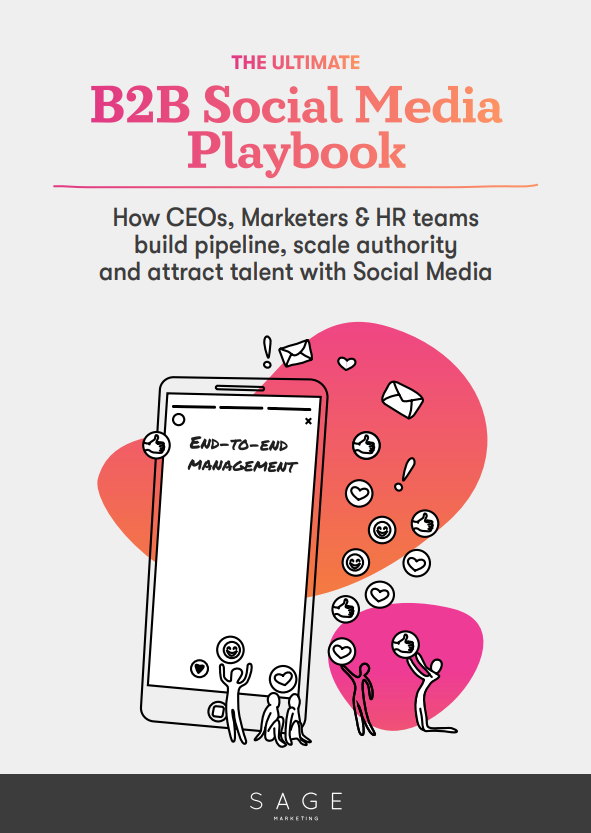
It started as research. We were developing The Ultimate B2B Social Media Playbook and needed real examples of what genuine thought leadership looks like on LinkedIn. People we could point to and say: this is someone worth paying attention to, this is the kind of presence that actually adds value to your feed.
The natural starting point was the most recognizable names. The founders of the companies we all know, the executives whose names come up at every conference, the people building platforms the rest of the world uses every day.

And that’s where things got interesting.

Because most of them aren’t really on LinkedIn. Not in the way we were looking for. The profiles are there, but the activity, where it exists at all, tends to be reshared company announcements or a photo from the latest industry event. Nothing wrong with that. It just wasn’t what we were looking for, and it told us that the list we needed to build was going to require a lot more digging than we expected.

So we widened the search and got much more specific about what we actually meant by thought leadership.

We were looking for two things: people who are genuinely sharing their own insights and perspectives, and people who might not be creating original content regularly but who reshare the ideas of others thoughtfully and intentionally, because that matters too. It signals curiosity. It signals a genuine interest in learning and in bringing others along. Both count.

What we found when we applied that criteria surprised us: finding 100 genuine thought leaders in the Israeli B2B ecosystem is harder than it should be. Not because the talent isn’t there, it absolutely is, but because so much of the thinking, the hard-won lessons, the honest reflections on what it takes to build something from nothing, is staying inside people’s heads instead of making it onto their feeds. The world, other founders, employees, young people entering the industry, global peers, is missing out on perspectives that could genuinely shape how they think and work.

Why This List Goes Beyond the C-Suite

There’s a tendency, in Israel and elsewhere, to treat the founder or CEO as the only voice in an organization that’s worth amplifying. SAGE doesn’t buy that, and this list reflects it.

Thought leadership isn’t a title. It’s a choice.

And in Israel right now, where entire industries are being invented in real time, that choice is available to everyone, not just the people at the top of the org chart. Marketers are figuring out how to build global audiences for Israeli companies at a moment when the word “Israel” itself has become complicated in international markets. They’re learning how to market AI tools when the landscape shifts every few weeks. HR leaders are hiring for roles that didn’t exist when their candidates were in school, and building people programs for workforces that look nothing like they did three years ago. These are not small challenges. These are genuinely new problems being solved in real time, and the people solving them have things to say that the rest of the industry needs to hear.

So this list includes CEOs and founders, but it also includes marketers, HR and people leaders, and a handful of thought leaders whose job titles don’t fit neatly into any category but whose voices are too valuable to leave off. An airline pilot. A chief economist. A former government envoy. The criteria was never about what someone does for a living, it was about whether they show up and share something worth reading.

What the List Revealed: Culture is Contagious

One of the most interesting things to emerge from building this list wasn’t about individuals at all.

It was about companies.

Several organizations ended up with more than one person on the list. Not because we went looking for them as a group, but because their people kept showing up independently, consistently, with real substance. And when that pattern became clear, it said something important: this isn’t coincidence. This is culture.

When multiple people from the same organization are all choosing to show up on LinkedIn with genuine insight and generosity, it means something has been decided at the organizational level, that having a voice online is valued, that sharing expertise is encouraged, that LinkedIn is a place where their people are not just permitted but genuinely supported in thinking out loud. The benefits flow in every direction: the broader community learns from their experts, employees feel seen and recognized beyond the walls of the company, and the organization’s name keeps showing up in the feeds of exactly the people they want to reach.

The companies that earned multiple spots on this list – Aleph, Fiverr, Wix, Reclaim Security, Taboola, Team Me, HiBob, Jazz, and Microsoft Israel – deserve recognition not just for the individuals they put forward, but for the culture that made those individuals possible.

We need more companies like them.

How to Get the Most From Following Thought Leaders

This list has 100 people on it, and we already know it’s incomplete. There are people who belong here that we missed, and we genuinely want to hear who they are.

But we also want to say something that might be slightly uncomfortable: not everyone who posts on LinkedIn is a thought leader, and that’s okay. What it means is that the people on this list have genuinely earned their place, and that there’s real work involved in showing up consistently with something worth saying.

If you’re already doing that, keep going. More people are reading and learning from your content than you probably realize, and your voice matters more than you think, especially right now, especially from Israel.

If you’ve been sitting on ideas and haven’t made the leap yet, consider this a nudge. You don’t need a content strategy or a personal brand framework or a posting schedule. You just need to start. You have more to say than you’re giving yourself credit for.

And if you’re not ready to create your own content yet, that’s completely fine, follow these people, engage with what they share, leave a comment, hit reshare. Amplifying someone else’s voice is its own form of contribution, and it counts.

The goal is simple: more Israeli B2B voices in the global conversation. More perspectives from the people who are actually in the middle of building the future. More of the thinking that we know is happening but that isn’t making it onto enough screens.

Want to build your own presence on this list someday?

The Ultimate B2B Social Media Playbook is SAGE’s guide to social media for CEOs, CMOs, HR leaders, and anyone who wants to show up on LinkedIn with something worth saying. It’s the resource we wish existed when we started looking for Israeli thought leaders to feature, a practical, honest guide to building a presence that actually adds value.

[Download The Ultimate B2B Social Media Playbook, link]


The List: 100 Israeli B2B Leaders Worth Following

CXO / Founder / Partner

Adam Singolda
Founder & CEO
Taboola 

Ami Daniel
Co-Founder & CEO
Windward 

Amitay Boneh
Co-Founder
Builders Lab 

Barak Klinghofer
Founder & CEO
Reclaim Security 

Dudi Malits
Co-Founder and CEO
Viper 

Eldad Postan-Koren
Co-Founder and CEO
WINN.AI 

Evgeny Sinay
CEO
Ultra AI 

Eynat Guez
Co-Founder & CEO
Papaya Global 

Eze Vidra
Managing Partner
Remagine Ventures 

Gal Aga
CEO & Co-Founder
Aligned 

Guy Katsovich
Founding Partner
Fusion VC 

Guy Manzur
Founder
Lunair 

Hadar Sutovsky
Investor 

Helen Gottstein
CEO
Loud and Clear Training 

Ido Livneh
Co-Founder & CEO
Jazz 

Itai Manor
Co-Founder
Rev.Hub 

Jeremie Berrebi
Founder & CEO
Magical Capital 

Kobi Samboursky
Founder & Managing Partner
Glilot Capital Partners 

Lior Div
Co-Founder & CEO
7AI 

Luiza Jarovsky
Co-Founder
AI, Tech & Privacy Academy

Maayan Gordon
5x Founder 

Maor Shlomo
Founder
Base44 

Matti Zinder
Founder & Chairman
DB Group Investments 

Micha Kaufman
Co-Founder & CEO
Fiverr 

Michael Eisenberg
General Partner
Aleph VC

Michal Braverman-Blumenstyk
Corporate Vice President
Microsoft 

Michal Oshman
CEO & Founder
Maximize Consultancy 

Moshe Dalman
CEO & Co-Founder
RodRadar 

Nadav Ellinson
Co-Founder
Blue and White Finance 

Natalie Lorberboym Mano
General Manager
PepsiCo Labs 

Neta Meidav
Co-Founder & CEO
Vault Platform

Nicole Priel
Investor 

Noa Zilberman
Co-Founder & CEO
Future Summit 

Noam Bardin
Founder
Flytrex

Omer David Keilaf
CEO and Co-Founder
Innoviz Technologies 

Pini Yakuel
Founder & CEO
Optimove 

Raquella Raiz
CEO
Stealth 

Ronni Zehavi
Co-Founder and CEO
HiBob 

Ruben Hassid
Founder & AI Content Creator 

Sagiv Malihi
CTO
Aleph VC 

Shahar Matorin
Founder & CEO
Startup Grind Education 

Shelly Tsalik
Founder & CEO
She.E.O Forum 

Sivan Cohen Shachari
CEO
The DeserTech & Climate Innovation Center 

Tal Alexandrovitz Segev
CEO
Ben Horin & Alexandrovitz 

Tomer Cohen
Advisor, Former Chief Product Officer
LinkedIn 

Tomer Diari
General Partner
Aleph VC 

Yael Kochman
GM, Syte by Nayax | Partner & CEO
Re:Tech Innovation Hub 

Yasmin Lukatz
Investor 

Yoseph Haddad
CEO
Together – Vouch For Each Other 

Yotam Tzuker
CEO & Co-Founder
Team Me 

Yuval Passov
Global Founder Advocate
Google for Startups 

Yuval Yarden
Founder
Pollinate 

Zohar Einy
CEO
Port.io 

HR / People

Adi Kovalyo
HR & Community Growth
WIZO 

Amit Lavy
Global R&D Brand & Developer Relations Team Lead
AT&T Telecommunications

Elit Hershko
Director of Global Talent Acquisition
Orbia (Netafim) 

Hadas Almog
CPO
Cloudinary 

Liron Hiroshi
Head of Global People Experience
Wiz 

Michal Gonen
Senior Employer Branding & Communications Manager
Plarium 

Mihal Elior (Sharabi) Ophir Azran
AI-Savvy Organizational Consultant
Ministry of Education, Israel 

Moran Segal
Country HR Manager
ARM Israel Semiconductor 

Naama Gelband
Global Internal Communications & Employer Brand Lead
Fiverr 

Naama Koren
Tech Career Consultant 

Netanel Ben Gigi
HR Manager & Employer Branding Manager
OZ 

Nofar Amos
Employer Branding Specialist
Monday.com 

Ofer Hirsh
Corporate Communications and Employer Branding Director
Israel Railways Company Transportation

Sharon Steiner
CHRO
Fiverr 

Yarden Gur
Brand Marketing Manager
Intuit 

Marketing

Adi Stein
Snr Cloud & AI GTM EMEA-Israel
Microsoft 

Amir Barkol
Head of Social Media & Brand
Microsoft Israel R&D Center 

Amit Ashbel
VP Marketing
Reclaim Security 

Ari C. Applbaum
VP Marketing
LeapXpert 

Asaf Azulay
Partner & CMO
Team 8 

Danielle Guetta
VP Marketing
Jazz 

Dror Wayne
Head of Marketing
Zimark 

Elit Ben Basat Nuriel
Head of Cloud Marketing
Google Cloud Israel 

Erica Marom Chernofsky
CMO
Aleph VC 

Gai Van-Straten
Senior Marketing Manager
HiBob 

Gily Netzer
SVP Marketing EMEA
JFrog 

Guy Aga
האקדמיה למקצועות הבינה המלאכותית 

Igal Bareket
CMO
Bank Hapoalim 

Jennifer Gutman
Director of Product and Customer Marketing
Oktopost 

Joanna Braunold
Director of Brand & Communications
Band

Judith Charbit
GTM Lead
Team Me 

Liz Cohen
Head of Marketing, VP Platform
Hetz Ventures 

Ofir Bloch
SVP Corporate Marketing
WalkMe

Polly Alluf
VP Marketing

Ran Gishri
VP Marketing, Self Service Business
Taboola 

Sarah Adam
Head of Influencer Marketing
Wix 

Sharon Argov
CMO
AI21 Labs 

Shira Levy Barkan
Marketing Strategy & GTM
Tel Aviv University 

Shiri Katalan
VP Marketing
Onit Security

Shlomo Genchin
Creative Director
Unbore 

Tom Orbach
Director of Growth Marketing
Wiz 

Thought Leaders

Adva Amir
Airline Pilot & TEDx Speaker 

Ben Lang
Building
Cursor 

David Schwartz
VP Tech Strategy, Partnerships and Innovation
PepsiCo 

Dror Poleg
Author & Speaker
Decoding the Future of Work & Cities 

Gad Levanon
Chief Economist
Burning Glass 

Noa Tishby
Former Special Envoy for Combating Antisemitism 

FAQs

What platforms are best for following thought leaders?

For B2B, LinkedIn is the clear answer – it’s where professional conversations happen, where industry knowledge gets shared, and where the people on this list are most active. That said, many thought leaders carry their ideas across multiple platforms. Some publish longer-form thinking on Substack, where they have more space and fewer algorithmic constraints. Others are active on X, particularly for real-time commentary on fast-moving industries like AI and cybersecurity. The best approach is to start with LinkedIn and then follow the people who resonate with you to wherever else they publish.

How many thought leaders should I follow at once?

There’s no magic number, but there is a principle worth keeping in mind: quality of attention beats quantity of follows. Following 500 people and scrolling past most of them is less valuable than following 30 people whose content you actually read, engage with, and learn from. We’d suggest starting with a focused list, maybe 20 to 30 people across the verticals most relevant to your work, and letting it grow organically from there. If someone’s content keeps making you stop and think, follow them. If you realize you’ve been scrolling past someone for months, it’s okay to unfollow. Your feed should feel like a resource, not an obligation.

How do I find niche thought leaders in my specific B2B vertical?

A few approaches that actually work: start with the people you already respect and look at who they follow and engage with – thought leaders tend to cluster around each other. Search LinkedIn for keywords related to your vertical and filter by posts rather than profiles, because the people writing consistently about a topic will surface faster than people who just have it in their headline. Pay attention to who keeps showing up in the comments sections of content you find valuable – the most thoughtful voices in any niche are often more visible in replies than in their own posts. And lists like this one are a shortcut. We’ve done the work of identifying people across verticals so you don’t have to start from scratch.

Are influencers the same as thought leaders?

Not quite, and the distinction matters. An influencer’s value is primarily in their reach: the size of their audience and their ability to get a message in front of a lot of people. A thought leader’s value is in the quality and originality of their thinking: the ability to shift how you see a problem, introduce an idea you hadn’t considered, or articulate something you felt but couldn’t name. The two can overlap: some thought leaders have large audiences, and some influencers do genuinely original thinking. But when we built this list, we weren’t looking for follower counts. We were looking for people whose content makes you smarter, more curious, or better at your job. 

Aliza Hughes Head of Social Media
About
the author
Aliza is a seasoned content and social media strategist with over a decade of experience humanizing B2B tech brands through organic growth and executive thought leadership.
Learn more

How B2B Tech Companies Can Use AI Search to Generate Pipeline in 2026

Michal <br>Tidhar
written by Michal
Tidhar
CMO as a Service

As CMO as a Service at SAGE, Michal is the external CMO for B2B tech companies: the senior marketing head they need, with a full team behind her, working like one of their own. She's who you call when you're tired of marketing that looks busy and changes nothing.

Sarit<br> Lamerovich
reviewed by Sarit
Lamerovich
Founder/CEO

Sarit founded SAGE to allow technology companies to take innovation to the next business level and fulfill the entrepreneur’s dream to change the world by building market recognition, increasinge customer awareness and improvinge the foundation for strong and sustainable revenue growth.

10 min read
Share
Why Partner with SAGE Marketing?
100+ B2B tech companies and startups — we literally grow unicorns.
No office, no walls — we work inside your world, embedded in your team.
Full-stack marketing approach: strategy, storytelling, content, HubSpot and execution under one roof.
Let’s Build Something Remarkable!
Whether you’re launching, scaling, or rebranding —
we’ll help you connect,
engage, and grow.
Contact us
client logo client logo client logo client logo client logo client logo
AI Marketing B2B Marketing AI tools AI search

One of the questions founders ask me most often this year sounds something like: “We spent a decade earning our Google rankings. So why does ChatGPT keep recommending our competitors?”

The question stings because the effort was real. But buyers changed the venue. They still do their research; they simply do a growing share of it inside AI assistants, where your rankings and your analytics can’t follow them. Generative engine optimization (GEO) is the discipline built for that shift: shaping your content and your reputation so that when a buyer asks ChatGPT, Gemini, or Perplexity who solves their problem, your company appears in the answer.

In this post I want to show you how AI search turns into pipeline in practice, the mistakes I keep seeing B2B teams make, and a framework you can start running this quarter.

Key Takeaways

  • B2B buyers now research vendors inside ChatGPT, Gemini, and Perplexity before they ever visit your website. In Semrush’s spring 2026 survey of over 600 US B2B professionals, 92% said AI tools shaped their vendor shortlist.
  • AI assistants cite content that answers questions directly: clear definitions near the top of the page, FAQ sections, schema markup, and original data.
  • Your AI visibility depends on your whole digital footprint, so mentions on trusted third-party sites count as much as anything on your own blog.
  • GEO is measurable. You can test what AI assistants say about your company today, fix the gaps, and track mentions quarter over quarter.
  • Small B2B companies can win in AI search, since assistants reward specific, well-structured answers over big-brand budgets.

How B2B Buying Behavior Has Changed With ChatGPT, Gemini, Claude & Perplexity

B2B buyers have moved a large share of their research out of search engines and into AI conversations. Instead of typing a keyword and clicking through ten results, they ask ChatGPT or Perplexity a full question (“which OT security vendors fit a mid-size utility?”) and receive one synthesized answer, complete with named vendors and reasons to pick them.

Gartner saw the move coming back in 2024, predicting that traditional search volume would fall 25% by 2026 as AI assistants absorb those queries. Reality turned out messier than the prediction, as reality tends to. Search didn’t collapse, but a meaningful slice of high-intent research moved into chat windows, and high-intent research is the slice B2B marketers care about.

The numbers back up what founders tell me. In Semrush’s survey of over 600 US B2B professionals this spring, 66% said they regularly use AI tools to research products, vendors, or solutions, and 92% said AI shaped their most recent vendor shortlist. We saw the same pattern in our own research for the State of B2B Tech Marketing for 2026, built on 150+ clients across 14 verticals and 50 CMO interviews: buyers arrive informed, opinionated, and further down the funnel than your CRM thinks they are.

So the implication for your team is uncomfortable but useful. By the time someone fills out your demo form, an AI assistant may have already told them how you compare with rivals, what your pricing roughly looks like, and what your users complain about. The first sales conversation now starts long before the first sales conversation.

Why B2B Buyers Increasingly Discover Vendors Through AI Answers

Buying teams now use AI assistants as their first filter, which means vendor discovery happens inside the answer, before anyone opens a website. A committee evaluating a data platform will ask Perplexity to compare vendors, ask ChatGPT to summarize the trade-offs, and only then visit three or four websites out of a market of forty.

Buyers treat those answers with healthy skepticism, to be fair. In the same Semrush survey, 75% said they trust AI vendor recommendations, and nearly all said they verify before committing. The AI answer rarely closes a deal on its own, but it decides who gets considered at all. And in B2B, the shortlist is most of the battle.

The hard part for marketers: when the assistant leaves your company out, the buying team rarely goes looking for you. There’s no page two to scroll to. Absence from the answer reads like absence from the market.

I’ve watched founders type their own category into ChatGPT for the first time. The silence in the room when their company doesn’t appear is very educational.

How to Structure Content So AI Systems Cite Your Company

AI systems cite content that answers a question completely, in a passage they can lift cleanly. The whole craft of AI search optimization comes down to writing pages a language model can quote without doing extra work.

Five habits make the biggest difference:

  • State clear definitions early. Put a plain, one-paragraph definition of your category or product near the top of the page. Models grab defining sentences, so write the exact sentence you want quoted.
  • Use FAQ sections. Direct questions paired with 40-70 word answers mirror how buyers prompt assistants. FAQs are prime citation real estate.
  • Add schema markup. Structured data (FAQ, Organization, Product) helps machines understand what your page claims and who claims it.
  • Publish original data. Assistants love citable numbers with a named source behind them. When we surveyed our client base for the 2026 report, 78% of B2B tech companies were already using AI in content production while engagement fell 38%. A stat like that earns citations precisely because nobody else has it. One modest proprietary survey beats ten opinion posts.
  • Keep brand mentions consistent. Use the same company name, product names, and descriptions everywhere you appear. When your descriptions differ across sites, models struggle to connect the mentions into one entity.

Not every asset carries equal weight here. Educational content built to answer real buyer questions does most of the citation work, and the logic behind the three types of content your B2B startup needs aged well: help first, sell later. AI assistants feel the same way.

Common GEO Mistakes B2B Marketers Make

Most GEO failures come from treating AI search like classic SEO wearing a new hat. Four mistakes come up again and again:

  • Focusing only on keywords. Answer engine optimization rewards complete, quotable answers. Stuffing a page with terms while dodging the underlying question gets you skipped, politely and permanently.
  • Skipping schema markup. Teams file structured data under “technical nice-to-have,” then wonder why machines misread their pages. Machines read structure first and prose second.
  • Using inconsistent brand names across the web. If your Crunchbase entry says one thing, your LinkedIn page another, and your website a third, assistants split your identity into fragments and cite none of them.
  • Ignoring the outside sources AI tools quote. Assistants lean heavily on third-party sites: review platforms, industry lists, LinkedIn, Reddit. Profound’s analysis of over a million AI citations found LinkedIn among the most cited domains for professional queries. If your presence there is thin, start with growing your B2B social media audience before expecting assistants to vouch for you.

The pattern across all four: teams keep polishing their own website while the models look at everything else.

A Practical GEO Framework for B2B Tech Companies

A generative engine optimization program doesn’t need a moonshot budget; it needs a repeatable loop. We now build the loop below into every plan, the same way we approach building a marketing strategy for 2026: start from where buyers already are.

Step 1: Check your current AI visibility. Ask ChatGPT, Gemini, and Perplexity the questions your buyers ask, in their words. Record which vendors appear, what each assistant says about you, and which sources it pulled from. The baseline usually surprises people, rarely pleasantly.

Step 2: Structure your content to be quotable. Rework your highest-intent pages using the habits above: a clear definition up top, an FAQ section, schema markup, and at least one citable stat per page. Write for a model that quotes one paragraph at a time.

Step 3: Build mentions on trusted external sites. Pitch industry lists, contribute expert commentary, keep your review profiles current, and show up in the communities your buyers read. Third-party mentions carry a weight your own domain can’t generate alone.

Step 4: Track when AI tools mention you. Re-run your baseline prompts monthly, log mentions and sentiment, and watch for AI-referred sessions in your analytics. Mentions make a fine early signal, but pipeline is the goal, so tie AI-referred visits to demo requests and closed deals rather than celebrating visibility for its own sake.

Step 5: Repeat. Models retrain and answers shift, so GEO works more like a habit than a project you finish. Each pass through the loop compounds the last one.

Why HubSpot Is Becoming a Strategic Platform for AI Search

As AI search continues to reshape how B2B buyers discover and evaluate vendors, companies need more than AI-friendly content – they need a way to measure, optimize, and connect AI visibility to business outcomes.

This is where HubSpot is taking a unique approach. With the introduction of HubSpot AEO (Answer Engine Optimization), marketers can monitor how their brand appears across AI platforms such as ChatGPT, Gemini, and Perplexity, benchmark their visibility against competitors, analyze which sources AI engines cite, and identify the prompts that matter most to their buyers. Even more importantly, HubSpot provides actionable recommendations that help teams improve their AI visibility instead of simply measuring it.

Unlike standalone AEO tools, HubSpot combines these insights with your CRM, website analytics, attribution reporting, and marketing automation. This enables marketing and sales teams to understand not only whether AI search is driving traffic, but also which prompts, pages, and AI-generated referrals are creating qualified leads, opportunities, and revenue.

Another unique advantage is that HubSpot’s AEO capabilities leverage your CRM data to suggest relevant prompts based on your industry, customers, and competitive landscape – making optimization significantly more strategic than relying on generic keyword research alone.

Checklist: 10 Actions Every Marketing Team Should Take This Quarter

  1. Ask ChatGPT, Gemini, and Perplexity your ten most important buyer questions, and save the answers.
  2. Note every prompt where competitors appear and you don’t.
  3. Add a clear, one-paragraph definition of your product and category to your homepage and key product pages.
  4. Add an FAQ section to your five highest-intent pages, with answers of 40 to 70 words.
  5. Implement FAQ and Organization schema markup across those pages.
  6. Audit your company descriptions on LinkedIn, Crunchbase, G2, and your website, and align them word for word.
  7. Publish one piece of original data. A small customer survey counts.
  8. Pitch two industry roundups or vendor lists in your category.
  9. Set up a monthly log of AI mentions and AI-referred traffic.
  10. Brief your sales team on what AI assistants currently say about you, so demo calls stop surprising them.
  11. If you use Hubspot – Activate the AEO software, decide which buyer questions matter most, review how your brand and competitors appear today, and identify the content or positioning gaps worth addressing.

FAQ

How long does it take to see results from GEO?

In our client work, structural fixes (definitions, FAQs, schema markup) start appearing in AI answers within two to three months, while reputation building on third-party sites takes six months or longer. Treat the timeline like SEO’s, with occasional faster wins when an assistant picks up a fresh page. Anyone promising results in two weeks is selling you something.

Can small or early-stage B2B companies compete in AI search, or is it only for big brands?

Small companies can absolutely compete. AI assistants reward specific, well-structured, well-evidenced answers, and a focused startup can produce those faster than an enterprise with a six-layer approval chain. In niche B2B categories, one sharp definition page plus consistent third-party mentions can outperform a household name that never answered the actual question.

Does GEO work the same way across ChatGPT, Gemini, and Perplexity, or do they each need a different approach?

The fundamentals transfer: quotable answers, schema markup, consistent naming, third-party proof. The platforms differ in sourcing, though. Perplexity cites live web results generously, Gemini leans on Google’s index, and ChatGPT blends training data with browsing. Citation studies show ChatGPT and Perplexity share only around 11% of cited domains, so check your presence on each rather than assuming overlap.

How do you measure whether GEO is actually working?

Track three layers: visibility (how often assistants mention you across a fixed set of prompts), traffic (AI-referred sessions in your analytics), and pipeline (demo requests where buyers mention AI research). Re-run the same prompts monthly so you measure movement rather than noise, and put “how did you hear about us” on every form. Buyers will tell you.

Does using AI to write content help or hurt your chances of being cited by AI search tools?

Generic AI-written content hurts. Our own 2026 client research links the flood of AI-produced content to falling engagement, and assistants have no reason to cite average text they could generate themselves. Using AI as a drafting assistant works fine when humans add what models can’t invent: original data, client stories, a real point of view. Citations go to sources that add information.

The Answers Are Still Soft Enough to Shape

The companies that won early Google didn’t win because they loved search engines. They won because they took a new channel seriously while their competitors dismissed it as a fad. AI search is the same moment repeating itself, and in 2026 the answers are still soft enough to shape.

At SAGE, we run GEO programs alongside classic SEO for our B2B tech clients, and the two feed each other: strong SEO foundations make GEO faster, and GEO forces the content discipline SEO always wanted from us anyway.

So start small: ask the assistants about your company this week. Whatever they say, you’ll know exactly where you’re starting from. And if you’d like a second pair of eyes on the answer, you know where to find me.

Michal
Tidhar
CMO as a Service
About
the author
As CMO as a Service at SAGE, Michal is the external CMO for B2B tech companies: the senior marketing head they need, with a full team behind her, working like one of their own. She's who you call when you're tired of marketing that looks busy and changes nothing.
Learn more

The State of B2B Social Media (2026 Report)

Sarit<br> Lamerovich
written by Sarit
Lamerovich
Founder/CEO

Sarit founded SAGE to allow technology companies to take innovation to the next business level and fulfill the entrepreneur’s dream to change the world by building market recognition, increasinge customer awareness and improvinge the foundation for strong and sustainable revenue growth.

Aliza Hughes
reviewed by Aliza Hughes Head of Social Media

Aliza is a seasoned content and social media strategist with over a decade of experience humanizing B2B tech brands through organic growth and executive thought leadership.

15 min read
Share
Why Partner with SAGE Marketing?
100+ B2B tech companies and startups — we literally grow unicorns.
No office, no walls — we work inside your world, embedded in your team.
Full-stack marketing approach: strategy, storytelling, content, HubSpot and execution under one roof.
Let’s Build Something Remarkable!
Whether you’re launching, scaling, or rebranding —
we’ll help you connect,
engage, and grow.
Contact us
client logo client logo client logo client logo client logo client logo
Social Media B2Bmarketing

Drawing on data from 150+ active clients across 8 social platforms. Exploring what separates B2B brands building durable audiences from those still broadcasting into the void.

B2B social media is splitting in two: brands that own audiences and brands that rent attention. 

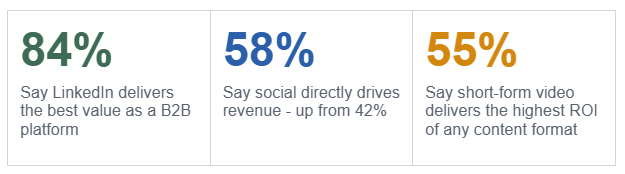
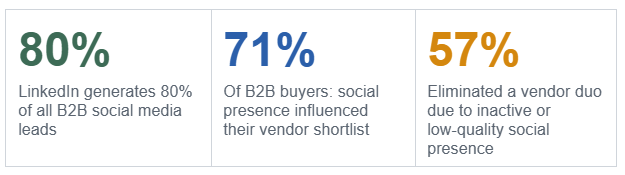
In 2026, LinkedIn consolidated its dominance. 84% of B2B marketers say it delivers the best organic results, and it now accounts for 84% of all B2B social media leads. Short-form video emerged as the highest-ROI content format, yet the majority of B2B tech teams are not taking advantage of this type of content. 

AI-generated social content has increased drastically, yet, is not always the best solution for content creation. Buyers have noticed: 57% say they can detect it, and 71% of those report reduced trust in that brand. The platforms posting with genuine human perspectives and not with generic content are creating the warmest B2B pipeline. 

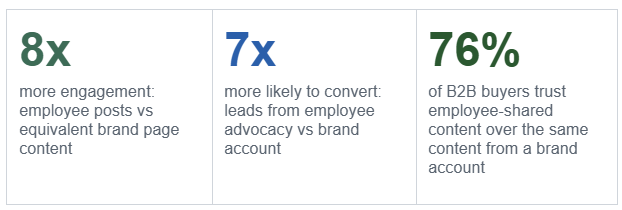
Meanwhile, employee advocacy remains the most underleveraged channel in B2B social. Employee posts generate 8x more engagement and leads from advocacy convert 7x more frequently than brand-direct leads. Yet fewer than one in three companies recognize its importance for company visibility.

The divergence is accelerating.

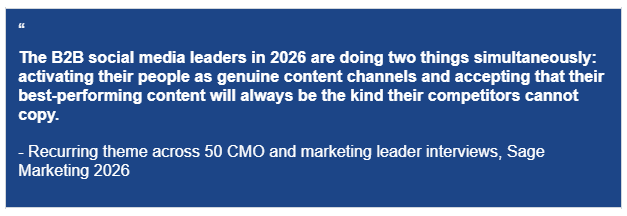
The B2B social media leaders in 2026 are doing two things simultaneously: activating their people as genuine content channels and accepting that their best-performing content will always be the kind their competitors cannot copy.

LinkedIn’s organic reach is tightening, but quality content is outperforming more than ever.

LinkedIn engagement jumped 44% year-on-year. Yet 68% of B2B buyers review a vendor’s LinkedIn before agreeing to a first sales meeting, and 54% have eliminated a vendor entirely because of a weak social presence. Multi-image carousels generate the highest likes and comments on the platform; videos are the most shared content type. Top-quartile content now earns 4.2x more impressions than the average post.

Employee advocacy is the most underleveraged channel in B2B social.

Posts from individual employees generate 8x more engagement than equivalent brand page posts, and leads sourced through advocacy programmes convert 7x more frequently. 76% of B2B buyers say they are more likely to trust content shared by an employee than the same content shared by a brand account.

Short-form video is the highest-ROI format  and the biggest execution gap.

55% of B2B marketers say short-form video delivers the highest ROI of any content format. TikTok B2B usage doubled year-on-year, from around 8% to 19% of marketers. 46% plan to increase social video distribution over the next 12 months. Yet the majority of B2B tech companies still produce short-form video at low volume, creating a significant first-mover window.

Dark social generates the warmest pipeline and the lowest attribution confidence.

84% of B2B marketers say integrating data across platforms is their single biggest measurement challenge. 56% identify social ROI attribution as their top strategic challenge. Private channel sharing (LinkedIn DMs, Slack, WhatsApp) generates warm, qualified inbound but registers as direct traffic in analytics. 84% of B2B buyers actively seek peer input when researching, most of it in channels invisible to standard measurement.

AI content is detectable  and it is eroding brand trust at scale.

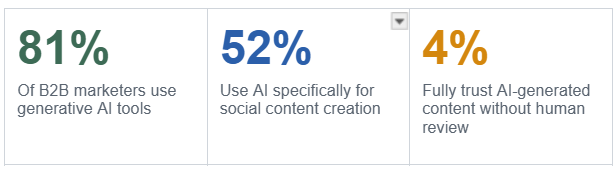
81% of B2B marketers now use generative AI tools: up from 34% in 2023. 52% use AI specifically for content creation. Yet only 4% fully trust AI output without human review, and only 38% have formal AI usage guidelines. The brands winning on social use AI for scheduling, reformatting, and research, not for generating the voice or opinion that buyers actually engage with.

Platform performance

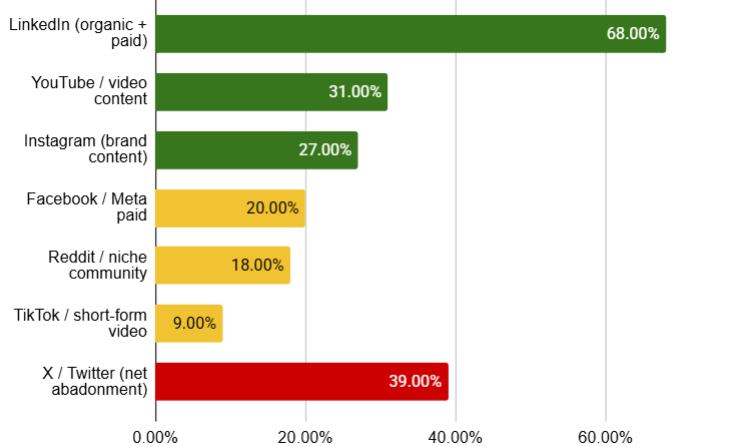
The B2B social landscape has consolidated sharply: LinkedIn is now the only platform where 84% of marketers say it delivers the best organic value, while X/Twitter has seen active abandonment. 39% of B2B marketers no longer use it at all, up from 27% the prior year. YouTube has emerged as the clear second platform for video-led strategies, with usage up 31% in a single year. TikTok’s B2B footprint doubled but remains nascent. 

Platform investment shift – percent of marketers increasing use:

Content Strategy

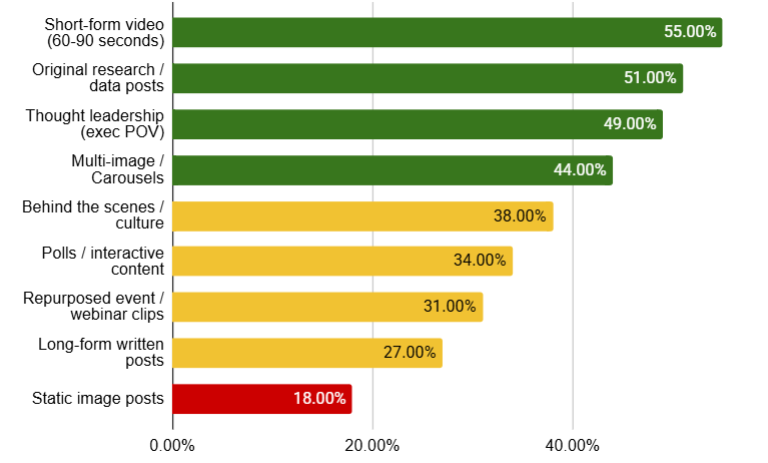
LinkedIn’s own engagement data shows which formats are earning attention: multi-image posts (6.6% engagement rate), native document posts (6.1%), and video (5.6%) consistently outperform other content types. Educational carousels generate up to 3.1x higher engagement than static posts. Lo-fi vertical video produces 2–3x more engagements than standard produced content for B2B brands.

Most effective B2B social media content formats – percent of marketers reporting high ROI:


Content volume on social has surged since AI tools became mainstream. 81% of B2B marketers use AI tools, but only 4% fully trust the output without human review.

Audience, Engagement & Dark Social

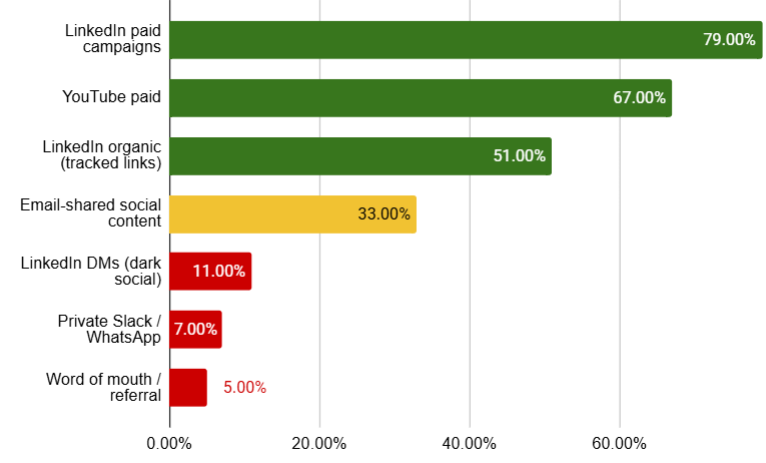
The warmest leads live where you can’t measure them. 84% of B2B marketers say integrating data across platforms is their top measurement challenge. The channels generating the most qualified pipeline: private DMs, Slack groups, WhatsApp shares, word-of-mouth referrals, all register as direct traffic in standard analytics. Investment follows measurement, so the best-performing channels remain chronically underfunded. 56% of teams identify ROI attribution as their top social media challenge. 

Social attribution confidence by channel

Employee Advocacy & Thought Leadership

Your people are your most powerful social channel. Employee content generates 8x more engagement than equivalent brand posts, and leads from advocacy programmes convert 7x more frequently. 76% of B2B buyers are more likely to trust content shared by an employee than by a brand account. 74% of marketers say employee advocacy is effective for brand awareness, but 74% of advocacy programme managers cite consistent participation as their biggest challenge.

Companies where the CEO maintains an active LinkedIn presence – posting regularly on industry topics, company milestones, and their own point of view – report measurably higher brand credibility, stronger inbound volume, and faster trust-building at the top of the funnel. A start-up CEO’s LinkedIn profile is often the first search result a prospect encounters. Marketing teams consistently report that CEO social activation multiplies the impact of every other channel.

Budgets are shifting from paid amplification to content and people. 

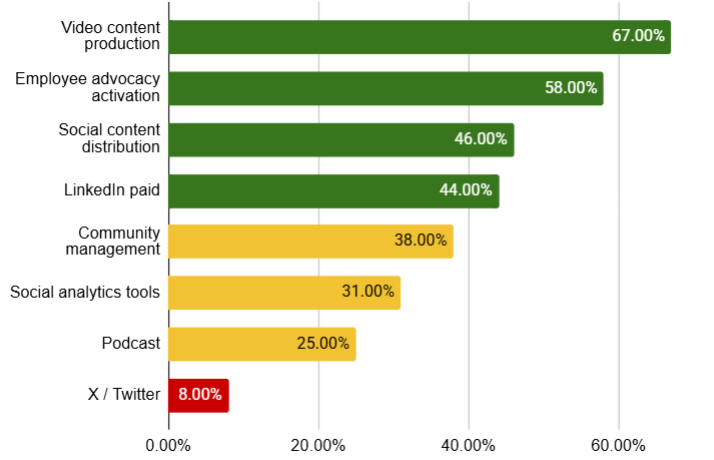
46% of B2B marketers plan to increase investment in social content distribution, and 41% plan to increase video distribution spend in the next 12 months. 84% currently use paid social channels and 73% run social ads. Budget allocation is shifting away from declining platforms toward content production, employee activation, and community management. The table below reflects SAGE client portfolio data across 150+ B2B tech companies.

Planned budget increases, next 12 months – percent of respondents

Track your social where your pipeline lives

The biggest barrier to sustained social investment is not performance, it’s proof. When social data lives in a separate analytics tool, disconnected from your CRM, email campaigns, and revenue data, it is almost impossible to demonstrate pipeline contribution to leadership. The measurement challenges documented throughout this report, 84% struggling to integrate data, 56% unable to attribute social ROI, are often a technology problem as much as a strategy problem.

Why SAGE Recommends HubSpot for B2B Social Tracking

HubSpot holds 38% of the global marketing automation market, the largest share of any platform, and serves 248,000+
customers across 135 countries. It is the only platform where B2B teams can manage social publishing,
monitor brand mentions, score leads from social engagement, and connect every interaction to a named CRM contact and a
revenue outcome, without any integration or data transfer between tools. LinkedIn organic social delivers 229% ROI and
LinkedIn paid delivers 192% ROI over three years when measured inside a unified platform like HubSpot.

HubSpot capabilityWhat it solves for B2B social teams
Social publishing + schedulingConsistent cadence managed within the same platform as CRM
Social monitoring / listeningBrand keyword and competitor tracking alongside pipeline data
Contact-level social attributionEvery social interaction tied to a named CRM contact record
Campaign-level reportingSocial alongside email, ads and content in one dashboard
Lead scoring from socialHigh-intent prospects identified automatically from engagement
Revenue attribution reportingSocial touchpoints connected to closed revenue
1,500 integrationsConnects to every tool in your marketing stack

SAGE implements HubSpot for B2B tech companies at every stage, from initial CRM setup through full RevOps configuration and social attribution. As a HubSpot Diamond Partner, we have implemented unified social and pipeline tracking for over 150 B2B companies. The most common outcome: marketing teams can show leadership exactly which social activity is generating pipeline.


What the highest-performing B2B social media teams are doing differently

Five behaviours consistently separate the top B2B social media teams from the rest. These are not tactics, they are structural commitments that compound over time. 

  • Make your people the channel, not just the brand account: Leading companies activate founders, executives, and subject-matter experts as primary LinkedIn channels. Individual thought leadership consistently outperforms brand page posts across every content format. This is infrastructure. It requires programme design, content coaching, and consistent activation.
  • Invest in short-form video: Lo-fi vertical video consistently outperforms produced content. The execution gap is wide and the window to establish category presence is still open.
  • Build community infrastructure, not just follower counts: Top performers build private communities(LinkedIn groups, invite-only roundtables) alongside their public social presence.
  • Accept dark social and measure leading indicators instead: Track DM volume, branded search uplift, profile visits, and content saves as leading indicators rather than demanding last-touch proof for every post.
  • Use AI for production logistics, never for voice: Use AI for scheduling, reformatting, research, and distribution. Do not use AI to generate opinion or narrative. Buyers engage with genuine expertise – AI cannot replicate it at the level that builds trust.

About this research 

Data pointDetail
Client base150+ active B2B tech companies
Research period2024 – 2026
Company statesSeed to Series B
Primary marketsUS, US, EMEA
Platforms tracked8 B2B social media platforms

Sarit
Lamerovich
Founder/CEO
About
the author
Sarit founded SAGE to allow technology companies to take innovation to the next business level and fulfill the entrepreneur’s dream to change the world by building market recognition, increasinge customer awareness and improvinge the foundation for strong and sustainable revenue growth.
Learn more

The 16 Best B2B Growth Marketing Agencies in 2026

Michal <br>Tidhar
written by Michal
Tidhar
CMO as a Service

As CMO as a Service at SAGE, Michal is the external CMO for B2B tech companies: the senior marketing head they need, with a full team behind her, working like one of their own. She's who you call when you're tired of marketing that looks busy and changes nothing.

Sarit<br> Lamerovich
reviewed by Sarit
Lamerovich
Founder/CEO

Sarit founded SAGE to allow technology companies to take innovation to the next business level and fulfill the entrepreneur’s dream to change the world by building market recognition, increasinge customer awareness and improvinge the foundation for strong and sustainable revenue growth.

10 min read
Share
Why Partner with SAGE Marketing?
100+ B2B tech companies and startups — we literally grow unicorns.
No office, no walls — we work inside your world, embedded in your team.
Full-stack marketing approach: strategy, storytelling, content, HubSpot and execution under one roof.
Let’s Build Something Remarkable!
Whether you’re launching, scaling, or rebranding —
we’ll help you connect,
engage, and grow.
Contact us
client logo client logo client logo client logo client logo client logo
Marketing strategy Cmo as a service startups marketing B2B Marketing

Almost every intro call I take opens the same way. A founder tells me the product is strong, the pipeline is thin, and the board wants to see movement by next quarter.

Choosing a growth marketing agency is usually the next sentence in that conversation. So I did what any marketer with strong opinions would do: I mapped the market, compared notes with the founders we work with, and wrote the list I wish someone had handed me years ago.

Full disclosure: The agency I work with sits at the top of this list. However, I’ll walk you through the exact criteria we used, so you can decide for yourself if we truly earned that spot.

Key Takeaways

  • SAGE Marketing is our top pick for B2B tech companies that want strategy and execution under one roof, led by a fractional CMO who owns the number.
  • Growth agencies treat your funnel as one system, from first touch to closed revenue, while traditional agencies tend to manage channels in isolation.
  • Retainers run from roughly $3,000 to $50,000+ per month, so the engagement model needs to match your stage before any contract gets signed.
  • Specialization beats size. An agency that knows your buyer will outperform a bigger one that doesn’t.
  • Your growth stage (pre-product-market fit, early scale, or expansion) should shape your shortlist as much as any ranking, including this one.

What Growth Marketing Agencies Do Differently

A traditional agency usually owns a channel. You hand over paid media, or content, or your website, and they report on the metrics of that channel.

A growth partner owns an outcome. The team looks at your entire funnel, finds the weakest link, and runs experiments until the number moves. When the bottleneck shifts from traffic to conversion, the work shifts with it.

In practice, you can spot the difference by the questions each one asks in the first meeting.
A channel agency asks for your brand guidelines. A growth team asks for access to your CRM, because pipeline is the only report that settles arguments. We broke down what that engine looks like day to day in our guide to running B2B tech marketing.

What to Look for in a Growth Marketing Agency

Over the years, I’ve learned that founders rarely regret the agency’s skill set. They regret the fit. So before you compare logos and awards, check these five things.

  • Proof in your category. Case studies with buyers who look like yours matter most, by a wide margin. A brilliant e-commerce team can still stumble on a nine-month enterprise sales cycle.
  • Full-funnel accountability. If the pitch mentions impressions before it mentions pipeline, keep looking. A serious b2b marketing agency will ask about your revenue targets in the first call.
  • Senior minds on your account. Ask who actually leads the work after the sale. The partner who pitched you and the junior who runs your campaigns can be very different people.
  • A visible experiment cadence. Real growth teams document what they test, kill what fails, and scale what works. Ask to see last quarter’s log.
  • Pricing that aligns incentives. Flat retainers reward pipeline. Percentage-of-spend pricing rewards a bigger ad budget, which is not the same thing.

The Best B2B Growth Marketing Agencies in 2026 (Full List)

We built the list from public case studies, review platforms like Clutch and G2, published pricing signals, and the conversations we have every week with B2B founders comparing partners. We weighted category depth and revenue accountability over headcount and awards.

1. SAGE Marketing

Yes, we put ourselves first, and since I run marketing here, you should read this entry with healthy skepticism, then check the receipts.

  • CMO-as-a-Service model: a fractional CMO owns your strategy, backed by a full execution team covering content, design, web, HubSpot, and demand generation. See the full scope of services.
  • B2B tech only. Cybersecurity, AI, SaaS, fintech, medtech, and IoT, with 100+ companies served, from seed stage to global scale-ups.
  • HubSpot Diamond Solutions Partner, with deep RevOps and marketing automation practice.
  • TechBehemoths’ best agency in Israel four years running (2022 through 2025), plus a 5.0 rating on Clutch.
  • Built for companies expanding globally, especially tech firms entering US and European markets.

2. Directive

Directive built its “Customer Generation” methodology for software and tech companies that want every dollar tied to closed revenue.

  • Performance-led: SEO, paid media, and CRO connected to CRM-level attribution.
  • Strong fit for mid-market and enterprise SaaS with meaningful ad budgets.
  • Publishes detailed benchmarks and teardown content, so you can inspect their thinking before you call.

3. Kalungi

Kalungi is the closest philosophical cousin to Sage on this list: a fractional CMO plus a full team, built exclusively for B2B SaaS.

  • Works only with B2B SaaS, mostly Series A through C.
  • Runs its T2D3 framework (triple, triple, double, double, double) for ARR growth.
  • Reported results include $4.7M in pipeline for CPGvision and 330% MQL growth for DataGuard.
  • Typical engagements land in the $15K to $25K per month range.

4. Refine Labs

Refine Labs reshaped how B2B marketers think about demand, arguing that buyers decide in channels your attribution software never sees.

  • Known for demand creation, dark-social thinking, and revenue-based measurement.
  • Premium retainers, generally $20K+ per month.
  • Best fit for SaaS companies above roughly $20M ARR; below that, the model gets expensive fast.

5. Powered by Search

Powered by Search works exclusively with B2B SaaS and built its playbooks around long sales cycles and multi-stakeholder deals.

  • Demand generation frameworks designed for complex buying committees.
  • Strength across SEO, paid media, and conversion work as one program.
  • A sensible pick when your deal size is high and your sales cycle stretches across quarters.

6. NoGood

NoGood runs squad-based growth teams out of New York for companies from startup to Fortune 100.

  • High-velocity experimentation across paid, organic, and lifecycle.
  • Client roster includes Amazon, TikTok, and P&G alongside earlier-stage companies.
  • Broader than pure B2B, so probe for experience with your specific buyer.

7. Single Grain

Single Grain combines SEO, paid acquisition, and CRO into one integrated program with real SaaS depth.

  • Long track record with software and technology brands.
  • Strong educational engine (podcasts, guides) that reflects how the team thinks.
  • Suits companies that want one partner across several channels at once.

8. Animalz

Animalz has set the editorial bar for B2B content for a decade.

  • Long-form thought leadership for brands like Intercom, Amazon, and Slack.
  • Content strategy tied to positioning, not keyword lists alone.
  • A content partner rather than a full-funnel one, so pair it with demand muscle elsewhere.

9. Siege Media

Siege Media builds organic growth engines through editorial content, technical SEO, and digital PR.

  • Known for content that earns links on merit instead of outreach volume.
  • Publishes traffic-value results openly, which we respect.
  • Best for companies where organic search is the primary growth lever.

10. Omniscient Digital

Omniscient Digital turns content and SEO into a growth channel for B2B software companies.

  • Founded by alumni of HubSpot and Shopify content teams.
  • Focuses on ranking content that maps to revenue, with published frameworks.
  • Lean and senior; a good match for teams that want strategy with their production.

11. Ironpaper

Ironpaper specializes in demand generation and ABM for complex, technical B2B sales.

  • Deep experience across technology, healthcare, industrial, and telecom.
  • Combines lead generation, content, websites, and sales enablement.
  • Built for long sales cycles with multiple decision-makers at the table.

12. New Breed

New Breed pairs HubSpot-native RevOps consulting with managed demand execution.

  • Elite-tier HubSpot partner with proprietary apps built on the platform.
  • Strong choice when your CRM and marketing engine need rebuilding together.
  • Expect platform depth first, creative range second.

13. Walker Sands

Walker Sands merges B2B PR with digital marketing, which few agencies do well under one roof.

  • Focused on technology, healthcare, and manufacturing brands.
  • Earns visibility and demand in the same program, useful for category creation.
  • A fit when credibility and coverage matter as much as clicks.

14. Ladder

Ladder has run over 8,000 documented marketing experiments across 200+ clients since 2014.

  • Testing-first methodology with a public playbook of tactics.
  • Works across B2B and B2C, from early-stage to Fortune 500.
  • Choose it for rigor and volume of experimentation rather than deep B2B specialization.

15. Deviate Labs

A rocket scientist and an investment banker founded Deviate Labs in 2014, which tells you something about how it approaches growth.

  • Known for unconventional tactics, borrowing plays across industries and scales.
  • Comfortable with both scrappy startups and enterprise brands.
  • Best when you need creative breakthrough thinking rather than a standard playbook.

16. Tuff

Tuff operates as a transparent, channel-agnostic growth team that embeds with yours.

  • Sprint-based engagements with hypotheses, tests, and honest readouts.
  • Publishes pricing and process openly, which remains rare in this market.
  • Great for early-stage teams that want a hands-on partner rather than a vendor.

How Your Growth Stage Determines Which Agency Fits

The most common mistake I see is stage mismatch. Founders buy the agency they hope to need in two years instead of the one their funnel needs now.

Before product-market fit, you need positioning, fast experiments, and senior judgment, not a big media budget. A fractional CMO model gives you strategic leadership without the $250K+ salary commitment; we compared the options honestly in CMO-as-a-Service vs. in-house marketing.

In early scale, the goal changes: take the channel that works and build a repeatable engine around it. A b2b growth marketing agency with full-funnel ownership earns its retainer here, because every experiment compounds.

In expansion, complexity becomes the enemy. New markets, ABM motions, and RevOps plumbing demand a partner who has run this stage before. The best growth marketing agency for you at this point is the one with scars from your next challenge, not your last one.

FAQ

What does a growth marketing agency do?

A growth agency owns outcomes across your entire funnel rather than managing a single channel. The team identifies your biggest bottleneck, whether traffic, conversion, or retention, then runs structured experiments to fix it. Expect strategy, execution, and measurement in one loop, with pipeline and revenue as the scoreboard instead of channel metrics.

How is growth marketing different from digital marketing?

Digital marketing describes the channels: search, social, email, paid media. Growth marketing describes a method: form a hypothesis, test it, measure revenue impact, then double down or move on. A digital marketer might run excellent campaigns in isolation, while a growth marketer connects every campaign to one compounding system.

How much do growth marketing agencies typically charge?

Monthly retainers range from about $3,000 at boutique firms to $50,000+ for enterprise programs, with most B2B engagements landing between $5,000 and $25,000. Watch the pricing model as closely as the price: flat retainers reward pipeline growth, while percentage-of-spend deals reward a bigger ad budget.

What results should I expect from a growth marketing agency?

Expect early signals within the first quarter: better conversion rates, cleaner attribution, and validated messaging. Meaningful pipeline movement typically takes two to three quarters, depending on your sales cycle. Marketing rewards patience over quarters, and any agency promising overnight revenue deserves your skepticism.

Sixteen agencies is a long shortlist, so end where I began: match the partner to your stage, demand proof from your category, and make them show you the funnel, not the deck.

And if you’re a B2B tech company weighing your options, talk to us. Worst case, you leave the call with a sharper brief for whoever you choose instead.

Michal
Tidhar
CMO as a Service
About
the author
As CMO as a Service at SAGE, Michal is the external CMO for B2B tech companies: the senior marketing head they need, with a full team behind her, working like one of their own. She's who you call when you're tired of marketing that looks busy and changes nothing.
Learn more