




































How to Build a B2B Social Media Calendar Around Holidays, Awareness Days, and Events

Aliza Hughes
written by Aliza Hughes Head of Social Media

Aliza is a seasoned content and social media strategist with over a decade of experience humanizing B2B tech brands through organic growth and executive thought leadership.

Sarit<br> Lamerovich
reviewed by Sarit
Lamerovich
Founder/CEO

Sarit founded SAGE to allow technology companies to take innovation to the next business level and fulfill the entrepreneur’s dream to change the world by building market recognition, increasinge customer awareness and improvinge the foundation for strong and sustainable revenue growth.

5 min read
Share
Why Partner with SAGE Marketing?
100+ B2B tech companies and startups — we literally grow unicorns.
No office, no walls — we work inside your world, embedded in your team.
Full-stack marketing approach: strategy, storytelling, content, HubSpot and execution under one roof.
Let’s Build Something Remarkable!
Whether you’re launching, scaling, or rebranding —
we’ll help you connect,
engage, and grow.
Contact us
client logo client logo client logo client logo client logo client logo
Social Media

Key Takeaway

  • A strong B2B social media calendar balances evergreen content, planned date-driven posts, and open space for reactive content.
  • Only commit to awareness days that connect clearly to your audience, your expertise, or your company values.
  • Industry events deserve a before, during, and after content plan, not a single “we’re here” post.
  • Plan the big picture a quarter ahead, but review the calendar monthly and adjust weekly.
  • The most common mistakes are overcommitting to dates, ignoring capacity, and treating the calendar as fixed.

It’s 1pm on International Women’s Day, and someone on your team just noticed every competitor posted about it this morning. You scramble, publish something generic, and it gets eleven likes. Moments like this are rarely a creativity problem. They happen because your social team doesn’t have a clear plan for which holidays to post about, what to say on those days, and how each one is relevant to your audience.

Holidays, awareness days, and industry events are easy anchors to build a B2B social media calendar around, but they are also where many brands go wrong. This guide covers how to structure your calendar, choose the right dates, and keep it flexible enough to stay timely.

What Belongs on a B2B Social Media Calendar

A social media content calendar is more than a list of post dates. For B2B brands, it should map out every recurring content type, every fixed moment in the year, and the business priorities those posts support.

Start with your content pillars: the three to five core themes your brand consistently talks about, such as product education, customer success, industry insight, and company culture. Every slot on the calendar should ladder up to one of them, which also helps you spot imbalances, like a month that is 80% promotional.

Next, layer in fixed dates. These include:

  • Company milestones: product launches, anniversaries, funding news, and major hires.
  • Industry events: conferences, trade shows, and webinars your team is attending, sponsoring, or speaking at.
  • Awareness days: relevant observances like Cybersecurity Awareness Month or International Women’s Day, depending on your market.
  • Holidays: major public holidays in your customers’ regions, including dates when you might pause posting.
  • Business cycles: fiscal year ends, budget seasons, and buying cycles that shape what your audience is thinking about.

Finally, include campaign windows from other teams, like a sales push or a hiring drive. A B2B content calendar works best when it is shared across departments, not built in isolation.

How to Decide Which Awareness Days Are Worth a Post

Awareness days marketing is where social media calendars can get crowded fast. There is a national day for almost everything, but loosely connected posts rarely perform and can make a brand look like it is chasing attention.

It also helps to be clear on what these posts are for. Awareness day content isn’t meant to generate leads. Its job is to build brand awareness and show the people behind the logo. That means these are the posts where your brand can loosen up, show some personality, and have fun with your audience. Before adding any observance, ask four questions:

  1. Is it relevant to our audience? Would the people who buy from you care about this day, or recognize it at all? A cloud security company posting for Data Privacy Day makes sense. The same company posting for National Heart Health Day probably doesn’t, unless there is a genuine team culture angle.
  2. Do we have something credible to say? The best awareness day posts share a real perspective, a team story, or an insight only your company could offer. If the only thing you say is “Happy [Day]!” with a stock image, skip it.
  3. Does it connect to our values or actions? Observances tied to social causes should be handled with extra care. Audiences quickly call out brands that post support without internal action behind it, so only participate if you can point to what your company actually does.
  4. Can we make it engaging? Think about how your audience will interact with the post. A poll, a behind the scenes photo, a lighthearted question, or a team member’s take all invite comments far more than a polished graphic. If you can’t picture anyone replying, rethink the angle.

Build a master list of potential observances at the start of the year, then score each one against these criteria and keep only the clear passes.

Planning Around Industry Events and Trade Shows

Industry events are some of the highest value moments on a B2B social media calendar. Your buyers, partners, and competitors are all in one place, paying attention to the same conversations. But many brands reduce their event presence to a single booth photo. A better approach is to plan content in three phases.

Before the event (two to four weeks out): Build awareness and set up meetings. Announce your participation, share booth numbers or session times, introduce speakers from your team, and tease any launches or giveaways. This is also a good time to publish thought leadership related to the event’s main themes so your brand is already part of the conversation when attendees arrive.

During the event: Events are fun and messy, and even the best prepared teams with the tightest plans end up improvising. The best moments are rarely the ones you planned for, so your social team needs to stay on its toes. The goal of live content is simple: get people to your booth. That means creating FOMO and buzz, not polished announcements.

Authentic, in the moment posts perform best here. Share candid team photos, genuine interactions with visitors, and quick takeaways from other sessions, tagging the speakers so they and their audiences see it. Posts that show your team actively engaging with other attendees make your booth look like the place to be. Assign one person to own live coverage so posting doesn’t slip while everyone else is in meetings.

After the event (one to two weeks out): This phase is often skipped, and it is where much of the value lives. Publish a recap, thank partners and attendees, and repurpose session content into carousels or short clips. Follow up posts also give sales a natural reason to reconnect with people they met.

To make pre and post social media planning for B2B events easier, create a reusable event template with standard post types for each phase. Then you only need to fill in the specifics for each conference rather than starting from scratch every time.

Leaving Room for Reactive and Unplanned Content

A calendar that is 100% planned will eventually feel stale or out of touch. In between the planned content, industry news breaks, a customer shares a big win, or a meme takes off on LinkedIn. If every slot is already locked, your team either misses the moment or scrambles to shuffle posts around.

A practical rule is to keep around 20% of weekly slots flexible, either as “reactive” placeholders or as evergreen posts that can be bumped without losing anything important.

It might seem counterintuitive, but reactive content works best when you prepare for it in advance. That means:

Setting up listening: Follow key industry publications, analysts, influencers and hashtags so your team spots relevant news quickly.

Defining approval paths: Decide ahead of time who can sign off on timely posts, so a quick reaction doesn’t wait three days for approval and miss the opportunity.

Knowing your lane: Agree on which topics your brand will comment on and which it will avoid. Not every trending topic is yours to weigh in on, and B2B brands don’t need to jump on every trend. Exercise particular caution with trends that carry legal or compliance risk, such as memes built on copyrighted images, trending audio you don’t have rights to, or commentary on ongoing lawsuits. If a trend needs a legal review to be safe, it probably isn’t worth the risk. 

Just as important is knowing when to pause scheduled content. During a major crisis, tragedy, or sensitive news event, a cheerful pre-scheduled post will land badly. Make sure someone on the team is responsible for reviewing the queue when the news cycle shifts.

How Far Ahead to Plan and When to Revisit

Planning horizons work best in layers. Each layer has a different level of detail.

Annual view: Map out the big fixed moments: major holidays, confirmed events, planned launches, and the awareness days that passed your filter.

Quarterly view: Add campaign themes, pillars to emphasize, and rough post concepts for key dates. This is where you align with other departments.

Monthly view: Two to four weeks ahead, finalize copy, creative, and scheduling. This is where most teams work day to day.

Weekly check-in: Review what’s scheduled, fill reactive slots, and adjust based on performance or news.

Once a month, also review results: which posts and dates drove engagement, and which fell flat. An awareness day that generated no engagement probably doesn’t deserve a spot next year.

Scheduling and Reporting Your Calendar in HubSpot

A calendar only works if it’s easy to execute. Teams that plan in one spreadsheet, schedule in another tool, and pull reports by hand from each network end up with gaps, duplicate posts, and data nobody looks at. Running your B2B social media calendar in HubSpot puts planning, publishing, and reporting in one place.

Scheduling. Once you connect your company and personal profiles, you can draft, schedule, and publish posts to LinkedIn and other major networks from a single dashboard. The calendar view shows everything planned across accounts, so it’s easy to spot an empty week before an event or two posts landing on the same day. When a reactive moment comes up, you can move or pause scheduled posts without opening each network separately.

Campaign alignment. You can tie each post to a HubSpot campaign, such as a trade show or a product launch. Your social activity then sits next to the emails, landing pages, and ads supporting the same goal, so social stops being planned in a silo.

Reporting. This is where HubSpot really pays off. Beyond likes and impressions, it connects social interactions to contacts in your CRM. You can see which posts drove website visits, which brought in new contacts, and whether people who engaged with your event content later turned into conversations with sales. That makes the monthly review far more useful: you’re not just asking which awareness day got the most reactions, but which content moved real people closer to a deal.

Common Calendar Mistakes B2B Teams Make

Even well organized teams fall into predictable traps. Here are the most common ones and why they matter.

Overcommitting to dates. Adding every possible holiday and observance leads to thin, generic posts that don’t reflect your brand. It also crowds out the content that actually drives pipeline, like customer stories and expert insights.

Planning without considering capacity. A calendar that requires ten custom graphics per week won’t survive contact with a small team. Build the plan around the resources you realistically have, and prioritize quality over volume.

Treating the calendar as fixed. When teams feel locked into a schedule, they stop reacting to what’s happening in their industry. The result is a feed that feels automated and disconnected.

Forgetting global audiences. If you sell into multiple regions, posting about a US holiday on a day that means nothing to your European or APAC buyers can feel tone deaf. Consider regional relevance, time zones, and local observances.

Planning in a silo. When social isn’t connected to sales, product, and marketing plans, opportunities get missed. A shared calendar helps social support launches and campaigns rather than working around them.

FAQs

How far in advance should a B2B social media calendar be planned?

Most B2B teams benefit from a rolling 90 day plan, with the next two to four weeks fully written and scheduled. Anything tied to a large event or product launch should be sketched out even earlier, often three to six months ahead, so design, legal review, and partner coordination have time to happen. Keeping a rolling window, rather than planning once a year, ensures the calendar always reflects current priorities.

Should B2B brands post about non-industry holidays?

Yes, selectively. Major holidays like New Year’s or Thanksgiving can humanize a brand, especially when paired with a team photo or a thank you message to customers. Keep these posts light and brief, and avoid forcing a product angle into them. If a holiday isn’t widely observed by your audience or feels unrelated to your company culture, it is fine to let it pass without a post.

How many posts per week should a B2B social media calendar include?

For most B2B brands, two to three posts per week on LinkedIn is a sustainable starting point, with frequency on other platforms depending on where your audience is active. Consistency matters more than volume, so choose a cadence your team can maintain for months. It also helps to test different frequencies over a quarter and compare engagement rates, since the right number varies by industry and audience size.

Who should own the social media calendar in a B2B company?

A single owner, usually a social media manager or content lead, should be accountable for the calendar, even if many people contribute to it. That person gathers input from sales, product, HR, and leadership, makes final scheduling decisions, and keeps the calendar up to date. Having one clear owner prevents duplicate posts, conflicting messages, and last minute gaps when multiple teams assume someone else is handling it.

Aliza Hughes Head of Social Media
About
the author
Aliza is a seasoned content and social media strategist with over a decade of experience humanizing B2B tech brands through organic growth and executive thought leadership.
Learn more

Your AI Problem Is a Handoff Problem: A Report on HubSpot’s State of AI 2026

Aliza Hughes
written by Aliza Hughes Head of Social Media

Aliza is a seasoned content and social media strategist with over a decade of experience humanizing B2B tech brands through organic growth and executive thought leadership.

Niv Lamerovich
reviewed by Niv Lamerovich Head of Sales and Business Development

At SAGE Marketing, Niv plays a key role in growing the HubSpot CRM practice by building trusted client relationships and ensuring every engagement is grounded in real business impact.

8 min read
Share
Why Partner with SAGE Marketing?
100+ B2B tech companies and startups — we literally grow unicorns.
No office, no walls — we work inside your world, embedded in your team.
Full-stack marketing approach: strategy, storytelling, content, HubSpot and execution under one roof.
Let’s Build Something Remarkable!
Whether you’re launching, scaling, or rebranding —
we’ll help you connect,
engage, and grow.
Contact us
client logo client logo client logo client logo client logo client logo
Hubspot B2B Marketing

Everyone Uses AI, Few Win With It

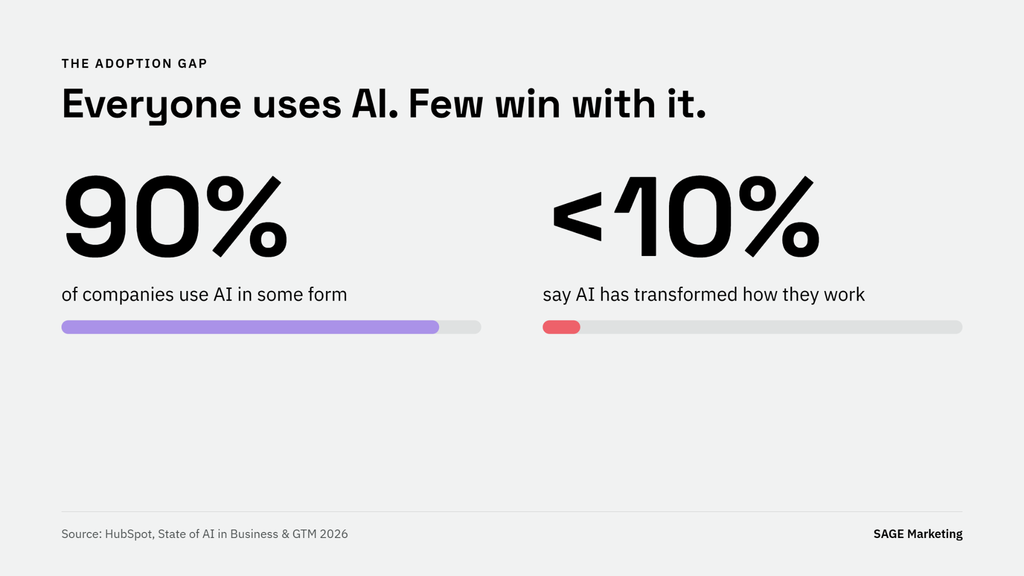
Roughly 90% of companies now use AI in some form. Fewer than 10% say it has transformed how they work.

That’s the real story of AI adoption in 2026, and it’s the one we highlighted while reading HubSpot’s two new reports: the State of AI in Business & GTM 2026 (around 6,000 go-to-market professionals) and the State of AI in Marketing 2026 (1,754 marketers, surveyed in June).

We’re writing this together because we sit on opposite ends of the same funnel. Aliza runs social and content at SAGE. Niv leads sales for our HubSpot practice. As a HubSpot Diamond Partner, we spend our days inside client CRMs, and the data in these reports matches what we see there almost line for line.

Our thesis is simple. The gap between using AI and being successful with it isn’t about tools or budget. It’s about context. And the place context breaks most often is the handoff between marketing and sales.

Why Sales AI Adoption Lags Marketing

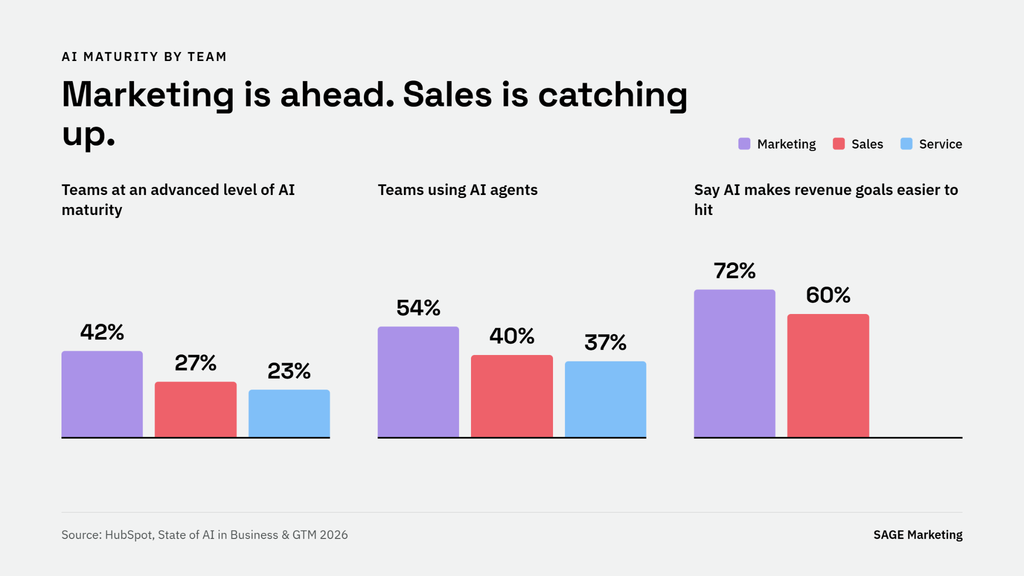
Aliza: If you map teams against HubSpot’s AI maturity model, marketing is clearly out in front. 

42% of marketing teams sit at an advanced level of maturity, compared with 27% of sales teams and 23% of service teams.

The pattern holds for agents too. 54% of marketing teams use AI agents, versus 40% in sales and 37% in service. And 72% of marketers say AI makes their revenue goals easier to hit, compared with 60% of sales professionals.


It’s tempting to read that as a win for marketing, but I don’t think it is. Marketing being ahead is only good news if what marketing learns actually reaches sales. Otherwise you’ve built a faster content and campaign engine that feeds a pipeline unable to use what it knows.

What Mature Marketing Teams Do Differently

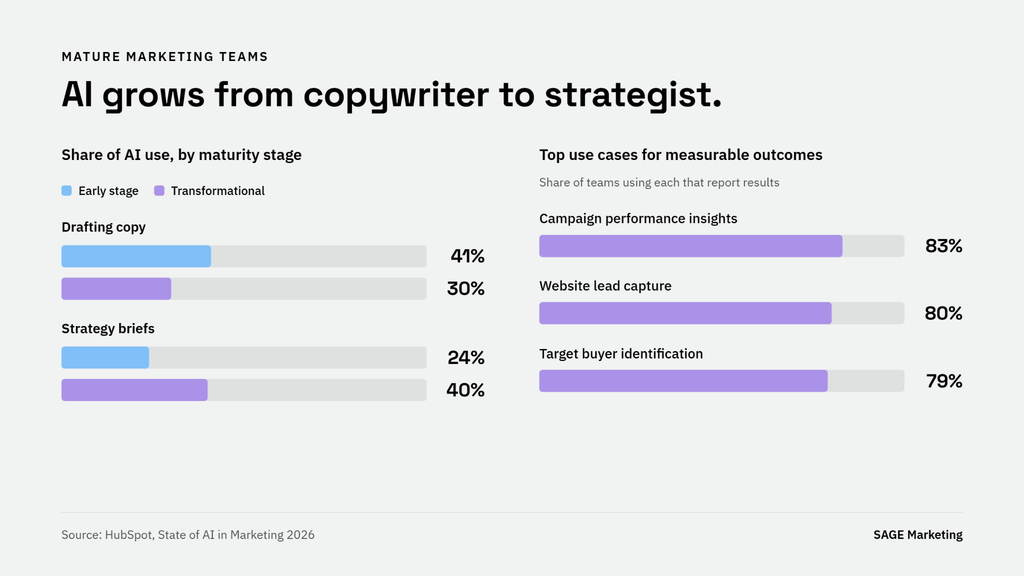
Aliza: The most interesting shift in the marketing report is what AI is actually used for as teams mature. It starts as a copywriter and grows into a strategist. Drafting copy drops from 41% of use at the early stage to 30% at the transformational stage, while strategy briefs climb from 24% to 40%.

The use cases most likely to produce measurable outcomes are data-driven, not creative: campaign performance insights (83%), website lead capture (80%) and target buyer identification (79%).

And the most mature teams aren’t running dozens of tools. Transformational marketing teams focus on about four use cases and go deep on them.

There’s no shortage of content today about how AI made execution cheap and how anyone can produce a decent post, email or landing page in minutes. What we need to focus on now is human perspective, positioning and clean data. 

That’s where AI in B2B marketing earns its keep, and it’s why we don’t think AI will replace marketers who bring those three things.

Where Sales Is Leaving Money on the Table

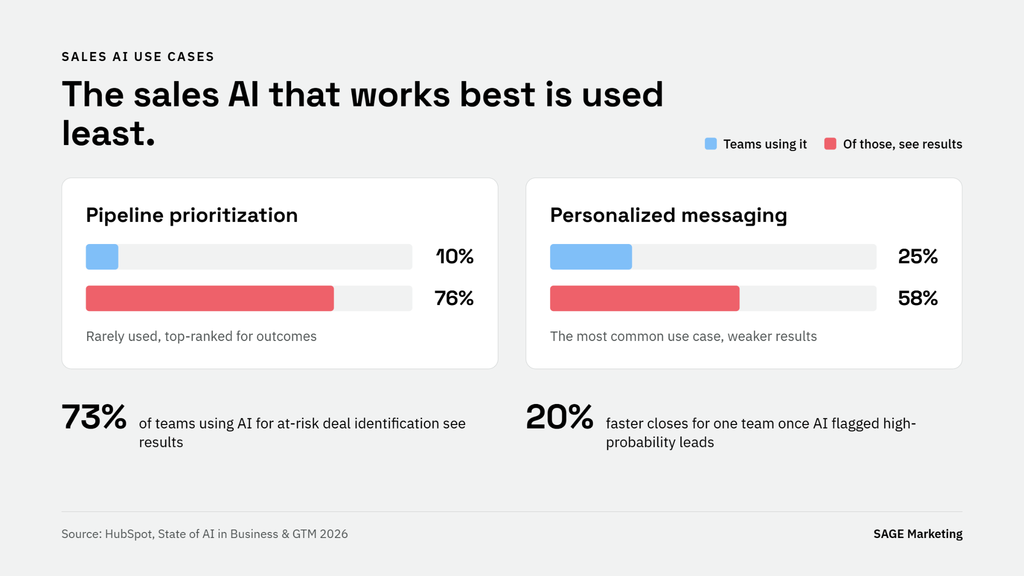
Niv: The sales numbers tell a story of misallocated effort. Only 10% of respondents use AI for pipeline prioritization, yet three out of four of those teams see measurable results. Meanwhile, the most common sales use case is personalized messaging (25%), and only 58% of those teams see results from it.

When you rank sales use cases by outcome, the top two are pipeline prioritization (76%) and at-risk deal identification (73%). In other words, the highest-value work is deal intelligence, and most teams aren’t doing it. One respondent in the report said their deals closed 20% faster once AI started flagging high-probability leads.

I see this every week. Reps default to AI for emails because it’s immediate and visible: you write a prompt, you get a draft, it feels productive. Deal intelligence asks more of a team. You have to trust the data in the CRM, and you have to change how pipeline reviews actually run. That’s harder, which is exactly why the teams that do it pull ahead.

The Handoff: Where Revenue Leaks

This is the section we care about most, because it’s where marketing’s lead and sales’ lag collide.

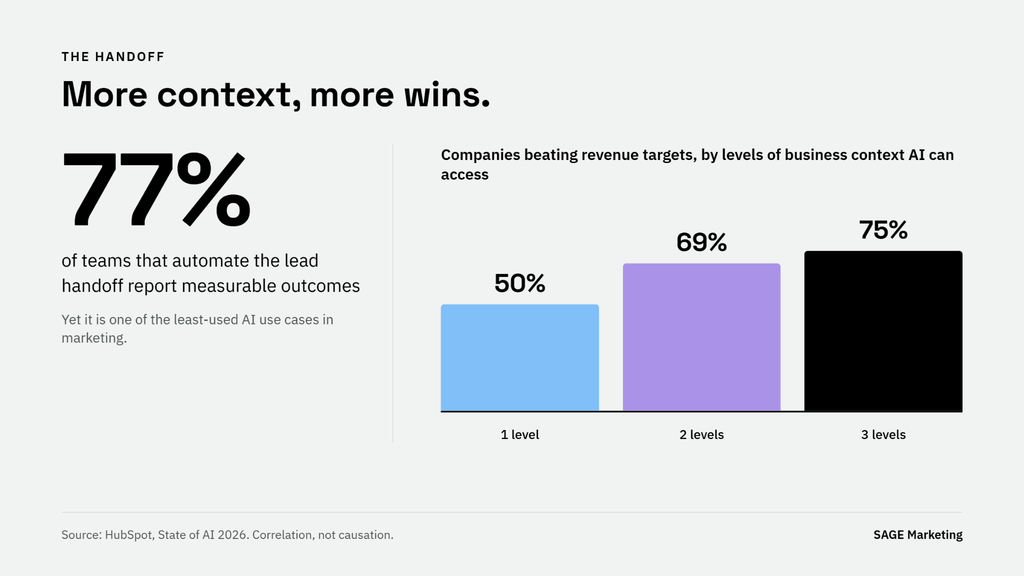
Lead handoff is one of the least-used AI use cases in marketing. Yet 77% of teams that automate it report measurable outcomes. Few teams are doing it, and most of those who do see it work.

The reason comes down to context. Companies that give AI access to one level of business context beat their revenue targets 50% of the time. With two levels, that rises to 69%. With three, 75%.

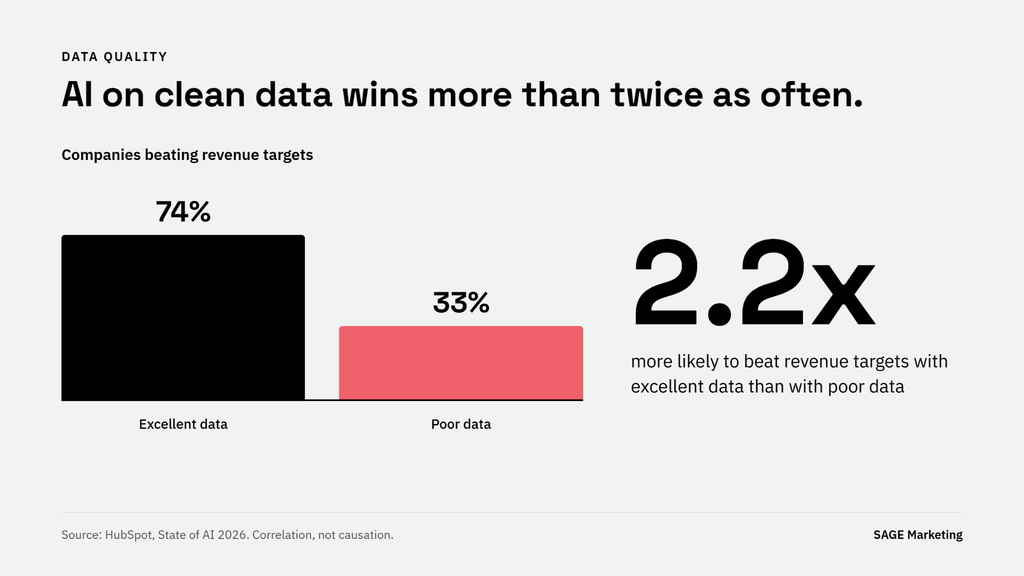
Data quality follows the same curve. 74% of companies with excellent data beat their revenue targets, compared with 33% of those with poor data. That’s a 2.2x difference.

A fair caveat: these are correlations, not proof of cause. HubSpot itself notes that more mature companies may simply have more resources. But the direction is consistent across every cut of the data, and it matches what we see in practice.

Here’s what that looks like in a real CRM. Marketing captures intent signals: the pricing page visit, the webinar attendance, the third download in a week. Sales never sees them, or sees them as a lead score with no explanation. Both teams use AI, but the two systems aren’t connected, so neither one has the full picture. 

Strong sales and marketing alignment used to be a nice-to-have. With AI on both sides, it’s the thing that decides whether your AI works at all.

Agents: The Shortcut for Teams That Aren’t “Mature” Yet

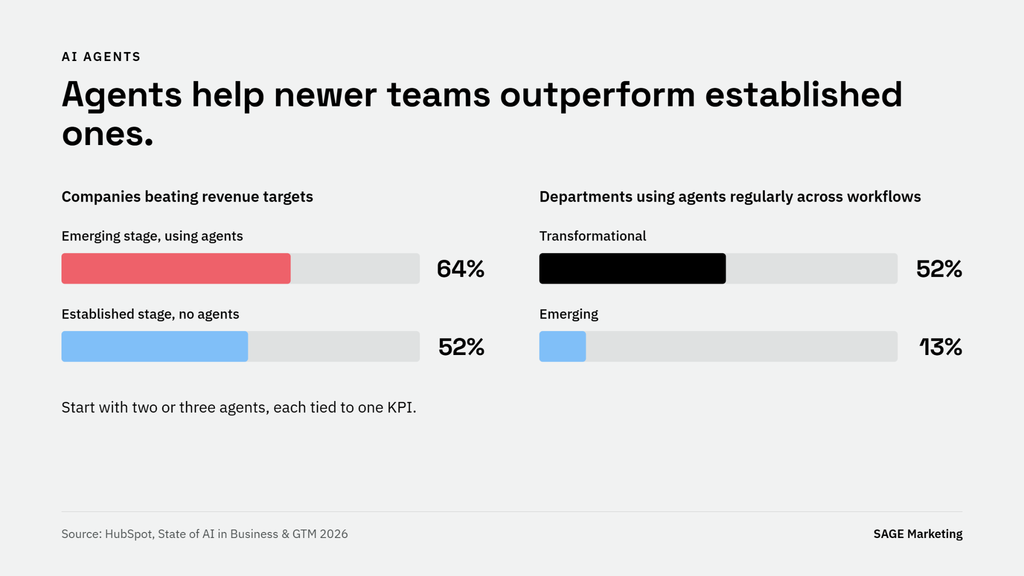
Niv: If you’re reading this and thinking your team is nowhere near “transformational,” here’s the most encouraging stat in the report. An emerging-stage company using agents beats its revenue targets 64% of the time. An established-stage company without agents does so 52% of the time.

Agents don’t replace maturity, but they can close part of the gap. Today, 52% of transformational departments use agents regularly across workflows, compared with 13% of emerging ones. That’s a big difference, and it’s also a big opportunity for teams willing to start.

My practical advice on AI agents in sales: start with two or three, each tied to one KPI. A prospecting agent measured on meetings booked. A deal-risk agent measured on slipped deals. Our Breeze AI guide is a good place to map where agents fit.

What AI Maturity Means for the People Doing the Work

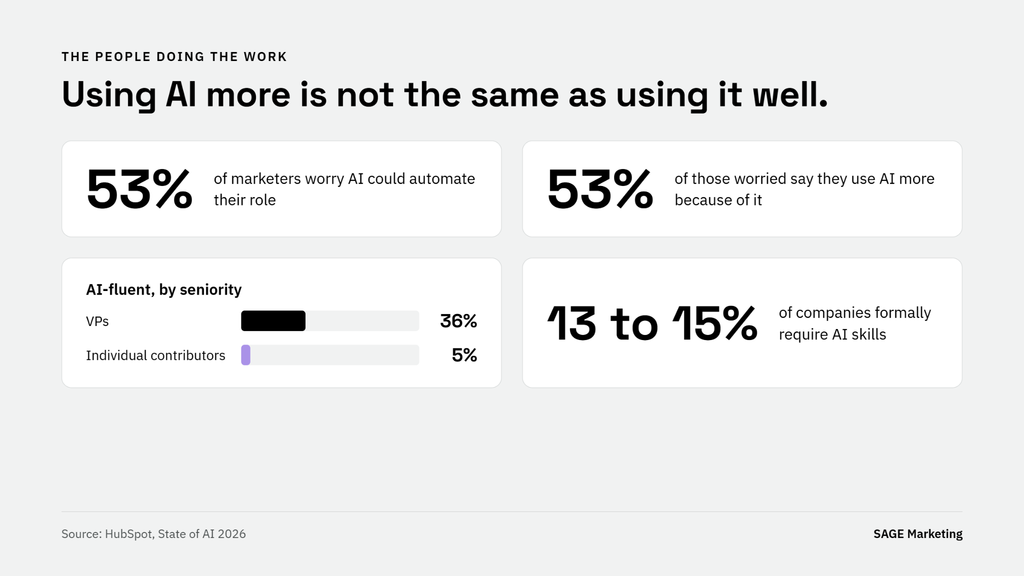
Aliza: 53% of marketers worry AI could automate their role. Interestingly, among those with job-security concerns, 53% say they use AI more because of it. Anxiety is driving adoption.

But using AI more isn’t the same as using it well. 36% of VPs are AI-fluent, compared with 5% of individual contributors. The difference isn’t access. Senior people get more value because they push back on AI outputs instead of accepting them.

Only 13% to 15% of companies formally require AI skills. Teams need enablement, not just licenses.

A Joint Playbook: 5 Moves for Marketing and Sales Leaders

  1. Agree on shared definitions before adding more AI. MQL, SQL and lifecycle stages need to mean the same thing to both teams, or AI will automate the disagreement.
  2. Fix CRM data quality first. AI on dirty data doesn’t fix mistakes. It scales them.
  3. Connect marketing intent signals to sales prioritization. Lead scoring and pipeline prioritization should run on the same signals marketing is already collecting.
  4. Pick one or two high-ROI use cases per team, each tied to a KPI. Then add agents.
  5. Invest in fluency. Teach people to challenge AI outputs, not just generate them.

The Bottom Line

AI maturity isn’t about how much AI you use. It’s whether marketing and sales are working from the same context.

Is your CRM AI-ready? Book a HubSpot AI readiness session with SAGE and we’ll show you where context is breaking between your marketing and sales teams, and what to fix first.

FAQ

What is AI maturity in marketing and sales?

AI maturity describes how deeply a team has built AI into its work, from early experimentation to transformational use across workflows. In HubSpot’s AI maturity model, mature teams use AI for strategy and decision-making rather than just content production, focus on a small number of use cases, and give AI access to rich business context and clean CRM data.

What percentage of sales teams use AI today?

Most sales teams use AI in some form, but few use it at an advanced level. According to HubSpot’s State of AI in Business & GTM 2026, 27% of sales teams are at advanced AI maturity and 40% use AI agents, both behind marketing. The most common sales use case is personalized messaging.

Does AI improve sales and marketing alignment?

It can, but only when both teams share data and definitions. AI applied separately in marketing and sales often widens the gap. Teams that automate the lead handoff see strong results, with 77% reporting measurable outcomes, and companies giving AI more business context are more likely to beat revenue targets.

Which AI use cases produce measurable results?

The highest-performing use cases are data-driven. In marketing, campaign performance insights (83%), website lead capture (80%) and target buyer identification (79%) lead. In sales, pipeline prioritization (76%) and at-risk deal identification (73%) top the list, while personalized messaging, the most common use case, delivers results less often.

Do smaller teams need AI agents to compete?

Agents can help smaller or less mature teams close the gap. HubSpot’s data shows emerging-stage companies using agents beat revenue targets 64% of the time, compared with 52% for established companies without them. The best approach is to start with two or three agents, each tied to a single KPI.

Aliza Hughes Head of Social Media
About
the author
Aliza is a seasoned content and social media strategist with over a decade of experience humanizing B2B tech brands through organic growth and executive thought leadership.
Learn more

How Social Media Insights Help B2B Marketers Find Better Topics, Channels, and Buyers

Aliza Hughes
written by Aliza Hughes Head of Social Media

Aliza is a seasoned content and social media strategist with over a decade of experience humanizing B2B tech brands through organic growth and executive thought leadership.

Sarit<br> Lamerovich
reviewed by Sarit
Lamerovich
Founder/CEO

Sarit founded SAGE to allow technology companies to take innovation to the next business level and fulfill the entrepreneur’s dream to change the world by building market recognition, increasinge customer awareness and improvinge the foundation for strong and sustainable revenue growth.

8 min read
Share
Why Partner with SAGE Marketing?
100+ B2B tech companies and startups — we literally grow unicorns.
No office, no walls — we work inside your world, embedded in your team.
Full-stack marketing approach: strategy, storytelling, content, HubSpot and execution under one roof.
Let’s Build Something Remarkable!
Whether you’re launching, scaling, or rebranding —
we’ll help you connect,
engage, and grow.
Contact us
client logo client logo client logo client logo client logo client logo
Social Media

Key Takeaway

  • Social media insights are the conclusions you draw from data, not the data itself. A metric tells you what happened. An insight tells you what to do next.
  • The best B2B insights come from a mix of sources: native platform analytics, social listening, comment threads, sales conversations, and competitor activity.
  • Insights should shape three core decisions: which topics to cover, which channels get budget, and which buyers to target.
  • A fixed monthly review cadence turns scattered observations into a repeatable planning habit.

Most B2B marketing teams have plenty of social data. Few use that data to make insightful decisions. Dashboards fill up with impressions, follower counts, and engagement rates, but does anyone act on those findings? The planning meeting happens anyway, and topics, channels, and targeting get chosen on instinct.

Turning that social media data into insights helps B2B marketing teams choose relevant topics, focus on the channels that matter, and reach the right buyers. This blog covers what B2B social media insights are, where to find the useful ones, and how to use them to make better decisions.

What Social Media Insights Actually Are in a B2B Context

Social media insights are the patterns and conclusions you pull from social activity that point to a specific action. They sit one step above reporting. A report says your LinkedIn post reached 1,200 people. An insight says posts about implementation challenges consistently draw comments from operations directors, while posts about product features draw almost none.

In a B2B context, this distinction matters more than it does in consumer marketing. Buying cycles are long, decisions involve several stakeholders, and the audience is small and specific. A campaign can hit strong reach numbers and still miss every person on the buying committee. Standard metrics like impressions and follower growth are useful for tracking visibility, but they rarely tell you whether you are reaching the right people with the right message.

B2B social media insights focus on questions that connect to pipeline:

  • Which job titles, industries, and company sizes are engaging?
  • Which topics start conversations?
  • Which content gets saved, shared internally, or referenced in sales calls?
  • What questions and objections keep appearing in comments and messages?

The goal is not more data. It is fewer, sharper conclusions that change what the team does next month.

Where B2B Marketers Find Insights Worth Acting On

Useful insights rarely come from one place. The strongest picture comes from combining several sources of social media data for marketing, each covering a different blind spot.

Native platform analytics. LinkedIn page and profile analytics show follower demographics by job function, seniority, industry, and company size. This is the fastest way to check whether your audience matches your ideal customer profile. Post-level data shows which formats and topics hold attention.

Comments and direct messages. This is the most underused source. The language buyers use in comments reveals their priorities, frustrations, and vocabulary. A recurring question in the comments is often a content topic waiting to be written.

Social listening. Social media research tools track conversations about your category, competitors, and industry pain points, including discussions that never mention your brand. This is where you spot emerging topics before they become crowded.

Competitor and peer activity. Reviewing what similar companies and respected voices in your space publish, and how their audience responds, shows which angles are saturated and which are underserved.

Sales and customer success teams. Your frontline teams hear buyer objections every week. Cross-checking social engagement against what sales hears on calls confirms whether a trend on social reflects real buying behaviour.

Employee and executive profiles. In B2B, personal profiles often outperform company pages. Their analytics show which thought leadership themes resonate with senior decision-makers.

Using Insights to Choose Topics Your Buyers Care About

Topic selection is where insights pay off fastest. Instead of brainstorming from scratch each month, teams can build a content plan from evidence.

Start with engagement quality, not engagement volume. Look for posts that generated comments with substance: questions, disagreements, personal experiences, or requests for more detail. These signal that a topic touched a real problem. Posts with high reactions and no comments often indicate agreement without interest.

Track link clicks as well. When a post sends people to a blog, guide, or case study, the click-through rate shows how many readers wanted to go deeper. A topic that draws modest engagement but strong clicks is often more valuable than one that collects reactions and goes nowhere. Compare clicks across posts that link to similar content, and you will start to see which subjects your buyers are willing to spend time on.

Next, mine the language. When buyers describe a challenge in their own words, use those words. If prospects keep saying “our reporting takes too long” rather than “we need better data visualisation,” your content should lead with their phrasing. This improves relevance on social and often helps search visibility too.

Then look for gaps. Social listening may show a topic being discussed widely in your industry with few credible voices answering it. That is an opening. A topic everyone is already posting about can also be worth covering, since the volume tells you it is relevant and timely. The catch is that crowded topics reward speed or originality. Unless you are among the first to weigh in, or you have a new angle, data point, or firsthand experience to add, your post is likely to get lost among dozens that say the same thing.

Finally, connect topics to the buying journey. Audience insights for B2B brands often reveal that early-stage buyers engage with problem-focused content, while later-stage buyers respond to proof, process, and comparison content. Mapping topics to these stages keeps your calendar balanced rather than stuck at the top of the funnel.

A simple test before any topic makes the plan: can you point to at least one piece of evidence that your buyers care about it? If the answer is no, it is a guess.

Using Insights to Decide Which Channels Deserve Budget

B2B teams can be tempted to spread effort across more channels than they can support well. Insights help you concentrate resources where your buyers are active.

Begin by comparing audience fit across channels. LinkedIn may deliver a smaller audience than other platforms, but if its demographics show a strong concentration of your target titles and industries, it deserves priority. A channel with larger reach but the wrong audience is a distraction, however good the numbers look.

Look at the type of engagement each channel produces. LinkedIn and niche communities, such as industry Slack groups or relevant subreddits, tend to drive conversation and relationship building, since that is where B2B buyers comment, ask questions, and connect with peers. YouTube is often the stronger traffic driver, because videos keep surfacing in search long after they are posted and the descriptions carry links. Instagram and TikTok are mostly awareness plays for B2B brands, useful for employer branding and showing company culture but rarely where deals start. X (Twitter) falls somewhere in between, good for real-time industry conversation and visibility with journalists and analysts. These patterns vary by industry, so check them against your own data. 

Match each channel to the job it does well rather than expecting every platform to generate leads.

Compare company page performance against personal profile performance. Many B2B brands find that executive and employee posts reach decision-makers far more effectively than branded content. If that is the pattern in your data, shifting budget toward thought leadership support, such as ghostwriting, content planning, and profile optimisation, may deliver more than increasing branded post volume.

Track what happens after engagement. Connect social activity to website visits, demo requests, and sales conversations where possible. Even imperfect attribution, such as asking new leads how they heard about you, shows which channels contribute to pipeline.

Be willing to cut. If a channel has shown weak audience fit and low-quality engagement for three to six months despite consistent effort, the insight is clear. Reallocate that time to the channels that work.

Using Insights to Sharpen Who You Are Targeting

Review who engages with your content, not just who follows you. Follower lists accumulate over years and include past employees, job seekers, and peers. Engagement data shows who is paying attention now. If you are targeting CFOs but your most engaged audience is finance managers, that is useful information. It may mean your content is pitched at the wrong level, or that finance managers are your real entry point into the buying committee.

Look for unexpected segments. Insights often reveal industries or roles you had not prioritised but that respond strongly to your content. These can become new targeting opportunities for both organic and paid efforts.

Use insights to inform paid targeting. Organic engagement patterns are a low-cost way to validate audiences before spending on paid campaigns. If a job title consistently engages with a specific topic organically, a paid campaign combining that audience and topic is a safer bet.

Finally, share these findings with sales. Knowing which accounts and roles are engaging on social helps sales prioritise outreach and start conversations with context.

Turning Insights Into a Repeatable Monthly Process

Insights only create value when they feed into decisions on a regular rhythm. A monthly review strikes the right balance for most B2B teams: frequent enough to adapt, spaced enough to see real patterns.

A practical monthly process looks like this:

  1. Gather. Pull platform analytics, listening highlights, notable comments, and sales feedback into one place. Keep it to a single page or dashboard.
  2. Identify patterns. Look for three to five observations that repeated across the month. Ignore one-off spikes unless they point to something new.
  3. Translate into decisions. For each pattern, agree on an action: a topic to add, a format to test, a channel to scale back, an audience to prioritise.
  4. Update the plan. Feed those decisions directly into next month’s content calendar and targeting.
  5. Track the result. Note what you changed so next month’s review can measure whether it worked.

Keep a running log of insights and outcomes. Over a few quarters, this becomes a valuable record of what your audience responds to, and it stops the team from relearning the same lessons.

The discipline matters more than the tools. A team with basic analytics and a consistent monthly review will outperform a team with sophisticated software and no process for acting on what it finds.

FAQs

What is the difference between social media insights and social media analytics?

Analytics are the raw measurements: reach, impressions, clicks, engagement rate, follower growth. Insights are the interpretation of those numbers in context, combined with qualitative signals like comments and listening data. Analytics answer “what happened?” Insights answer “why did it happen and what should we change?” A team can have excellent analytics and still lack insights if nobody is connecting the numbers to decisions about content, channels, or audience.

How much data does a B2B brand need before insights become reliable?

There is no fixed threshold, but most B2B brands need around three months of consistent posting before patterns become trustworthy. Consistency matters more than volume: posting two or three times a week gives enough data points to compare topics and formats. Smaller audiences mean more variation, so treat early findings as hypotheses to test rather than conclusions. Qualitative signals, such as recurring questions in comments, can be useful much sooner.

Which team should own social media insights in a B2B company?

The social media or content team usually owns gathering and interpreting insights, since they are closest to the data. But insights should be shared across marketing, sales, and leadership. Demand generation can use them for paid targeting, sales for account prioritisation, and product marketing for messaging. The most effective setup has one clear owner responsible for the monthly review, with a standing slot to share findings with other teams.

How often should social media insights be reviewed?

A monthly review works best for strategic decisions about topics, channels, and targeting. Weekly check-ins are useful for spotting timely conversations or posts that are gaining unusual traction, but they should not drive major changes on their own. A quarterly review adds a broader perspective, helping teams assess longer trends, audience shifts, and whether channel investments are paying off over a full planning cycle.

Aliza Hughes Head of Social Media
About
the author
Aliza is a seasoned content and social media strategist with over a decade of experience humanizing B2B tech brands through organic growth and executive thought leadership.
Learn more

10 Best B2B Brand Positioning Agencies in 2026

Shlomit<br> Hertz
written by Shlomit
Hertz
CMO-as-a-Service

Today, as CMO-as-a-Service at SAGE Marketing, Shlomit partners with technology companies to build powerful brands, accelerate demand generation, and connect innovation with results. Her approach is creative, data-driven, and always focused on what truly matters — turning strategy into measurable success.

Sarit<br> Lamerovich
reviewed by Sarit
Lamerovich
Founder/CEO

Sarit founded SAGE to allow technology companies to take innovation to the next business level and fulfill the entrepreneur’s dream to change the world by building market recognition, increasinge customer awareness and improvinge the foundation for strong and sustainable revenue growth.

10 min read
Share
Why Partner with SAGE Marketing?
100+ B2B tech companies and startups — we literally grow unicorns.
No office, no walls — we work inside your world, embedded in your team.
Full-stack marketing approach: strategy, storytelling, content, HubSpot and execution under one roof.
Let’s Build Something Remarkable!
Whether you’re launching, scaling, or rebranding —
we’ll help you connect,
engage, and grow.
Contact us
client logo client logo client logo client logo client logo client logo
Branding Marketing strategy startup marketing B2B Marketing

Most B2B tech companies do not lose deals because their product is weak. They lose because buyers cannot tell them apart from three other vendors that sound exactly the same. When every website promises “AI-powered,” “end-to-end,” and “seamless,” the company with the clearest story wins the shortlist.

That is the job of brand positioning agencies. They help you decide which market you compete in, who you serve best, and why you are the obvious choice for that buyer. Everything else (the website, the pitch deck, the campaigns) is built on top of that decision.

Below, we break down what a positioning engagement includes, profile 10 of the best B2B brand positioning agencies working in 2026, and share how to pick the right partner without getting burned in the pitch.

Key Takeaways

  • Brand positioning is a strategic decision about market, audience, and value. Logos, taglines, and campaigns come after it.
  • The best brand positioning agencies for B2B combine customer research, competitive analysis, and sales input before writing a single line of copy.
  • Positioning-first agencies and creative-first B2B branding agencies solve different problems, so match the agency to the gap you have.
  • Look for proven B2B experience, a clear research process, and deliverables your sales team can use on day one.
  • Be wary of agencies that jump to visuals in the pitch or promise results without talking to your customers.

What a Brand Positioning Engagement Covers

A positioning engagement answers one question: why should a specific buyer choose you over every alternative, including doing nothing? It is strategy work. The output is a set of decisions your whole company can align behind, and it usually shapes b2b brand strategy for years.

Most engagements follow a similar path:

  1. Discovery and research. Interviews with customers, lost prospects, sales reps, and leadership. Good agencies also review win/loss data and CRM notes.
  2. Competitive and market analysis. Mapping how competitors describe themselves, where the category is heading, and which claims are already crowded.
  3. Positioning definition. Choosing the market category, target segments, core value, and proof points. This is where brand differentiation gets decided.
  4. Messaging framework. Turning the positioning into a value proposition, key messages by persona, and supporting proof.
  5. Activation. Handing it off to sales, product marketing, and creative teams through workshops, pitch narratives, and guidelines.

General brand or creative work starts from a different place. A visual identity project asks “how should we look?” A campaign asks “how do we get attention?” Positioning asks “what do we stand for, and for whom?” Skip that step and even beautiful creative ends up saying nothing specific.

Best B2B Brand Positioning Agencies in 2026

1. SAGE Marketing (Tel Aviv, London, Dubai)

Best for: High-growth B2B tech companies and startups expanding into global markets.

SAGE Marketing is a b2b branding agency built for tech companies that need positioning and execution under one roof. Its brand strategy and messaging practice defines the category, audience, and differentiators, then carries that story straight into sales decks, websites, events, and demand generation. Because SAGE also runs CMO as a Service and HubSpot programs (as a HubSpot Diamond Partner), positioning does not sit in a slide deck. It shows up in the pipeline. Clients span Cybersecurity, FinTech, SaaS, ConstructionTech, HealthTech, TravelTech, Communication, Imaging, and more.

2. Motto (New York, London, Berlin, Dallas)

Best for: B2B tech companies facing a defining moment such as a pivot, rebrand, or new category launch.

Motto is a strategic branding agency with more than 20 years in the market. Its services include business strategy, brand positioning, category definition, and brand design, with a strong focus on aligning leadership teams around one core idea. Recent work includes AI and tech brands such as Maisa and Ivo AI.

3. Emotive Brand (Oakland, CA)

Best for: Venture-backed B2B tech and AI companies that want a brand with emotional pull.

Emotive Brand is a brand strategy and design firm focused on B2B tech and AI. It argues that B2B buyers are people first, so positioning should build belief as well as logic. Deliverables cover positioning, strategic narrative, verbal and visual identity, and employer branding. Clients include Moveworks, Harness, Marqeta, and Skyflow.

4. April Dunford / Ambient Strategy (Remote)

Best for: Product-led B2B software companies with a strong product and a fuzzy story.

April Dunford, author of Obviously Awesome, runs one of the best-known positioning practices in B2B tech. Her flagship Positioning + Sales Pitch Workshop is a three-day session that defines the five components of positioning and turns them into a sales pitch. She also offers team training and custom engagements. It is a lean, founder-led option, so expect a workshop format in place of a full agency team.

5. Play Bigger (Silicon Valley)

Best for: Companies creating a new category or trying to escape a crowded one.

Play Bigger pioneered the category design approach through its book of the same name. The firm helps companies define and own a new market category, which goes one step beyond positioning within an existing one. It reports more than $50B in market cap created with the companies it has worked with. Best suited to venture-backed scale-ups with ambitions to lead a market.

6. Siegel+Gale (New York and global)

Best for: Enterprise B2B companies dealing with complexity, mergers, or spin-offs.

Siegel+Gale is built around one belief: simple is smart. With offices in New York, San Francisco, London, Dubai, Shanghai, and Tokyo, it handles brand strategy, naming, and M&A branding for companies like HPE and Micron. It is a strong fit when your offer is complex and your positioning has to simplify it for many audiences.

7. Prophet (Global)

Best for: Large B2B organizations linking brand positioning to business growth strategy.

Prophet is a growth consultancy that combines strategy consulting with brand and marketing services. Its brand transformation and go-to-market work suits companies where positioning is tied to bigger decisions such as new business lines or M&A. Expect a consulting-style process with enterprise-level budgets.

8. Stein (New York, London, Singapore and more)

Best for: Global B2B brands that want positioning connected to demand generation.

Stein, formerly Stein IAS and part of the MSQ group, uses its Brand-to-Demand Experience (BDX) model to unify brand and demand. It was named #1 B2B Agency in the World 2025 by The Drum. Clients include Samsung, HSBC, and Juniper Networks, which makes it a fit for enterprises running multi-region programs.

9. Pretzl, formerly Velocity Partners (London, New York and more)

Best for: B2B tech marketers who need storytelling for hard-to-explain products.

Velocity Partners built its reputation on making complex B2B tech easy to understand for clients like Workday, Salesforce, and HubSpot. In 2026, Velocity joined four sister agencies to form Pretzl, a roughly 300-person B2B agency within Next 15 Group. The combined firm pairs strategy and creative with an AI buyer-journey platform called JourneyLab.

10. Gravity Global (Global)

Best for: Industrial, aerospace, and technical B2B brands.

Gravity Global is a full-service agency whose brand strategy and research practice feeds go-to-market, creative, and media. Its work for Airbus and Embraer shows depth in technical sectors where buyers are engineers and procurement teams. A good choice if you want positioning and execution from the same partner in a heavy-industry context.

Comparison Table

AgencyHQ / OfficesBest ForCore StrengthCompany Size Fit
SAGE MarketingTel Aviv, London, DubaiGlobal B2B tech growthPositioning plus full executionStartups to unicorns
MottoNYC, London, Berlin, DallasPivots and rebrandsCategory definition, leadership alignmentGrowth stage to enterprise
Emotive BrandOakland, CAB2B tech and AIEmotional brand strategySeries B+ to enterprise
April DunfordRemoteProduct-led SaaSPositioning and sales pitch workshopsStartups to mid-market
Play BiggerSilicon ValleyNew categoriesCategory designVenture-backed scale-ups
Siegel+GaleNYC and globalComplex enterprisesSimplicity, naming, M&AEnterprise
ProphetGlobalBrand-led growth strategyConsulting-grade strategyEnterprise
SteinNYC, London, Singapore +Brand and demandBDX modelGlobal enterprise
Pretzl (Velocity)London, NYC +Complex tech storiesStorytelling plus AI journey dataMid-market to enterprise
Gravity GlobalGlobalIndustrial and aerospaceResearch-led strategyMid-market to enterprise

How Positioning Agencies Differ From General B2B Branding Agencies

Both types of agency can improve your brand. They start from different ends of the problem.

Positioning-led agencies start with strategy. They spend the first weeks on research, interviews, and competitive mapping. Their core deliverable is a positioning statement and messaging framework, and the people leading the work are strategists, often with product marketing or consulting backgrounds. Visuals, if offered, come later.

Creative-led or content-led B2B branding agencies start with expression. They are strongest at identity design, websites, campaigns, and content at scale. Many ask you to bring the positioning with you, or they cover it in a short workshop before moving to design.

Neither model is better in general. If buyers already understand what you do and why it matters, a creative partner can help you look and sound the part. If your sales team tells five different stories, win rates are slipping, or you are entering a new market, you have a positioning problem. No amount of design will fix it.

Many growing tech companies need both, which is why hybrid agencies that own positioning and execution have become popular. The benefit is continuity: the team that defined your differentiation also builds the sales deck, website copy, and social content. For a look at how that plays out on one channel, see our state of B2B social media report.

What to Look for When Evaluating a Brand Positioning Agency

Use these criteria to compare brand positioning agencies on substance, not polish.

  • B2B and industry experience. Selling to buying committees with 6 to 10 stakeholders is different from consumer marketing. Ask for case studies in your category or a close neighbor.
  • A research-led process. The agency should plan to talk to your customers, lost deals, and sales team. If they can explain their interview approach in detail, that is a good sign.
  • Clear, usable deliverables. Ask to see a sample positioning document and messaging framework. It should be something your reps can use in a first call, not a 90-page deck.
  • Sales involvement. Positioning that marketing loves and sales ignores is wasted. Strong agencies run sessions with sales leaders and test messaging in live conversations.
  • Senior people doing the work. Find out who will lead interviews and workshops. The partner you meet in the pitch should be in the room.
  • A path to activation. Check how the agency hands off to your website, content, and demand teams, or whether it can carry the work into execution itself.
  • Proof of impact. Look for results tied to business outcomes such as win rates, sales cycle length, or pipeline, alongside creative awards.

Red Flags to Watch for During the Agency Pitch

The pitch tells you a lot about how the engagement will run. Watch for these warning signs:

  • Logos and taglines in the first meeting. If an agency shows creative concepts before it has spoken to a single customer, it is guessing.
  • No customer research in the scope. A plan built only on internal workshops will reflect what your team already believes.
  • One-size-fits-all frameworks. A proprietary model is fine. Forcing every client through the same template is not.
  • Vague deliverables. “Brand platform” and “strategic narrative” mean little until you see what the documents contain.
  • Bait-and-switch staffing. Senior strategists pitch, then junior staff run the project.
  • Guaranteed results. Positioning improves your odds. Any agency promising a specific revenue lift before discovery is overselling.
  • No questions about sales. If the agency never asks how deals are won and lost, the output will not reflect how buyers decide.

FAQs

How long does a brand positioning engagement typically take?

Most B2B positioning projects run 6 to 12 weeks. Research and interviews take the first 3 to 5 weeks, followed by positioning workshops and a messaging framework. Workshop-based formats can deliver core positioning in a few days, though prep work happens beforehand. Add more time if the scope includes naming, visual identity, or a website, which can extend the project to four to six months.

What is the difference between brand positioning and brand identity?

Brand positioning is the strategic choice about where you compete, who you serve, and why buyers should pick you. Brand identity is how that choice is expressed: logo, colors, typography, tone of voice, and imagery. Positioning is the foundation and identity is the expression. Building identity first often leads to a brand that looks good but says nothing distinctive.

When does a B2B company need a brand positioning agency?

Common triggers include a new funding round, entry into a new market, a product pivot, a merger, or a new competitor that makes you sound generic. Internal signals matter too. If sales reps describe the company differently, win rates are falling, or prospects keep asking how you differ from a competitor, outside positioning help usually pays for itself.

How do you measure whether brand positioning is working?

Track both sales and marketing signals. On the sales side, look at win rates against key competitors, sales cycle length, and deal size. On the marketing side, watch conversion rates on key pages, share of branded search, and message recall in customer interviews. Compare a baseline from before launch with results after two to three quarters.

Can a brand positioning agency help with sales messaging?

Yes, and the strongest ones treat it as a core deliverable. Good positioning work translates into a sales narrative, discovery questions, objection handling, and pitch deck structure. Ask whether the agency will run enablement sessions with your reps and review real call recordings. Messaging that is tested in live deals becomes sharper and gets adopted faster by the sales team.

Shlomit
Hertz
CMO-as-a-Service
About
the author
Today, as CMO-as-a-Service at SAGE Marketing, Shlomit partners with technology companies to build powerful brands, accelerate demand generation, and connect innovation with results. Her approach is creative, data-driven, and always focused on what truly matters — turning strategy into measurable success.
Learn more